
Is There a Secret Language Hidden Inside Your Brain?
The Chess Machine That “Thought” It Needed Its Queen
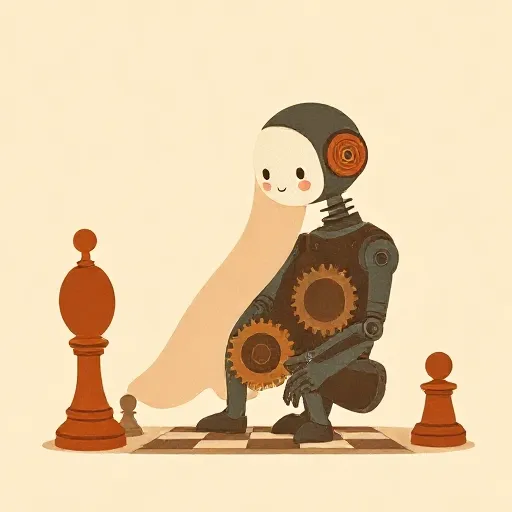
In the late 1970s, the philosopher Daniel Dennett (born 1942) heard a computer programmer make a strange remark about a rival’s chess-playing program. “It thinks it should get its queen out early,” the programmer said. That remark was useful: you could predict how the program would play. Yet when you looked inside the code, there was no sentence anywhere that said “I should get my queen out early.” The machine behaved as if it had a belief, but the belief was not written down inside it.
This puzzle points to a much bigger question: When you think about pizza or plan a trip, are your thoughts written in some inner language? Or is thinking something completely different from language? The idea that thinking actually happens in a kind of secret mental code is called the language of thought hypothesis (LOTH). Its most famous champion was the philosopher and cognitive scientist Jerry Fodor (1935–2017).
Fodor started from everyday psychology. We explain why Mary walked to the fridge by saying she believed there was orange juice inside and desired some orange juice. Beliefs and desires are propositional attitudes: they are attitudes you take toward a proposition, like “there is orange juice in the fridge.” They are about something. According to Fodor, having a belief that p means that you stand in a special psychological relation to a mental representation — a mental item that means that p. Imagine a “belief box” in your mind: to believe* something is to place a mental sentence with that meaning into the box. To desire* it is to place it into a “desire box.” A mental representation is a repeatable type, like a piece of sheet music. When you actively think, a token of that type — a particular mental event — lights up. This whole picture is the representational theory of thought (RTT). It says that thinking consists of chains of tokenings of mental representations. The mental language they make up is often called Mentalese.
Building Endless Thoughts from Simple Pieces

If you believe that the cat chased the mouse, you can also believe that the mouse chased the cat. And you can think not just one thought, but endlessly many: “The cat sat on the mat,” “The cat sat on the mat that the dog scratched,” and so on. Thought is productive: you can entertain a potential infinity of thoughts with a finite brain. It is also systematic: if you can think John loves Mary, you can automatically think Mary loves John; the ability travels with the parts.
Fodor argued that RTT explains these facts elegantly. Mentalese works like a Lego set. It has simple symbols — mental “words” — that combine into complex sentences according to rules. The meaning of a complex sentence depends on the meanings of its parts and how they are arranged. This is compositionality. When you think John loves Mary, you token a mental sentence built from the same components that would let you build Mary loves John simply by rearranging them. Because your mind can recombine those components, systematicity is built into the system. The productivity argument says that if you have a finite stock of primitive symbols and a set of combinatory rules, you can generate an infinite array of mental sentences. That is exactly what a compositional mental language provides. Notice that this argument does not yet say anything about computers. It simply claims that the best explanation for systematic, productive thought is that our minds manipulate sentence-like mental representations with meaningful parts.
The Connectionist Rebellion: Minds Without Sentences
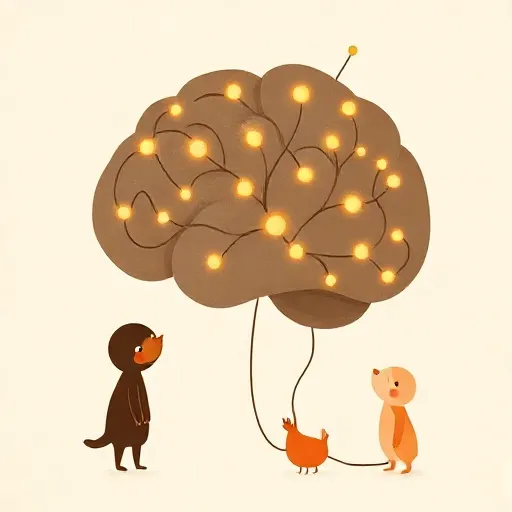
In the 1980s, many scientists argued that the brain is not a symbol-crunching machine at all. Connectionism models the mind as a web of simple units, or nodes, that pass signals to one another through weighted connections. There is no central processor, no memory slot holding a sentence token. Instead, thoughts are patterns of activation sweeping through the network — more like a storm than a library.
Fodor and his colleague Zenon Pylyshyn (1937–2022) fired back. Yes, you can build a connectionist network that happens to be systematic: it might learn to recognize “Mary loves John” only if it can also recognize “John loves Mary.” But nothing in the connectionist recipe guarantees systematicity. You could just as well build a network that recognizes one but not the other. In human minds, however, systematicity seems to be a law — it is not an accident. The classical language-of-thought picture, with its structured symbols, makes systematicity inevitable. Therefore, Fodor and Pylyshyn argued, connectionism alone cannot be the whole story. At best, neural networks might be how the brain implements the classical symbol system, not a replacement for it.
Some philosophers and scientists replied that mental representations could have structure without being classical concatenative sentences. They proposed that a network’s distributed activity patterns could encode an “implicit constituency” — the parts are not literal physical pieces of a token, but the network can still treat them as distinct components during computation. That debate remains heated. For now, notice that the argument is not about whether symbols exist, but about what kind of structure thought has, and whether connectionist architectures alone can do the explanatory work.
Can You Ever Learn a Brand-New Idea?

There is a deeper puzzle lurking inside the language-of-thought idea. Imagine you are learning the word “cat.” A natural story is that you form a hypothesis: “The word ‘cat’ denotes cats.” But to form that hypothesis, you must already have a mental symbol — a Mentalese word cat — that stands for cats. If you don’t have it, you cannot even frame the hypothesis. This threatens an infinite regress: to learn any concept, you would need an earlier mental language containing that very concept, and so on backward forever.
Fodor’s startling answer: we do not learn most of our concepts. He uses “innate” to mean “unlearned.” On his view, the fundamental mental words of Mentalese are innate — they are triggered by experience, but not built from it. That’s not as wild as it sounds. He does not claim that a newborn already thinks about carburetors. Rather, he claims that when you do eventually think about carburetors, the mental word carburetor was never pieced together from simpler ideas through hypothesis testing; it is primed by the right experiences in a way that is not, strictly speaking, a rational learning process.
Many philosophers push back. Maybe there are other ways to learn concepts that do not require already having the concept, such as “bootstrapping” from older, simpler concepts like shape and motion. Or maybe connectionist systems can genuinely acquire new concepts without formulating explicit hypotheses at all. This frontier is still wide open. The regress does not sink the language-of-thought idea, but it forces anyone who believes we have concepts to explain where they come from. LOTH makes the question starker: how do any building blocks get into the system in the first place?
Why the Language of Thought Matters to You

The fight between sentence-like thought and network-style thinking is not just for professors. It determines how we try to build machines that understand language and reason. Today’s large language models, like the one behind many chatbots, are descendants of connectionism. They do not store neat sentence tokens with compositional structure in the way Fodor imagined. And yet they chat coherently. Do they really think? That is the modern echo of Dennett’s chess machine. If a system behaves intelligently but lacks an inner language of thought, is it just a hollow performer, or is our own mind secretly connectionist too?
The question also touches your own learning. If your mind already has hidden innate resources, then education might be about awakening them rather than writing on a blank slate. If concepts can be learned without an inner language, then there is more room for brand-new ideas to grow from experience. Philosophers, neuroscientists, and AI researchers are still wrestling with these possibilities. The language-of-thought hypothesis remains one of the most powerful tools for framing what it means to have a thought — and how a physical brain can be about anything at all.
Think about it
- If a computer can be programmed to act like it has beliefs, but nowhere in its code is a sentence saying what it believes, does it really think? What would you need to know to decide?
- Imagine trying to teach an alien the concept of “jealousy” without using any word that already contains that idea. How would you do it, and what does that tell you about learning?
- Are you more like a symbol-rearranging machine or a web of connections that lights up patterns? Could both views be partly right?