Why Does a Melody Make You Feel Brave? The 2,500-Year Debate
The Man Who Heard Numbers
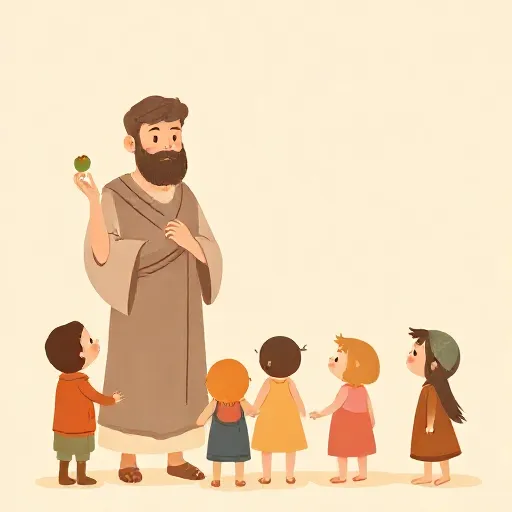
Imagine you are listening to a piece of music with no words—just a melody. All of a sudden you feel a surge of courage, or a wave of sadness. Where did that feeling come from? In the ancient Greek city of Croton, around 500 BCE, a mathematician named Pythagoras (c. 570–c. 490 BCE) asked a similar question.
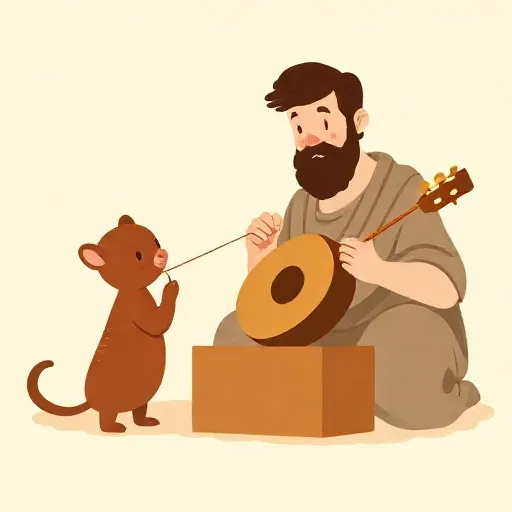
One day, Pythagoras stretched a single string and plucked it. Then he pressed his finger exactly in the middle, making the string half as long. The note jumped up an octave higher. He smiled: the most beautiful sound in music, the octave, was also the simplest mathematical ratio, 2 to 1. A monochord, an instrument with one string and a movable bridge, could show that other intervals fit perfect ratios too: a fifth was 3:2, a fourth was 4:3. Pythagoras believed he had uncovered a deep secret: musical harmony was really a number puzzle.
For him and his followers, this was not just about music. They thought the whole universe was built on the same ratios. Planets whirled in their orbits at distances that matched musical intervals, producing a silent cosmic music—the harmony of the spheres. The human soul, they believed, was itself a kind of tuning, a harmony of parts. This is why music could reach inside you and change how you felt. One Pythagorean sacred symbol, the tetraktys, was the series 1, 2, 3, 4—the very numbers that produced the most perfect intervals.
Not everyone was convinced. Aristotle (384–322 BCE) fired back. He argued that planets are physical bodies with weight, not pure numbers, so they cannot literally sing. He also pointed out that loud sounds shatter glass and physically shake us. If the planets really produced music as they moved, the effect on us would be enormous—and yet we hear nothing. Aristotle rejected the idea that the soul itself is a kind of harmony, too. Even so, the Pythagorean vision of a mathematically ordered musical cosmos survived for centuries.
How Music Shapes Your Soul: Plato and Aristotle

The Greeks did not just wonder about the stars. They worried about what music does to your character. Both Plato (427/28–347 BCE) and Aristotle believed that music imitates emotions, and that this mimesis (imitation) can be a powerful teacher—or a dangerous one. Their concept of mousikē was broader than ours: it included poetry, dance, and melody all woven together.
Plato thought music’s imitative power could train the young before they were ready for abstract reasoning. He wrote that “rhythm and harmony permeate the inner part of the soul more than anything else, affecting it most strongly.” If you heard music that imitated courage—resolute tones in battle—you would slowly become more resolute yourself. The Dorian and Phrygian modes (ancient scales) seemed to do this, so Plato wanted those in his ideal city. But he was also afraid: once musical tastes shift, he warned, the whole society can unravel. He even blamed the wild new tunes that followed the Persian Wars for a collapse in respect for authority.
Aristotle agreed that music imitates emotions, but he was far more nuanced. He thought visual arts, like painting, could only show the outer signs of an emotion—a man weeping or smiling. Music, however, could directly represent the emotional state itself. When you hear a courageous melody, it does not just make you think of courage; it can make you feel it. That feeling, he argued, is the key to moral training. Aristotle wrote, “The habit of feeling pleasure or pain at mere representations is not far removed from the same feeling about realities.” In other words, if you learn to enjoy good characters in songs, you are more likely to admire them in real life.
He also added another function: catharsis. Music could help someone who was overwhelmed with wild grief or religious frenzy by giving them a safe, musical version of that same agitation, like a storm that passes and leaves calm air. Unlike Plato, Aristotle was comfortable with instrumental music alone—he thought even a wordless tune could stir distinct emotions.
The Listeners Who Fought Back: Trusting Your Ear
Not every ancient thinker bowed to numbers. A student of Aristotle named Aristoxenus (fl. 4th century BCE) argued that harmonics—the study of musical intervals and scales—should be built on what we actually hear, not on abstract mathematics. For him, a note was defined by how the singing voice rests on a pitch, not by a ratio. To follow a melody, he said, you need only perception and memory: “we have to perceive what is coming to be and remember what has come to be.” No equations required.
This empirical approach (trusting experience) stood against the Pythagorean mathematical approach (trusting eternal proportions). The clash mattered: it was a fight about what counts as an explanation for beauty. Do you need secret cosmic math, or is it enough that the sound strikes a skilled listener as right? Ancient commentators took passionate sides, and the only known Greek woman music theorist, Ptolemais of Cyrene (fl. between the 3rd century BCE and the 1st century CE), even sorted thinkers into “the musicians” (empiricists) and “the rule-makers” (Pythagoreans).
A few later writers, like Ptolemy (c. 100–c. 170 CE), tried to blend both camps—crafting mathematical constructs that better matched real music. But the two sides never fully merged. The tension would echo right down to the 1700s.
A Thousand Years of Echoes: Boethius, Christians, and Islamic Voices

After the fall of Rome, much of ancient Greek philosophy was kept alive by a Roman statesman named Boethius (c. 480–525/26). His book De Institutione Musica sorted music into three kinds: musica mundana (the Pythagorean harmony of the universe), musica humana (the harmony within the human body and soul), and musica instrumentalis (actual singing and playing). To Boethius, the music we can hear was the least important of the three because it was only a shadow of the cosmic order. Medieval Christian writers loved this idea; they simply recast the harmony of the spheres as something God built into creation.
Not everyone bought it. When Aristotle’s works became available again, thinkers like Albert the Great (c. 1200–1280) rejected celestial harmony on physical grounds. Meanwhile, in the Islamic world, philosophers also wrestled with the same Greek sources. Al-Farabi (872–950) threw out the music of the spheres and proposed that music developed out of human needs—cries of pain or pleasure. He sorted melodies by how they affect a listener: some please the ear, others paint mental images, and the best ones express psychological states. Ibn Sina (Avicenna) (980–1037) revived the Aristotelian idea that music imitates character.
For centuries, however, music was mostly treated as a branch of mathematics inside the quadrivium (the four number-based liberal arts). The sound and feeling of a performance were often viewed with suspicion. That was about to change.
The Great Melody vs. Harmony Showdown
In the late 1500s, a group of Florentine intellectuals called the Camerata set out to recapture music’s ancient power to move the listener. They blamed complicated polyphony (interweaving many voices at once) for hiding the emotional message. Their solution was monody—a single expressive vocal line that followed the rhythms and pitches of impassioned speech. The result was the stile rappresentativo, the style of early opera. The composer Vincenzo Galilei (c. 1520–1591), father of the astronomer Galileo, wrote that modern music “delights the ear” but fails to “induce in another the same passion that one feels oneself.”
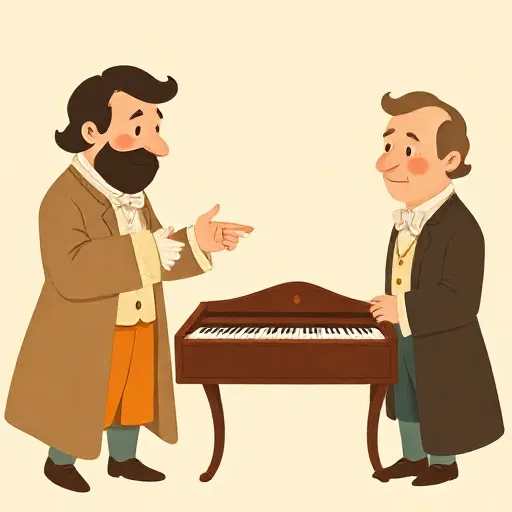
A furious debate soon erupted between defenders of melody and defenders of harmony. Jean-Jacques Rousseau (1712–1778) attacked the music theorist Jean-Philippe Rameau (1683–1764), insisting that a single, gripping tune was the true source of music’s emotional force—what he called “unity of melody.” He thought complex chords only got in the way. Rameau, by contrast, argued that melody was nothing but a surface expression of an underlying harmonic structure, one that could even be traced to the physics of vibrating strings and their natural overtones.
Beneath their technical dispute lay a bigger question: should we explain music by what we can feel and hear, or by a hidden rational order? It was the same battle Aristoxenus had fought against the Pythagoreans, now replayed with harpsichords and wigs. The Camerata’s focus on emotional expression also began to weaken the old idea that music must literally copy the sound of a crying or laughing voice. Some theorists, like Charles Avison (1709–1770), began to separate imitation (making a sound that resembles a thunderclap or a laugh) from true expression (directly arousing a feeling in the listener). Expression, they said, is what matters.
The Philosopher and the Music Without Words
Immanuel Kant (1724–1804) was the first major modern philosopher to put pure instrumental music at the center of his thinking about art. In his Critique of the Power of Judgment, Kant argued that when you find a piece of music beautiful, you are making a judgment of taste. This judgment is personal—it involves a feeling of pleasure—but it also claims that anyone ought to feel the same way. That is different from merely finding something agreeable, like the taste of a snack, which you do not demand others share.
Crucially, instrumental music for Kant is an example of free beauty. It does not depend on a concept or a text; you judge its form—the arrangement of tones and rhythms—purely. Yet he also believed that music can express an “aesthetic idea,” an imaginative whole that suggests a dominant emotion, almost as the old Affektenlehre (doctrine of the affections) had claimed. Scholars still argue whether Kant was a real formalist (thinking only structure matters) or whether he tried to unite form and feeling. What is certain is that after Kant, philosophy of music no longer revolved around words and voices. The instrumental piece had become the main puzzle.
And that puzzle is yours every time you put on headphones. Why does a song with no lyrics make your heart race? The ancient debate never ended. Some people still think the secret is hidden mathematical proportion in the vibrations. Others say music works by copying, or directly sparking, the inner shape of an emotion. The next time a tune stops you in your tracks, you are stepping into a conversation that started with a plucked string in Croton twenty-five centuries ago.
Think about it
- If a song with no words makes you feel happy, is that because the melody somehow resembles happiness, or because it simply presses a “happiness button” in your brain? How could you design an experiment to test your idea?
- Plato worried that a new musical style could shake up society. Do you think a genre of music today can really change how people act, or is that just older generations being nervous?
- Pythagoreans believed numbers secretly rule the universe, and music was their proof. Can you think of something in your life that feels magical but might actually follow an invisible mathematical rule—like a video game glitch that turns out to be predictable?