Can a Melody Feel Sad? The 200-Year-Old Debate
A Letter That Couldn’t Be Written

In 1842 the composer Felix Mendelssohn (1809–1847) sat down to answer a friend who had asked what a piece of music meant. Mendelssohn loved the piece. But when he tried to pin the feeling into words, he exploded the usual complaint. It’s not that music is too fuzzy to describe, he wrote. The thoughts a beloved piece gives him are “not too indefinite to be put into words, but on the contrary too definite.” Ordinary language wasn’t too blunt; it was too clumsy to capture something knife-sharp.
Mendelssohn was giving voice to a new idea that swept through Europe around 1800. Earlier thinkers had treated music mostly as an imitation of nature or a pleasant decoration. The young Romantics flipped the table. They argued that instrumental music — music without words — wasn’t the weakest art but the strongest one, precisely because it didn’t copy anything you could see or touch.
Earlier, the writer Wilhelm Heinrich Wackenroder (1773–1798) had already claimed that musical tones “don’t imitate, they don’t beautify, but rather represent a separate world in itself.” The critic and composer E. T. A. Hoffmann (1776–1822) pushed the idea further: music “discloses to man an unknown realm, a world that has nothing in common with the external sensual world that surrounds him, a world in which he leaves behind him all definite feelings to surrender himself to an inexpressible longing.”
Together these thinkers planted what philosophers later called the ineffability thesis — the claim that what music says cannot possibly be turned into language, not just that we happen to lack the right words right now. Music, they insisted, is a symbol system of a wholly different order than speech.
Schopenhauer’s Hidden Universe

No philosopher gave that idea a grander home than Arthur Schopenhauer (1788–1860). He built a whole system in which the deepest reality isn’t matter or mind but a blind, striving force he called the Will. Every desire, every hunger, every restless impulse in you is a little ripple of that one Will. Ordinary waking life, Schopenhauer thought, is mostly suffering, because wanting is painful and satisfaction never lasts.
Art, in his view, offered a temporary escape. Most arts represent the Will through particular Ideas — architecture shows heavy forces, tragedy shows human struggle. But music, Schopenhauer argued, does something far stranger: it doesn’t represent the Will second-hand. Music is a direct copy of the Will itself, running parallel to the whole physical world. He even wrote that, in some sense, music could exist if there were no world at all.
To make the idea concrete, Schopenhauer lined up the sounds. Low rumbling notes, he said, are like inorganic matter and brute physical forces; the fast, high, twisting lines of melody are like the rapid rise and fall of human feeling — tension, release, straining, resting. The emotions we hear in a melody aren’t anyone’s particular feelings; they are the shape of emotion itself, stripped of names and persons. That’s why they hit so deep, and why words can never file them into neat boxes.
Schopenhauer’s picture gave composers a kind of cosmic dignity, but it also set a strict rule: music that merely imitates chirping birds or clashing swords is cheating, because it copies superficial appearances instead of speaking the inner nature of things.
Hanslick Fires Back: The Music That’s Just Moving Shapes
Not everyone was swept away by the Romantic tide. The sharpest counterattack came from the Austrian critic Eduard Hanslick (1825–1904) in his short, fierce book On the Musically Beautiful. Hanslick admitted that music often stirs up feelings, but he insisted that those feelings have nothing to do with what makes it musically beautiful. A beautiful piece of music, he argued, doesn’t need to represent any emotion at all.
His strongest weapon was a cool look at what emotions actually are. Emotions aren’t just moods of buzzing or sinking; they include a conceptual content — a thought about something. Hope reaches toward a future you imagine as better. Melancholy broods over a happier past. Music, Hanslick observed, has no way to supply that kind of thought. It can mimic the quick rise and fall of excitement or the slow drag of weariness, but it cannot pin down the idea that makes excitement into hope or weariness into grief. So a piece of music may be deeply moving, yet it cannot represent any specific emotion the way a poem or a face can.
He backed up the point with a playful example: the aria “Che farò senza Euridice” by Gluck sounds full of dejection, but if you slap a cheerful wedding text onto the same tune, most listeners would accept it as joyful without complaint. Music, Hanslick said, wears its emotions like a costume that any lyric can swap.
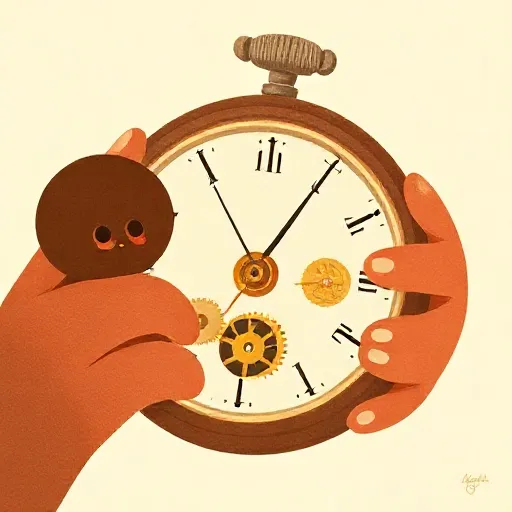
His positive picture was even more provocative. The only content music really has is its own form — the patterns of tones, rhythms, and harmonies that unfold in time. He coined a phrase that has echoed ever since: music is “sonically moved forms.” Appreciating it is a job for the intellect, for the mind that follows the structure, not for the heart that just gets washed away by a swelling orchestra. That didn’t mean he hated feeling; it meant that genuine musical understanding happens when you grasp the design, the same way you might admire the inner workings of a clock.
What’s at Stake When You Press Play

Hanslick’s book lit a fire that still hasn’t gone out. His target wasn’t just Romantic swooning; he was defending the worth of absolute music — instrumental works like symphonies that don’t come with a story or a lyric sheet — against those who thought it was empty without a program. The fight was as personal as his clash with the composer Richard Wagner, who wanted to drown music in drama.
Today the terms have shifted, but the question is alive every time you get goosebumps from a song nobody wrote words for. When a piano piece aches with sadness, are you detecting a property that belongs to the sounds themselves, the same way you detect a color? Or are you just feeling your own reaction and projecting it outward? Philosophers still argue about whether music “expresses” emotion, is merely “expressive of” it, or only nudges your brain into a state you then label with words borrowed from real life.
Neither side has won. The Romantic intuition — that some things music tells you are simply too definite for language — won’t go away, probably because most people who love music feel it in their bones. Hanslick’s challenge hasn’t gone away either, because it’s genuinely hard to explain how a pattern of vibrating air can contain anything like the specific tangled thoughts that make up a real hope or a real grief. You’re free to land where you like, but for two hundred years that tension has been the very engine of serious thinking about music.
Think about it
- If two friends listen to the same instrumental piece and one calls it the sound of quiet joy while the other hears deep sorrow, could both be right? What makes one description count as better than the other?
- Suppose a computer program could generate brand-new “sonically moved forms” that no human ever composed. If the result gave you the same chills as your favorite song, would the music be expressing something — or would something be missing?
- You tell a friend, “This tune is so sad.” The friend asks, “How do you know it’s the tune that’s sad, and not just you?” How would you answer — and what would your answer say about what you think music really is?