The 13th-Century Teacher Who Solved the Mystery of "Every"
A Puzzling Question in a Paris Classroom
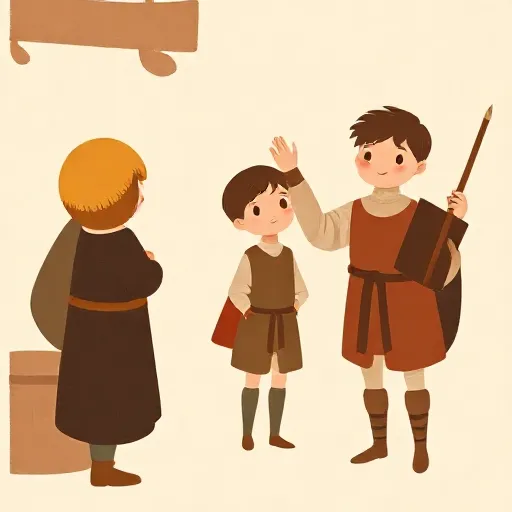
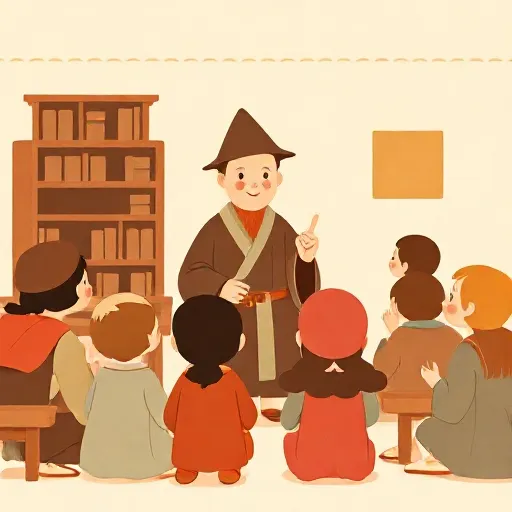
It is the year 1240. A young student at the University of Paris scratches a sentence into a wax tablet: Omnis homo est animal — “Every man is an animal.” He frowns and looks up. “Magister, if no men existed, would this sentence still be true?” The teacher, William of Sherwood (c. 1200–1272), pauses. He has been thinking about words like “every,” “all,” and “is” for years. Now he has to give an answer that will ripple through centuries.
William probably grew up in England and later became a master at Oxford. But during the 1230s and 1240s he was teaching logic in Paris, where students wrestled with Aristotle and fresh ideas about language. He wrote two important books: an Introduction to Logic and a treatise on syncategorematic words — tiny words like “every,” “only,” “not,” and “is” that do not name things by themselves but completely shift what a sentence says. In the Introduction he also wrote about the properties of terms, and that is where his solution to the riddle begins.
The “Three Things” Rule: Why “Every” Isn’t Like “Both”

Sherwood noticed that a word like “man” does not simply wave a concept in front of your mind. It also reaches out and points to the things that actually exist right now. He called this property appellation: the power of a term to pick out present, real examples. So the appellata of “man” are the living men in the world, not imaginary ones and not dead ones.
And here is the twist: Sherwood argued that the sign “every” (or “all”) comes with a special requirement. It needs at least three appellata — three things that the subject term really stands for. He took this idea from Aristotle, who once said, “Of two men we say that they are two, or both, and not that they are all.” If there are only one or two men, you should say “the one man” or “both men,” not “all men.” So when no men exist, “every man” has nothing to hook onto, and “Every man is an animal” turns out false — at least on one reading.
This rule flips everyday language on its head. You might casually say, “Every dragon breathes fire” while reading a story. But by Sherwood’s strict rule, if dragons do not exist, “dragon” fails to appell anything, and the sentence is false. That seems strange. Isn’t it just a rule about what dragons would be like if they existed? To answer that, Sherwood introduced a crucial split.
The Double Life of “Is”: Actual and Habitual Being

Sherwood said the word “is” is sneaky. It can mean two different things, which he named esse actuale (actual being) and esse habituale (habitual, or rule‑like being). When you say “Socrates is running” and you mean he is running right this moment, you are using “is” in the actual sense. But when you say “A triangle is a shape with three sides,” no triangle needs to exist this instant. You are stating a rule that links “triangle” and “three‑sided shape.” That is habitual being — almost like a hidden “if … then”: if something is a triangle, then it has three sides.
So what about “Every man is an animal”? Sherwood argued: take it with actual being, and it is false if no man exists. But take it with habitual being, and it is true even in an empty world. It acts like a conditional: “If something is a man, then it is an animal.” That rule holds whether the world is full of people, completely empty, or populated by talking dragons. Sherwood was one of the first logicians we know of to treat “is” this way, and his move looks a lot like how modern thinkers talk about the truth conditions of “All A are B.”
The solution had a strange side‑effect. If the rule‑sense of “is” is true when nothing exists, you have to grant that things that could exist — what Sherwood called possibilia — have a shadowy, diminished sort of being. A unicorn has no actual being, but it possesses a tiny kind of reality because the rules about unicorns do not vanish. Most thirteenth‑century thinkers resisted that idea, but Sherwood did not back away from it.
Sing Along with Barbara Celarent: The First Great Logic Rap

Sherwood was not only a deep thinker — he was a teacher who knew how to make ideas stick. In his Introduction he wrote down a song‑like list of nonsense names: Barbara, Celarent, Darii, Ferio… The chant is the oldest known surviving version of a memory trick that logic students would sing for centuries.
Each name encodes a syllogism, a three‑sentence argument where two premises force a conclusion. A classic example runs: All philosophers are curious. Socrates is a philosopher. Therefore, Socrates is curious. Sherwood used the vowels a, e, i, o inside a name to mark the type of statement: a for “All … are …,” e for “No … are …,” i for “Some … is …,” o for “Some … is not ….” So Barbara has three a’s — two universal affirmative premises and a universal affirmative conclusion. The consonants give extra clues about how to check the argument’s shape.
Sherwood may not have invented every piece from scratch — words like Festino crop up even before him — but he put the chant together in the form that raced across Europe. His fellow logicians, including the hugely popular Peter of Spain, adopted it, and it became the backbone of logic teaching for hundreds of years. If you have ever used a rhyme or a jingle to memorize something for a test, you are walking in Sherwood’s footsteps.
Socrates Is Running: Why Singulars Break the Square
Ever since Aristotle, logicians had arranged the four standard sentence types — “All S are P,” “No S are P,” “Some S is P,” “Some S is not P” — into a Square of Opposition. But Sherwood spotted a hole. What about singular statements like “Socrates is running” or “This cat is gray”? In most medieval textbooks singulars were either ignored or pushed aside. Sherwood took them seriously.
He saw that “Socrates is running” and “Socrates is not running” are contradictories: one must be true and the other false, with no middle ground. But the pair “Some man is running” and “Some man is not running” are not contradictories — they are subcontraries, which means they can both be false at once (if no man exists). So singular statements behave differently. To show how they fit, Sherwood expanded the Square into a Hexagon of Opposition, with fresh corners for singulars. No medieval drawing survives, but scholars think his manuscript once held the diagram.
By giving singular terms — proper names and phrases like “this cat” — both simple and personal supposition, Sherwood let them shift meaning in the same way common nouns do. That made his logic unusually flexible.
Why the Puzzle of “Every” Never Went Away

You might suppose that a debate about whether “Every man is an animal” is true in an empty world belongs in a dusty manuscript. But the question lives on whenever you say something like “All my friends like pizza” and you are not sure any friend is around, or “Every superhero has a weakness” while knowing Superman is fictional. Sherwood’s split between actual being and rule‑like being is exactly the distinction that modern philosophers make between sentences that are true only of existing things and sentences that are “vacuously” true because the condition can never fail.
His insight that words like “every,” “only,” and “not” carry hidden logical weight — he labeled them syncategorematic terms — stands behind the way logicians and computer scientists analyse language today. When you search for “all cats that are fluffy” on the internet, the search engine has to decide whether to count extinct cats or imaginary ones. That is Sherwood’s puzzle with a keyboard.
The mnemonic lines he likely shaped still echo in philosophy classrooms. The hexagon reminds us that logic grows when we dare to fit stubborn singulars into neat diagrams. And the picture of a thirteenth‑century teacher calmly explaining that is can mean two things — that is philosophy itself: refusing to let a small word stay unexamined.
Think about it
- If you say “Every unicorn has a horn” but unicorns don’t exist, would you count that sentence as true or false? Why?
- “Both of you passed the test” sounds wrong if there are three people. What does that tell you about the hidden rules packed into words like “both” and “all”?
- Create a rule‑sentence about a made‑up creature (for example, “Every griffin has wings”). Now say it again using “is” to mean real existence. How does the truth change?