
Why "Everything" Is More Complicated Than You Think
What Do You Mean, “Everything”?

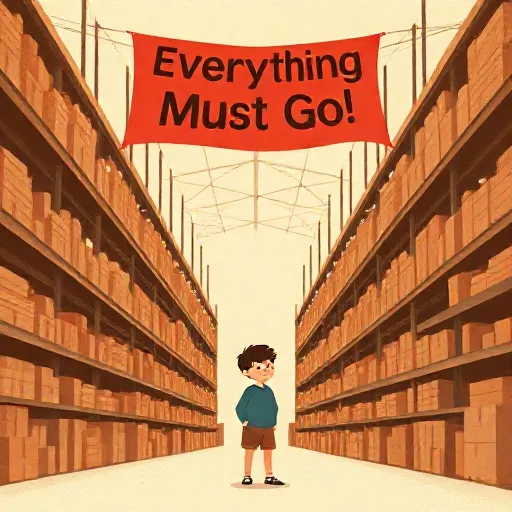
You are walking through a shop and see a bright sign: Everything Must Go! You grab a board game, but the cash register isn’t for sale. The floor isn’t for sale. The building itself isn’t included. The word “everything” in everyday talk almost never means absolutely all things. We silently restrict it to what matters in the moment.
That little trick hiding in plain sight matters to philosophers. If we cannot trust a simple word like “everything,” what does it even mean to talk about all that exists? Logic — the study of careful reasoning — was built to answer exactly that question.
Frege Invents a Code for “All” and “Some”
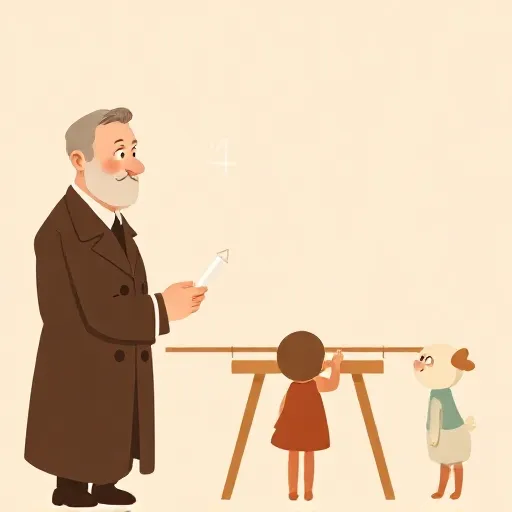
Gottlob Frege (1848–1925), a German mathematician and philosopher, wanted a language so exact that nothing would be left to guesswork. In 1879 he invented two symbols that we still use: ∀ and ∃.
The symbol ∀ means “for every” or “all.” ∃ means “there exists” or “some.” These symbols work like a net. You first decide a domain — the set of things you are talking about, like all the objects on a shelf. Then the quantifier ∀ scoops across that domain and says “every one of them has a certain property.” ∃ says “at least one of them does.”
Using variables like x and y, a sentence such as ∀x (Cat(x) → Furry(x)) reads: for everything in the domain, if it is a cat, it is furry. No hidden exceptions, no fuzziness.
To Exist Is to Be Something
Frege and the British philosopher Bertrand Russell (1872–1970) shared a big idea: existence itself is explained by the net. Saying “Socrates exists” does not describe a special glowing property stuck to Socrates. It simply means: something is Socrates — ∃x (x = Socrates). Existence is being something, not having a special feature.
Russell illustrated this with a famous puzzle, noting that the present king of France is bald. There is no present king of France, but the sentence still feels meaningful. Russell’s logic showed that the sentence secretly says: there exists exactly one king of France and that thing is bald. Since the first part is false, the whole claim is false — neatly solved.
The logical tool meant that grand ontology — the study of what there is — could be done with quantifiers and variables.
Quine’s Rule: Your Words Force You to Believe Things
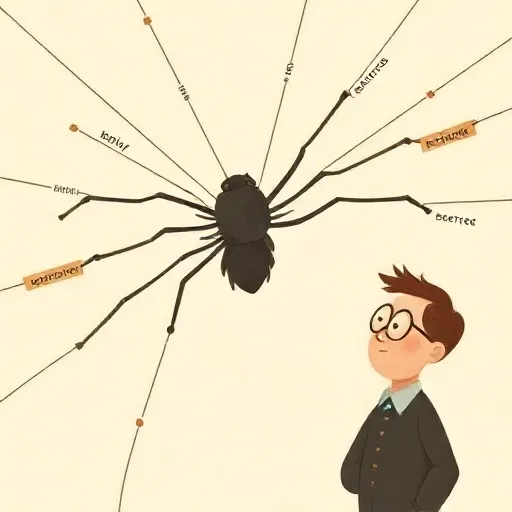
The American philosopher Willard Van Orman Quine (1908–2000) sharpened the net into a test. In a 1948 essay, he gave a famous criterion of ontological commitment. The slogan: “To be is to be the value of a variable.” That means a theory commits you to the existence of whatever must be inside the domain for the theory’s sentences to be true.
Take a simple scientific claim: “There are electrons.” To make that true, your domain must contain electrons. Quine pushed further: if our best overall picture of the world — science, mathematics, everything — says “there are numbers,” then numbers are real. They are values the variables range over. Your words, carefully written in quantifier language, push you to accept some things as real even if you can never touch them.
The Biggest Everything: Can There Be a Set of All Things?
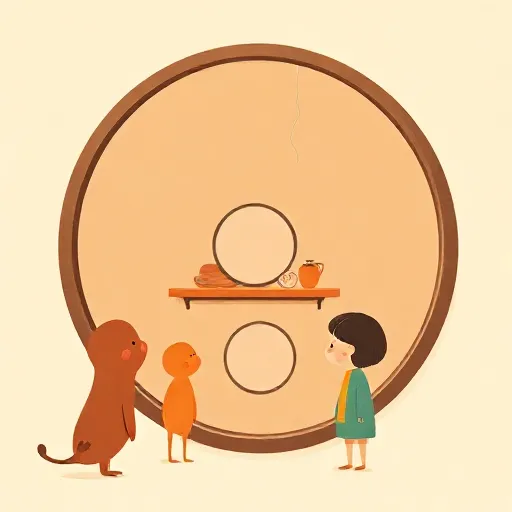
If existence is being caught in the net, what is the largest net possible? Can we talk about absolutely everything at once? That would mean a domain that contains all objects — a set of all things.
Russell discovered a famous obstacle in 1901. Imagine the set of all sets that do not contain themselves. Does that set contain itself? If it does, it shouldn’t; if it doesn’t, it should. Contradiction. So there can be no set that collects absolutely all sets — and maybe no set of absolutely everything.
Some philosophers, like Richard Cartwright, argue that to quantify over everything you would need a set-like container that holds all objects — an “All-in-One” principle. Since that container would itself be an object, you get caught in Russell’s trap. On this view, genuinely unrestricted quantification is impossible.
But other thinkers resist. George Boolos (1940–1996) showed you can use plural quantification — talk about “some things” without wrapping them into a single set. You can say “some things are all and only the non-self-membered sets” without claiming those things form a set. On this view, you can still say “everything” without needing a box for everything.
The debate remains unsettled. Some philosophers think the paradoxes only show that not every description picks out a set, not that all-inclusive talk is impossible. Others follow Michael Dummett’s idea that concepts like “set” and “object” are indefinitely extensible — you can always find more.
Why It Still Matters: What’s Real in Your World?

When your friend says “Everything is awesome!”, you probably don’t think they mean every atom, every sadness, and every distant galaxy. You silently restrict the domain. The same happens when you talk about a story: “There are dragons” in a novel is true inside the fiction, but doesn’t force you to believe dragons exist in the real world.
Quine’s test pushes you to ask harder questions. Does your best theory of the world need numbers? If it does, then numbers exist — they are values of variables. Does your best theory need possible worlds to explain what could have been? Then possible worlds are in the net. Logic doesn’t settle what exists, but it forces you to own up to the commitments hidden in your words. And the paradox of “everything” reminds you that even the most basic tool — the ability to talk about all things — is still a mystery we are untangling.
Think about it
- When a friend says “Everything is awful,” do you think they mean all facts in the universe, including the distance to Jupiter? How do you silently decide what “everything” includes in that moment?
- If a scientist says “There are particles so tiny we can never detect them,” does the word “there are” in that sentence make those particles real, or just part of a useful story?
- Could there ever be a complete list of everything that exists? What problem would a list run into if you tried to write it down?