
Can a Game Tell You What “Every” Means?
The game of guessing without knowing

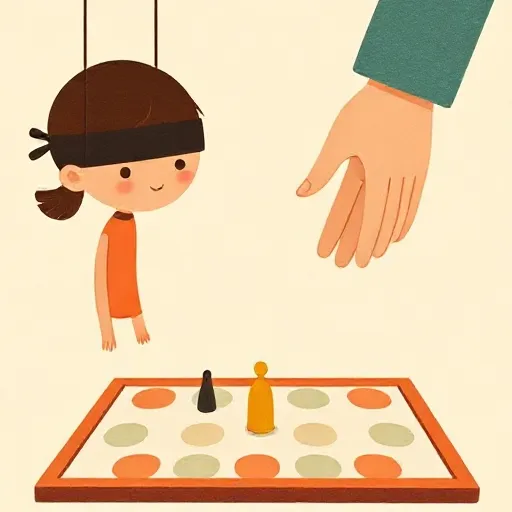
Imagine a strange game. I secretly pick a number — either 0 or 1 — and keep it hidden. Your job is to guess it. You win if your number matches mine. But there is a catch: you never get to see my number before you choose. Can you come up with a plan that guarantees a win?
No single move works every time. If you always guess 0, I can pick 1; if you always guess 1, I can pick 0. You have no winning strategy. Strangely, I don’t have one either: I can’t force you to lose no matter what you do, because you might guess randomly. Mathematicians say this tiny game is undetermined — neither player can force a win.
This guessing game is not just a playground puzzle. In the mid‑20th century, logicians realized that all the everyday words we use to talk about the world — words like “every,” “some,” “and,” and “if” — work like rules for a two‑player game. Studying those games reveals how truth itself unfolds.
How “every” and “some” become moves

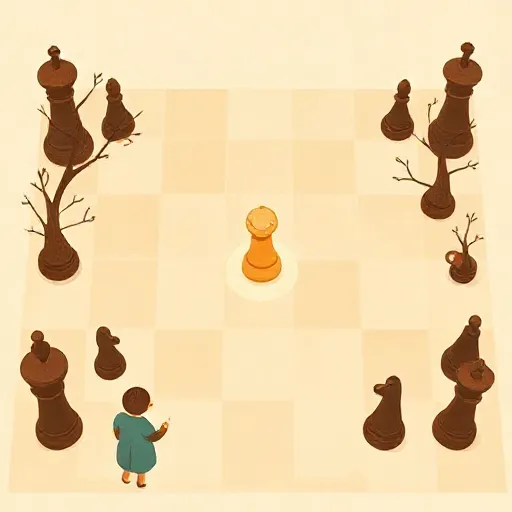
Take a simple sentence: “For every number there is a bigger one.” On the surface it’s just a fact about numbers. But the 20th‑century logician Leon Henkin noticed that you can see the sentence as a little battle between two opponents.
Call them ∀ (pronounced “all”) and ∃ (“some”). The sentence tells them how to play. ∀ goes first and picks any number he likes — he’s standing in for the word “every.” Then ∃ must answer by picking a number of her own — she represents “there is.” ∃ wins the round if the number she chose is larger than his. If she can always do that, no matter what ∀ picked, she has a winning strategy. And that is exactly what it means for the original sentence to be true.
The Finnish philosopher Jaakko Hintikka expanded this idea in the 1970s. He showed that not only “every” and “some” but also “and” and “or” can be turned into moves. A sentence like “It is raining and the sidewalk is wet” gives ∀ the chance to choose which half he wants to challenge: “Prove to me it’s raining,” or “Prove the sidewalk is wet.” With “or,” the power flips — ∃ gets to choose which half she will defend. Even negation becomes a swap: to play the game for “It is not raining,” the two players simply trade roles and play the game for “It is raining.”
How a single strategy captures truth
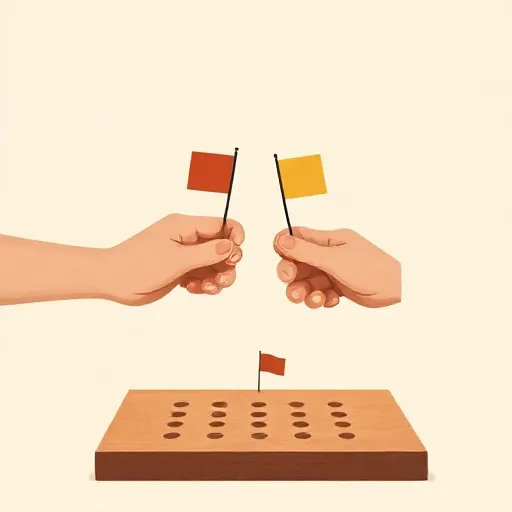
When a logician writes a sentence like “Every frog has a hop,” they want to know whether the sentence is true in a certain world. Tarski, in the 1930s, gave a careful definition of truth that unpacks the sentence piece by piece. Hintikka’s game gives the very same yes‑or‑no answer, but for a different reason: ∃ can force a win.
If ∃ has a foolproof plan — a winning strategy — the sentence counts as true. If she doesn’t, and the other player ∀ can force her to lose, the sentence is false. For simple sentences, the two answers always match. Indeed, for any sentence that uses only the usual logical words, the game will be determined: one of the players has a winning strategy. This is guaranteed by a famous result called the Gale–Stewart Theorem for well‑founded games, which are games that always end in a finite number of moves.
The strategy itself can be thought of as a collection of “If‑you‑do‑this, I’ll‑do‑that” instructions. For a sentence that says “For every x there is some y,” ∃’s winning strategy might be a function that tells her what y to pick based on the x that ∀ chose. Mathematicians call those helper functions Skolem functions. So a winning strategy is a proof that the sentence can always be satisfied, one smart response at a time.
When two worlds look exactly alike

Logicians don’t just play games on single sentences. They also use a different kind of game to compare entire universes — say, two sets of objects with different shapes and colors but the same pattern of relations. This is the back‑and‑forth game, invented by the Polish logician Andrzej Ehrenfeucht.
Here the players are called Spoiler and Duplicator. Two structures A and B sit in front of them. Spoiler wants to show they are different; Duplicator wants to prove they are indistinguishable — at least for the language being used. Each turn, Spoiler picks an object from either A or B. Duplicator must immediately pick a matching object from the other structure. After several rounds, Spoiler wins if some simple atomic sentence (like “this object is red” or “these two objects are connected”) is true in one structure but false in the other.
If Duplicator has a winning strategy that keeps everything matched forever, then no sentence in that language can tell the two structures apart. They are elementarily equivalent — they behave the same way from the point of view of logic. This idea turned out to be a jewel. Computer scientists use it to prove that a query language cannot detect a certain property (like “even number of items”). Without writing a single line of code, the game shows that two databases look identical to the language, even though a human can see the difference.
Debating like a logician

What if a logical game could mimic a real argument? In the 1960s, the German logician Paul Lorenzen designed dialogue games that work exactly like a structured debate. The Proponent tries to prove a sentence; the Opponent challenges her.
If the sentence is a conjunction, “A and B,” the Opponent might demand, “Show me B!” — and the Proponent must be ready. If it’s an implication, “If A then B,” the Opponent can temporarily grant A and challenge the Proponent to reach B. The rules are tuned so that the Proponent has a winning strategy precisely when the sentence is a theorem of intuitionistic logic, a kind of logic where you can only claim something exists if you can actually construct it.
Lorenzen’s game gave a fresh answer to the question, “What is a proof?” A proof is not a frozen list of symbols; it’s a guide for winning a dialogue against any skeptical challenger. Later researchers borrowed the idea to build games for other logics, including ones that let the players act asynchronously, like independent computer programs pinging each other only when they need to.
Why it still matters — from computers to your kitchen table

Today, logical games are everywhere outside philosophy textbooks. Computer scientists use back‑and‑forth games to verify that a new website behaves exactly like the old one, or to measure how powerful a database language is. The bisimulation games that sprang from modal logic let engineers check that two systems interact with the outside world in exactly the same way, step‑by‑step.
Even the simple guessing game you met at the beginning — the one where nobody could force a win — turns up in real life. When you play a cooperative video game and your teammate acts before you know what you’ll need, you’re dealing with imperfect information. Designers use ideas from logical games to figure out what you can still achieve when you can’t see the whole board.
And when you argue with a friend about which movie to watch, you’re already inside a dialogue game. You make claims, they challenge them, you defend. If the rules were made explicit, a third person could judge which side really proved their point. Logic games don’t replace ordinary arguments; they just let us see the hidden structure that makes good reasoning work. Once you spot the players moving behind the words, “every” and “some” never sound the same again.
Think about it
- If you had to teach the word “every” to a person who shares no language with you, could you do it using only a game? What would the rules look like?
- Two apps on your phone give you exactly the same information at the same time, even though their buttons and colors are different. Are they really the same app? What would you check to know for sure?
- When you’re in a debate, are there moves that feel unfair even if they follow the rules? Can you think of a rule that would make debates more fair?