Can You Always Find a Sure Win? The Logic Hidden Inside Every Game
The Puzzle of the Uncooperative Chores

Mia and Jake want extra screen time. Their parents make them a deal: if they clean the room together, they each get 2 points. Mia must decide first: pick up a broom (clean) or ignore the mess (shirk). Then Jake decides. If both clean, each gets 2. If one cleans and the other shirks, the cleaner gets 0 and the shirker gets 3. If both shirk, they each get 1.
Jake thinks it through. If Mia cleaned, he gets 3 by shirking and only 2 by cleaning. If Mia shirked, he still gets 1 by shirking and 0 by cleaning. Either way, shirking pays more for him. So Jake will always shirk.
Mia knows Jake will shirk. If she cleans, she gets 0; if she shirks, she gets 1. She shirks. They end up with 1 point each. Yet if they had both cleaned, they would have 2 each — both better off. Acting rationally, they walked into a trap.
This kind of reasoning is called backward induction: you look at the end of the game and reason step by step toward the start. But does it always give the best result? To understand why it can fail, we need a language that can see the whole game at once — a logic of games.
A Winning Strategy and a Magic Formula
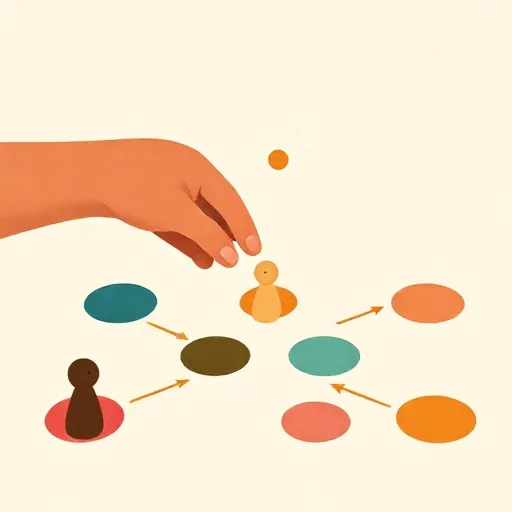
Imagine a two‑player game where everything is out in the open — no hidden cards, no dice. Abe and Ella take turns moving a token. Ella wins if she lands on the star. The board is a tiny tree: from the start, Abe can move left or right. After each, Ella can move up or down. The star is only reachable after some combinations. Can Ella guarantee a win?
Logicians have a way to say this precisely. They use a formula: [A]
This isn’t just neat notation; it uncovers a deep fact. The law of the excluded middle says that either the formula [A]
So logic can freeze a whole game into a single statement, and the rules of logic then force a hidden guarantee: one player has the power to win, or neither can force a win.
When Trust Makes the Difference: The Stag Hunt
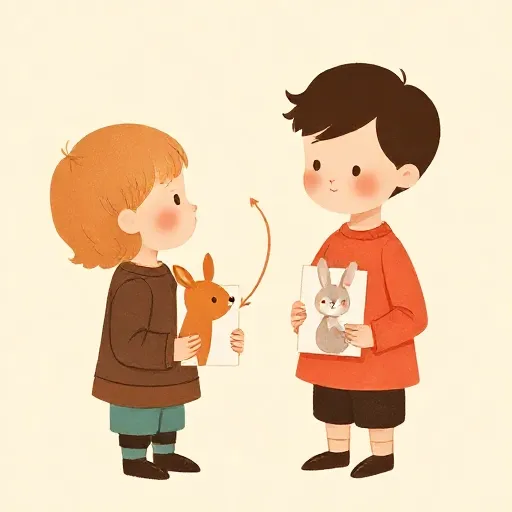
Not all games are turn‑by‑turn. Sometimes players choose at the same time without seeing each other’s move. The Stag Hunt is a classic example, going back to the philosopher David Hume. Two friends, Sam and Lily, can each decide to hunt a rabbit alone or join forces to hunt a stag. The rabbit is safe: hunting it always gives 1 point no matter what the other does. Hunting the stag is risky: if both choose stag, they each get a glorious 2 points. But if one hunts stag and the other hunts rabbit, the stag‑hunter gets nothing, while the rabbit‑hunter still gets 1.
You can picture this as a grid:
| Sam \ Lily | Rabbit | Stag |
|---|---|---|
| Rabbit | 1, 1 | 1, 0 |
| Stag | 0, 1 | 2, 2 |
If Sam thinks Lily will definitely hunt rabbit, he would rather hunt rabbit too and get a safe 1 than gamble on stag and get 0. But if Sam believes Lily will hunt stag, he’d also hunt stag for the bigger reward. So there are two Nash equilibria — situations where neither player can do better by switching alone — one for (Rabbit, Rabbit) and one for (Stag, Stag). Both are stable, but (Stag, Stag) is better for everyone.
Which one happens? That depends on what Sam believes about Lily, and what Lily believes Sam believes, and so on. In logical terms, we need common knowledge of each other’s plans. If everyone knows that everyone is going to choose stag, and everyone knows that everyone knows it, then stag becomes the rational choice. In the chore puzzle earlier, sticking to “clean” would also work if each could trust the other. Logic helps us model these layers of belief and see why a team can unlock better outcomes only when they share reliable expectations.
Logic as a Game: How “Or” and “And” Make Moves
Now flip the picture. What if logic itself is a game? There are games where the point is to prove a statement by outmaneuvering an opponent. Suppose you claim, “It is Tuesday or I am wearing blue.” A skeptic challenges you. You can pick which part you are prepared to defend. If you say, “I am wearing blue,” and you show your shirt, you win. The skeptic loses. This is an evaluation game. The rule for “or” gives you the choice; the rule for “and” would let the skeptic demand proof of both parts. The logical symbols act like moves in a two‑player game.
The player trying to show the sentence is true is the Verifier; the one trying to show it is false is the Falsifier. When the Verifier has a winning strategy — a way to answer every challenge — the original sentence is true in the model. This is exactly the same notion of a winning strategy we saw with Abe and Ella, but now it lives inside the definition of truth. Suddenly, games aren’t just something we analyze with logic; logic is something we can do as a game.
This way of seeing logic has led to new kinds of logic, helped design programming languages, and even inspired computer programs that can check whether a formula is true by playing a game against themselves. Games and logic are two sides of a single coin.
Why You Already Think Like a Game Master
You play these hidden games all the time. When you argue about the rules of a board game, you’re building a tree of possible clarifications. When you try to agree with friends on what to do tomorrow, you’re in a Stag Hunt: if everyone commits to the plan, you’ll all have more fun, but if someone flakes, it’s safer to keep a backup option. When you try to convince a sibling to share, you’re using statements whose logical form has a Verifier and a Falsifier.
Seeing the logical structure doesn’t make the world mechanical — it makes it clearer. You can ask, “Is there a winning strategy here?” Or, “What do I need to believe about others to make cooperating the right move?” Next time you play tic‑tac‑toe, remember Zermelo’s theorem: either you or your opponent has a sure‑win plan, or the game will always end in a draw. The logic was there before you made your first move.
Think about it
- Can you invent a simple game — maybe on a piece of paper — where the first player can force a win, and explain the plan using the pattern “for every move you make, I have a reply”?
- Have you ever been in a situation where everyone did what was best for themselves, and everyone ended up worse off? Could better communication have changed the outcome?
- If a computer can solve games with pure logic, do you think a computer could ever be a perfect friend or fair negotiator? What might it still miss?