What If the Smartest Move Makes Everyone Lose?
Two prisoners, one terrible logic
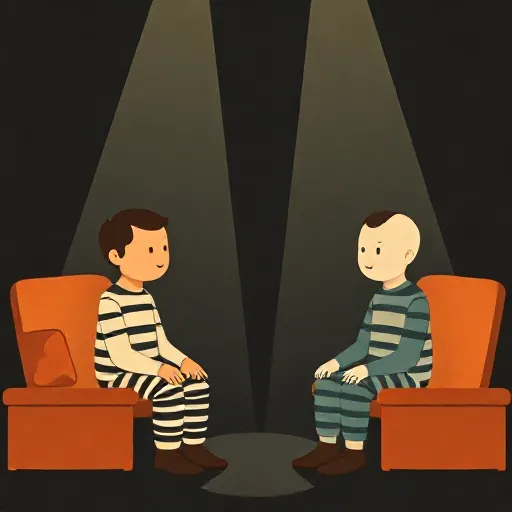
Imagine you and your partner in crime have been arrested. The police know you robbed a bank together, but they don’t have quite enough evidence to convict you for the big charge. They do have enough to send you both away for two years for a smaller crime—stealing the getaway car.
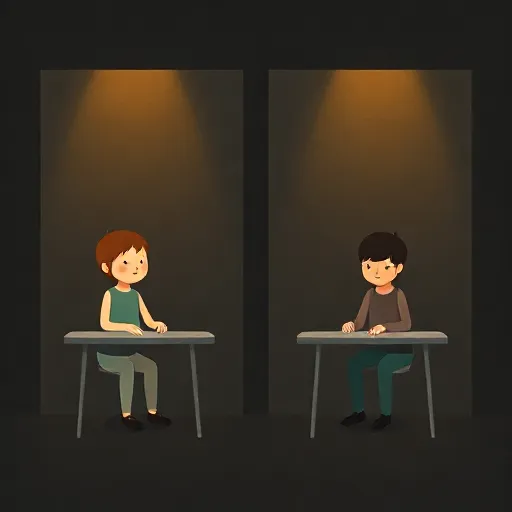
The lead detective separates you into two rooms. Then she makes each of you the same offer, out of earshot of the other:
If you confess and your partner stays silent, you walk free and your partner gets ten years. If you both confess, you both get five years. If neither of you confesses, you both get two years for the car theft.
You sit there, heart pounding. What should you do?
Here is the cold, logical truth. If your partner confesses, you are better off confessing too—five years beats ten. If your partner stays silent, you are still better off confessing—walking free beats two years. No matter what the other person does, confessing is the smarter move for you alone.
The trouble? Your partner reasons exactly the same way. You both confess. You both get five years. But if you had both stayed silent, you would each get only two.
This is the Prisoner’s Dilemma, the most famous puzzle in game theory—the study of how people make choices when the outcome depends on what other people decide. And it is not just about prisoners.
When life is more like kicking a person than a rock
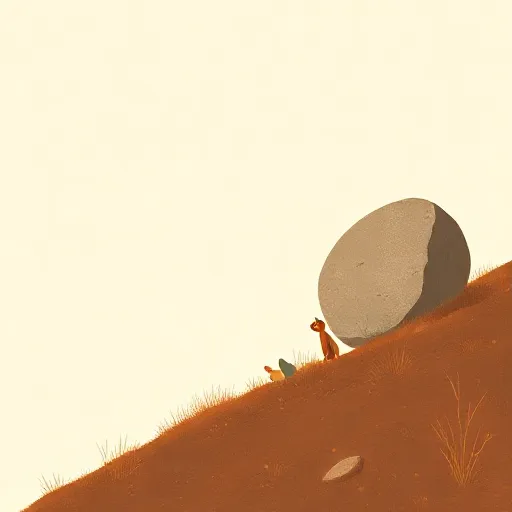
If you want to kick a rock down a hill, you just need to know physics: the rock’s weight, the slope, how hard you kick. The rock does not care about your plans. It will not dodge, plot, or kick back. This is what philosophers and economists call a parametric decision—you against a fixed world.
But if you try to kick a person down a hill, everything changes. That person has plans of their own. They might see you coming and step aside. They might grab your leg. They might pretend not to notice, then shove you first. Your best move depends on what they do—and their best move depends on what they think you will do.
This kind of situation is non-parametric. It is the domain of game theory.
The mathematicians John von Neumann (1903–1957) and Oskar Morgenstern (1902–1977) gave game theory its first full mathematical shape in 1944. But the underlying logic is ancient. The Greek philosopher Plato, writing over two thousand years earlier, described soldiers at the Battle of Delium who realized that if everyone else stands and fights, no single soldier needs to risk his life—but if everyone reasons that way, the whole army collapses.
The Spanish conqueror Cortez understood this logic too. When he landed in Mexico with a tiny force facing the vast Aztec army, he burned his own ships. Retreat was now physically impossible. His soldiers had no choice but to fight with everything they had. Even more cleverly, the Aztecs saw the ships burn and thought: “Only a commander certain of victory would destroy his own escape route.” They retreated into the hills, and Cortez won without a battle.
Why both players confess: the Nash equilibrium
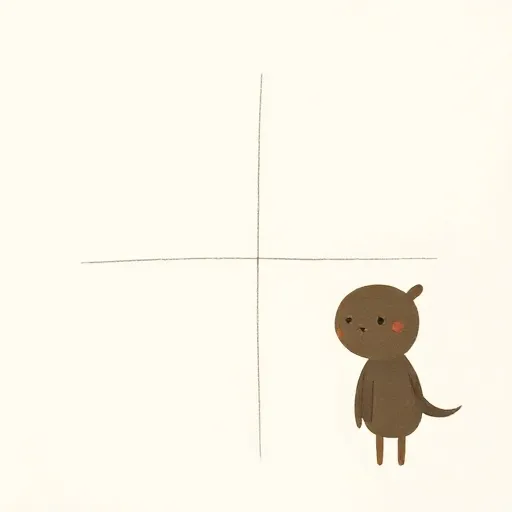
Let us put numbers on the prisoners’ choices. Game theorists call these numbers utility—a measure of how much a player values an outcome. Higher utility means a better result from that player’s point of view.
For our prisoners, going free is best (let us call that 4 points), two years is next best (3 points), five years is worse (2 points), and ten years is worst (0 points). We can arrange their choices in a grid called a payoff matrix, where the first number is Player One’s utility and the second is Player Two’s.
If Player One confesses and Player Two refuses, the numbers are (4, 0)—Player One goes free, Player Two gets ten years. If both confess: (2, 2). If both refuse: (3, 3). If Player One refuses and Player Two confesses: (0, 4).
Now look closely at Player One’s options. If Player Two confesses, confessing gives 2 points while refusing gives 0. If Player Two refuses, confessing gives 4 points while refusing gives 3. Either way, confessing pays better. Game theorists say confessing strictly dominates refusing—it is always the better choice, no matter what the other player does.
Both players, reasoning this way, confess. The outcome (2, 2) is called a Nash equilibrium, named after the mathematician John Nash (1928–2015). A set of strategies is a Nash equilibrium when no single player can improve their payoff by changing only their own strategy, assuming everyone else sticks with theirs.
Notice the bitter irony: if both had refused, they would each get 3 points—better than the 2 they actually get. But that cooperative outcome is not a Nash equilibrium, because each player has a private incentive to break the deal. This is why the Prisoner’s Dilemma is not just a sad story—it is a deep logical problem.
Hobbes, traffic lights, and the war of all against all
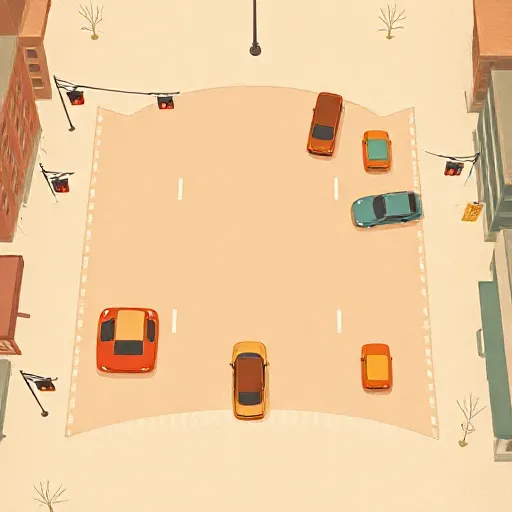
The English philosopher Thomas Hobbes (1588–1679) saw the same deadly logic at work in political life. In his book Leviathan, Hobbes imagined people without any government—a state he called the “war of all against all.” Even if most people want peace, he argued, fear drives them toward conflict. If I worry that you might attack me to take my resources, I have an incentive to strike first. But you, knowing I am thinking this, have the same incentive. Soon we are both armed and dangerous, even though neither of us wanted a fight.
Hobbes’s solution was a powerful government—a “Leviathan”—that could punish anyone who broke promises. With a big enough threat hanging over everyone’s head, cooperation becomes the safer bet. The logic is exactly the one armies use when they threaten to execute deserters: the cost of running now exceeds the cost of staying.
But not every collective trap is a Prisoner’s Dilemma. Some are coordination games—situations where everyone benefits from doing the same thing, and the main challenge is agreeing on which thing to do.
Think about which side of the road to drive on. “Everyone drives on the left” and “everyone drives on the right” are both perfectly good rules—both are Nash equilibria. The problem is picking one and sticking with it. The philosopher David Lewis (1941–2001) showed that language itself works this way. The word “chicken” means chickens and “ostrich” means ostriches, but we could have swapped them and been fine—as long as we all swapped them together.
The economist Thomas Schelling (1921–2016) noticed that in coordination games, people often lock onto focal points—obvious, salient features that everyone expects everyone else to notice. If you and a friend get separated in a big city with no phones, you both head to the most famous landmark at noon. It is not logically required—but it works.
Reputation, revenge, and the power of tomorrow

So far our games have been one-shot—you play once, and then it is over. But real life is full of repeated games, where you face the same people again and again. And that changes everything.
Imagine our two prisoners expect to work together on future crimes. Now confessing today might get you a short-term gain, but it costs you a partner tomorrow. If both players care enough about the future, cooperation can become a Nash equilibrium even in a Prisoner’s Dilemma.
The simplest strategy for sustaining cooperation in repeated games is called Tit-for-tat: start by cooperating, then in every round after that, do whatever your partner did in the previous round. If they cooperated, you cooperate. If they betrayed you, you betray them right back. It is forgiving—one cooperative move resets the relationship—but not a pushover.
Real societies run on this logic. Your reputation is a kind of commitment device. If you get a reputation for cheating, people stop dealing with you. The more you have invested in a good reputation, the more it costs you to throw it away for a single selfish win. This is why tipping at a restaurant you will never visit again can still make sense—it maintains a habit of generosity that others can count on.
The philosopher Thomas Hobbes may have been too pessimistic. Game theory shows that even without a giant enforcer, repeated interaction and concern for reputation can pull people toward cooperation. But it also shows that these solutions are fragile. If people stop caring about the future—or if they can hide their identities—the old traps spring shut again.
Why it still matters
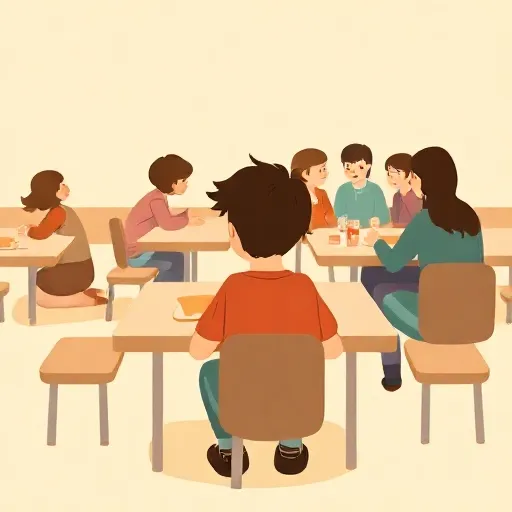
You have probably been in a Prisoner’s Dilemma without knowing it. Have you ever worked on a group project where nobody wanted to do the hard parts, hoping someone else would step up—and then everyone got a bad grade? That is the dilemma in action.
Have you ever watched two friends stop talking to each other, each waiting for the other to apologize first, until the friendship just died? That is a coordination failure—both wanted the same thing, but neither would move.
Game theory does not tell you that people are selfish or that cooperation is hopeless. It shows you the structure of certain traps. And once you see the structure, you can start thinking about how to change it. You can build in repetition. You can invest in your reputation. You can find focal points. You can burn your ships—or help someone else burn theirs—so that the best selfish move and the best cooperative move become the same thing.
This is not just about solving puzzles. It is about designing better classrooms, fairer laws, safer online spaces, and smarter ways to tackle big problems like climate change—where every country would benefit if all countries cut emissions, but each country would prefer that someone else go first. Game theory is the toolkit we use to understand those problems. The rest is up to us.
Think about it
- If you knew for certain that someone would betray you in a Prisoner’s Dilemma, could it ever still make sense to cooperate? What if that person was your best friend?
- Think of a time when you and your friends all did what seemed best individually, but the group ended up worse off. What could have changed the outcome?
- Online, people can hide their identities. How does that change the power of reputation? Can you design a rule or a system that makes cooperation easier in anonymous spaces?