
Can a Sentence Be True and False at Once? Medieval Logic Tricks
A Classroom Trick That Split Truth in Two

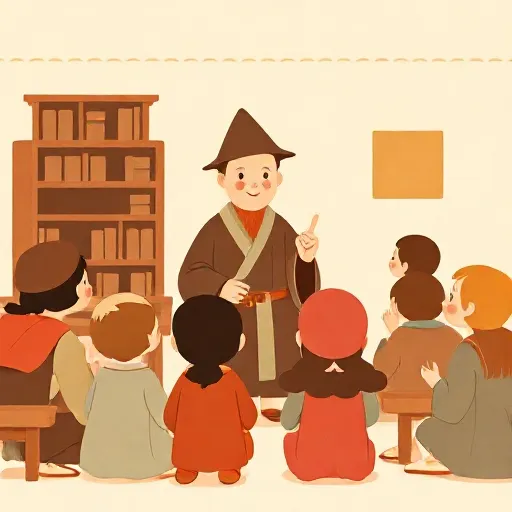
Picture a classroom in Oxford or Paris around the year 1270. The benches are hard. The room smells of candle wax and damp wool. A teacher reads aloud a sentence that sounds completely obvious: “Every man is every man.” You can almost hear the students nodding along. Of course every man is every man—what could be more boring and true?
But then the teacher asks them to prove it, and then to disprove it.
That single sentence launches a battle. One student argues: “This man is this man, that man is that man—so every man is every man.” Another student fires back: “Some man is not every man—Socrates is just one man, not all men. So the sentence is false.” The room splits in two. The sentence now looks both perfectly true and obviously false at the same time.
The teacher finally reveals the trick. The word “every” is equivocal—it can mean two different things. “Every man” can mean “any single man taken one by one,” and it can also mean “all men taken together as a group.” The sentence “Every man is every man” quietly switches between those two meanings from subject to predicate. Once you spot the slide, the puzzle dissolves. Until you spot it, you’re trapped.
This was a sophism—a puzzle sentence designed to look straightforward but hide a logical flaw. And in the thirteenth century, students practiced on a whole book of them, over three hundred strong.
The Medieval Art of the Disputation

The book that held all these puzzles was called the Abstractiones, a Latin title that roughly means “extracts” or “summaries.” It wasn’t a book you read silently by yourself. It was a training manual for the disputatio, the oral debate that sat at the heart of medieval university life.
Here’s how a disputatio worked. The teacher would propose a sophism sentence. Sometimes the sophism came with a casus—a short made-up situation that set the trap. Then students would take sides. The proof side had to construct arguments showing the sentence was true. The disproof side had to construct arguments showing it was false. Only after the clash did the teacher offer the resolution: the identification of the exact fallacy (logical error) that caused the confusion, followed by an explanation of which side’s evidence held up and why.
The first sophism in the book—“Every man is every man”—was one of the easiest. It needed no special casus. The fallacy was equivocation, sliding between two meanings of “every.” Later puzzles added more moving parts: slippery contexts, ambiguous grammar, hidden assumptions about time and existence. The fallacies tracked closely with the list Aristotle had laid out in his De Sophisticis Elenchis (Sophistical Refutations) over fifteen hundred years earlier. Students learned to spot equivocation, accident (confusing a thing with its incidental properties), composition and division (grouping words together one way versus another), and the fallacy of the consequent (running an implication backwards). The list was old; the training was intense and practical.
The author’s name, we know from a colophon (a scribe’s sign-off poem at the end of the manuscripts), was Richard. He was called Magister Abstractionum—the Master of the Abstractiones—and Richardus Sophista. Back then, sophista didn’t mean “someone who uses dishonest arguments.” It simply meant “logician,” a person skilled in reasoning.
More Puzzles: From Iron-Eating to Nonexistent Things

The three hundred-odd sophisms in the Abstractiones range from the mildly puzzling to the deeply brain-tangling. A quick glance at a few of them shows how varied the traps could be.
Some sound like riddles. “You have not ceased to eat iron” (number 187). When would that claim be true? If you never started eating iron, then it’s true you haven’t ceased—but it’s also misleading, because it suggests you once did. The fallacy turns on what’s presupposed versus what’s strictly stated.
Some play with numbers and groups. “All ten except one are nine” (number 215). If you have ten things and take away one, you have nine—that’s arithmetic, not logic, right? But the phrasing “all ten except one” bundles the exception into the subject in a way that can make the counting wobble depending on which one you silently exclude.
Some mess with existence itself. “Whatever exists or does not exist exists” (number 16). At first that sounds absurd—how can a thing that does not exist also exist? The puzzle forces you to ask what the word “exists” is doing. Is it a real property of objects in the world, or just a piece of grammar that lets us build a sentence? These were not idle games. They forced students to investigate the relationship between words, thoughts, and reality—what philosophers today call the boundary between logic and metaphysics.
One of the knottiest problems in the book involved the sentence “Everything other than an animal which plus Socrates are two differs from Socrates” (number 39). You may need to read that twice. Medieval students had to read it, parse it, construct a proof and a disproof, and then face the teacher’s resolution. Doing this daily rewired how a mind handled complexity.
The Mystery of Magister Richard

So who was Richard the Logician? The short answer is: nobody is completely sure.
The two most complete surviving manuscripts of the Abstractiones end with a little verse: “These are complete, which you, Richard the Sophister, flower of virtue and teacher of logic, have produced.” That gives us a first name and immense respect from later scribes—but no last name and no city.
The book was probably written in the 1230s or 1240s. We know this because the earliest references to a Magister Abstractionum appear around the 1270s and 1290s, and the writing style fits the logical culture of those decades. Famous logicians who lived decades later—William of Ockham, Walter Burley, Adam Wodeham—still referred to the Abstractiones and its author. For a textbook to stay in use for over half a century was a genuine achievement.
Scholars have proposed two main candidates. One is Richard Fishacre, a thinker whose dates fit the right quarter of the thirteenth century. The other is Richard Rufus, a philosopher who studied at Oxford. The argument for Rufus rests partly on a similarity between a doctrine attacked by the philosopher Roger Bacon and a distinction that appears in the Abstractiones. The doctrine involves the idea of habitual being (esse habituale): roughly, the notion that words can keep their meaning even when the things they normally point to don’t currently exist. Bacon objected that this invented a kind of shadow-existence for things that weren’t there. If Richard Rufus held that view, and Richard the Sophister’s book uses a similar-sounding distinction, maybe they are the same person.
But the evidence doesn’t quite lock together. The exact phrases used in the Abstractiones differ from the phrases used by Rufus and Bacon. More importantly, the way the Abstractiones uses the “habitual being” distinction closely resembles how another logician, William of Sherwood, used it—and scholars have argued convincingly that Sherwood’s version escaped Bacon’s criticism. So the alleged doctrinal link between Rufus and the Abstractiones weakens under inspection.
For now, the author remains Richard the Sophister: a name, a massive collection of logic puzzles, and a reputation that outlasted him by at least seventy years.
Why 800-Year-Old Logic Tricks Still Matter

You don’t sit on a wooden bench debating Latin sentences in a candlelit hall. But you face equivocations every day.
When an advertisement says “up to 50% off,” the word “up to” does some quiet work. It means some items are half-price; most might not be. When a social-media post says “studies show a link between X and Y,” the word “link” can slide between correlation and cause. When a friend says “everyone’s going,” they might mean “all the people I count as the group that matters.” The same fallacy that hid in “every man is every man” hides in ordinary language right now.
The Abstractiones survived because it gave students a transferable skill: the ability to hear a sentence, pause, and ask what exactly does that mean, and could it mean something else? That skill doesn’t belong to any century. It belongs to anyone who cares about being clear-headed.
Richard the Sophister didn’t create the fallacies he catalogued—most come from Aristotle. His gift was to gather over three hundred of them into a single, portable training ground, and to present them in a way that forced students to argue both sides before settling on an answer. That’s a habit you can use in a lunchroom argument, a science classroom, or even just thinking through a big decision on your own.
The book’s author remains a mystery. But the question his book trained people to ask—“is this really true, or have I just been tricked by the words?”—is as alive as ever.
Think about it
- If someone says “I didn’t lie—I just used a different meaning of the word,” when is that a fair move, and when is it just a sneaky trick? How could you tell the difference?
- Try to invent your own sophism: a sentence that sounds obviously true in one way and obviously false in another. Test it on a friend. What fallacy is doing the work?
- We trust a book of logic puzzles even though we don’t know exactly who wrote it. Does not knowing the author change how much we can trust an idea? Why or why not?