A Monk's Puzzle: How Can the Word 'Man' Mean the Whole Human Race?
The Student’s Puzzle
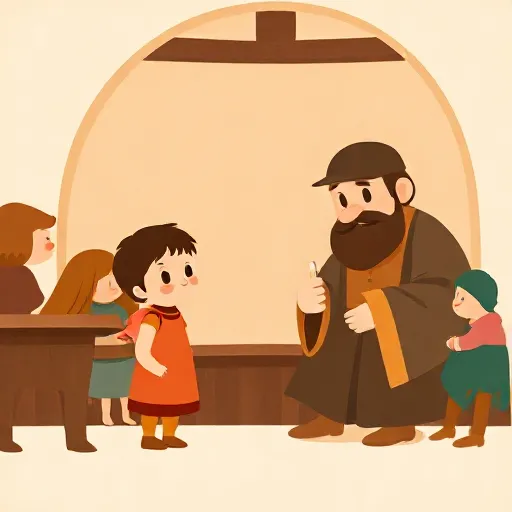
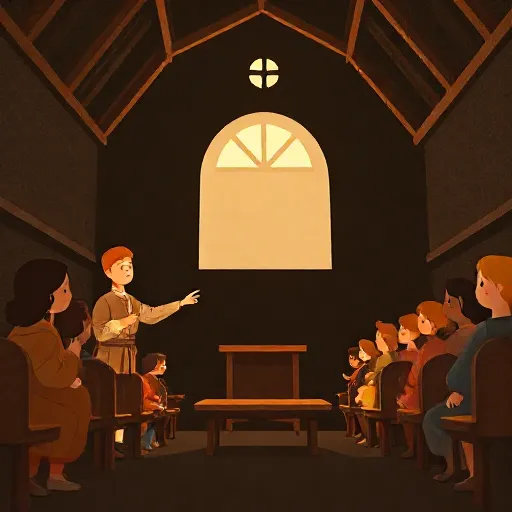
Imagine you are a student in a thirteenth‑century university classroom. Your master writes a sentence on a wax tablet: Man is a species. You know the word man refers to all human beings. But in this sentence, it does not pick out any single person. It seems to refer to the idea of humanity itself. Then the master writes another sentence: A man is running. This time man clearly stands for some actual living person. How can one word do two such different jobs?
That puzzle was at the heart of a textbook that shaped European education for centuries. The book was called the Summulae logicales—a collection of logic lessons—written by a mysterious figure known as Peter of Spain (active in the 1200s). Through thousands of manuscript copies and printed editions, his ideas about words, meaning, and argument reached students from Paris to Prague. And they still matter today, whenever you think carefully about what words really stand for.
The Bestselling Mystery Author
Who exactly was Peter of Spain? Scholars are not sure. Some evidence points to a Portuguese doctor who became Pope John XXI. Other evidence says he was a Spanish Dominican friar named Petrus Ferrandi, who died in the 1250s. Another tradition says the Summulae was compiled by a Black Friar nearer to 1300. Modern research leans toward a Dominican, but the case is not closed. We do not even know exactly when the textbook first appeared—best guesses fall between the 1220s and the 1250s.
What we do know is that the Summulae logicales became a blockbuster. It was the standard logic manual in European universities well into the 1600s. Later thinkers like John Buridan used an expanded version as a core teaching text. Alongside it, Peter wrote a second work, the Syncategoreumata—a study of special words that do not name things but shape how sentences work. Almost certainly the same author wrote both books, because they always traveled together in medieval manuscripts and share the same doctrinal outlook.
Logic Boot Camp: Syllogisms and Topics

Peter’s textbook has two big parts. The first part covers what medieval teachers called the old logic and the new logic—the core of Aristotle’s and Boethius’s teachings. It starts with basic ideas: what a noun is, what a verb is, how a proposition works, and how propositions relate to one another. Then it marches through the five predicables (genus, species, difference, property, and accident), the ten categories of Aristotle, and the art of the syllogism.
A syllogism is a three‑step argument, like this: All humans are mortal. Socrates is a human. Therefore Socrates is mortal. Peter explains mood and figure—the rules that make some syllogisms valid and others not—and how to spot paralogisms, which are arguments that seem good but go wrong. The first part ends with a long discussion of topical relationships, which are ways to build arguments based on patterns such as “from definition” or “from opposites.” For example: A rational animal is running; therefore a man is running.
The Secret Life of Words: How Supposition Works
The second part of the Summulae breaks genuinely new ground. It tackles what Peter calls properties of terms—the ways words behave in different contexts. The most important of these is supposition. To understand it, you first need to know about signification.
For Peter, signification is “the respresentation of a thing by means of a word in accordance with convention.” It is the basic dictionary meaning a word carries, tied to the universal nature it was originally imposed to name. A word can have more than one signification if it was applied to two distinct universal natures. Supposition, by contrast, is the acceptance of a substantive term for some thing. Signification belongs to a word on its own; supposition happens only when the word is actually used in a sentence. So supposition depends on signification—you cannot stand for something with a word that has no meaning—but it adds a concrete job.
Peter divides supposition in a branching tree. First, there is discrete supposition, when a proper name like “Socrates” stands for exactly one individual, and common supposition, when a general term like “man” stands for many. Common supposition then splits into natural and accidental. Natural supposition is the capacity of a term taken by itself to stand for all individuals—past, present, and future—that share in the universal nature it signifies. The word “man,” considered apart from any particular context, naturally reaches to every human who ever lived or ever will. Accidental supposition arises when a term gets paired with something else that limits its reach. Add a present‑tense verb—A man is—and “man” stands only for currently existing men. Use a past‑tense verb—A man has been—and it shifts to past men.
Accidental supposition divides further into simple supposition and personal supposition. Simple supposition occurs when the term stands for the universal nature itself: Man is a species or Every man is an animal. In both sentences, “man” refers to the shared humanity, not to particular people. Personal supposition occurs when the term stands for one or more of its particular individuals: A man is running.
Personal supposition then splits into determinate and confused. Determinate supposition picks out a certain individual in an indefinite or particular way—A man is running or Some man is running. Confused supposition happens when a term is paired with a universal sign like “every”: Every man is running sweeps over all men at once.
This framework is powerful, but it also contains a tension. Signification already seems to cover the universal nature and all its individuals. So what exactly does natural supposition add? Interpreters say that signification is the permanent, built‑in capacity of a word to represent things, while natural supposition makes that capacity explicit when we look at the term “by itself.” Later thinkers, like William of Ockham (c.1287–1347), would reject Peter’s simple supposition entirely, arguing that in Man is a species the word “man” actually stands for a mental concept, not a mysterious universal thing. The debate has never really stopped.
Peter also tackles surprising boundary cases. The rule of thumb was that the universal sign omnis (“all” or “every”) required at least three appellata—three particular things to refer to. But what about the phoenix, a mythical bird that was thought to be unique? Peter argues that omnis phoenix est (“Every phoenix is”) is still acceptable: the rule has an exception when there is only one thing. This attention to real usage kept his logic grounded.
The Words That Play Tricks: Syncategoremata

Peter’s Syncategoreumata focuses on a special class of words that do not have a definite meaning by themselves but act like logical glue. The ancient grammarian Priscian called them syncategoremata—words that “consignify” or help other words do their work. The list includes only, alone, except, unless, if, begins, ceases, necessarily, contingently, and, or, and several more.
Peter begins with the words est (“is”) and non (“not”), because he thinks they are implicitly present in all the others. His discussion of “is” goes deep into the idea of composition. When you say S is P, the verb “is” composes a quality with a substance, joining two parts into a unified thought. Peter asks: does this composition count as something that “is” in reality? His answer is subtle. If we talk about the composition in general—the mental act of joining subject and predicate—it can apply to both beings and non‑beings. We can truthfully say A chimera is a non‑being, even though a chimera does not exist. So the composition involved is a “being in a certain sense” (ens quodammodo), not a full‑blown being. That distinction lets us talk sensibly about impossible things without treating them as real.
Negation, for Peter, removes the composition. When we say Socrates is not white, the word “not” does not destroy a thing in the world; it removes the affirmation that goes with the composition. The same state of affairs—a non‑white Socrates—is present to the mind whether we affirm or deny it. The difference lies only in our mental act.
The chapter on exclusive words like only and alone works out exactly what gets excluded. Peter says an exclusion involves four elements: what is excluded, what it is excluded from, the respect in which it is excluded, and the act of exclusion itself. Adding an exclusive term to a word under the category of Substance excludes other substances, but what about accidents? The book carefully sorts through such puzzles.
Modal terms like necessarily lead Peter into territory where logic meets reality. He maintains that the expression A man is necessarily an animal is true even if no men exist, because “necessarily” expands the subject to cover all possible times. Some earlier logicians had disagreed, saying the proposition required actual men. Peter sides with the realist view: logical necessity rests on the necessary relationships among the things themselves. The proposition Homo necessario est animal is about the way reality is permanently structured, not about a temporary population count.
His treatment of “if” is similarly tied to the world. For Peter, si (“if”) signifies causality by way of antecedence. An “if‑then” statement reports that the antecedent somehow brings about the consequent. This raises a famous problem: does anything follow from an impossible antecedent? Peter draws a distinction. If the impossibility is something like A man is an ass—a combination of real concepts that clash—something genuine can still follow, for instance Therefore a man is an animal. But if the antecedent is a pure impossibility, such as You know that you are a stone, nothing follows at all. The link hinges on whether there is any “something” (a res) to serve as the foundation of the inference.
Why Word Puzzles Still Matter

You probably do not spend your afternoons drawing trees of supposition. Yet Peter of Spain’s questions are everywhere in your own life. When you say “Justice is important,” the word justice works like a simple supposition—it stands for an abstract concept, not a thing you can touch. When you promise “If I finish my homework, I’ll watch the movie,” you are using a conditional that echoes Peter’s analysis of causality and consequence. If there is a loophole in your promise—what if the internet goes down?—you are wrestling with the same kind of exception‑handling that medieval logicians did when they debated omnis and the phoenix.
Modern philosophers of language still argue about the very issues Peter raised. How does a word hook onto the world? Does “every” really require a certain number of things? When we talk about fictional beings, are we committing to some shadowy kind of existence? The medieval vocabulary has changed, but the puzzles are remarkably stable.
Peter of Spain’s real gift was to teach students that words are not simple labels. They carry meanings that shift in the light of context, and those shifts can make an argument soar or crash. Next time you find yourself in a disagreement over what a word really means, you are following in the footsteps of a thirteenth‑century classroom, where a master pressed a wax tablet and asked: What does “man” stand for?
Think about it
- If you say “Dragons breathe fire,” does the word “dragon” refer to something real? How is that different from saying “Horses breathe air”?
- The word “every” seems clear, but it can cause confusion. Can you think of an everyday sentence that uses “every” and might be true in one way but misleading in another?
- Suppose a friend says “If I study, then I’ll pass the test.” Do you think they mean that studying will cause them to pass, or only that it is impossible to study and still fail? How would you talk about the difference?