What Makes ‘Socrates’ Point to One Man? A Medieval Name Puzzle
Socrates is Dead — Does His Name Still Work?
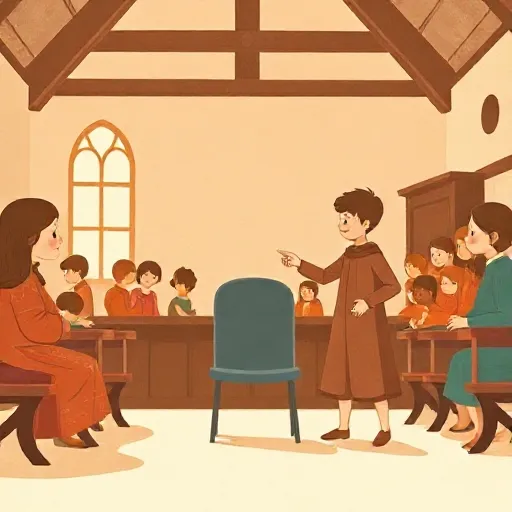
Paris, around the year 1250. In a crowded lecture hall, a young scholar rises and asks a question that makes the room fall silent: “Master, if I say ‘Socrates is running,’ but Socrates died yesterday — is my statement true or false?” The teacher hesitates. How can a name pick out someone who no longer exists?
At the heart of the puzzle is a singular term: a word or phrase that refers to exactly one thing. Proper names like “Socrates,” demonstratives like “this man,” and pronouns like “I” are all singular terms. They seem to hook directly onto a single individual. But what happens when that individual disappears, or when the same name is used for two different people, or when the object pointed to isn’t what you think it is? For several centuries, medieval logicians wrestled with these questions — and along the way they built some of the most surprising ideas about language ever put on parchment.
The problem felt especially urgent because of an older idea inherited from ancient grammar. In the sixth century, the grammarian Priscian (fl. 500) had taught that every proper name carries a hidden load of qualities.
The Grammarian’s Secret: Names Carry Hidden Qualities

According to Priscian, a proper name like “Socrates” does two things at once: it names an individual substance and it signifies a proper quality — a unique bundle of properties that belong only to that person. Think of it as the name secretly carrying an invisible backpack stuffed with features: being the son of Sophroniscus, having a snub nose, being a philosopher, walking around Athens. If you could see the backpack, you would know exactly which individual was meant.
That sounds tidy. But the backpack idea created a huge problem. If the bundle includes little things like exists right now, then when Socrates dies the backpack loses a piece — and maybe the name stops working. Some logicians, like Boethius of Dacia (13th century), solved this by saying that a name’s signification depends on a person’s understanding, not on the real existence of the thing. Even so, many thinkers worried that proper names were too fragile: they seemed to change their meaning moment by moment.
Worse, what about the name “Caesar”? In logical puzzles known as sophismata, masters discussed propositions like “Caesar is a man” long after the Roman general was dead. Was the sentence still true? If the name lost its grip on reality, maybe all talk about the past would be nonsense.
Priscian also noticed something else: a pronoun like “this” (when you point at someone) doesn’t carry a quality-backpack at all — it simply points, bare and direct. Medieval grammarians and logicians began to wonder: are proper names more like hidden descriptions, or are they really just glorified pointings?
Abelard’s Rebellion: ‘Socrates’ Doesn’t Describe, It Points
A sharp answer came from Peter Abelard (1079–1142), the fiery logician who was never afraid to pick a fight. Abelard hated the bundle-of-accidents view, and he said it made no sense. If the proper name “Socrates” really signified all those accidental properties, then the name would be an accidental term, not a substance term. That would wreck the most basic logical relations: the proposition “Socrates is a man” is supposed to be an essential, necessary truth — like saying “this human is a human.” But if the name’s meaning were built from a loose pile of changeable accidents, the sentence would be as wobbly as “this snub-nosed philosopher is a man” — still true perhaps, but not describing what Socrates is at his core.
So Abelard made a bold move. He argued that the proper name “Socrates” means exactly the same thing as the phrase “this man” — not “this white, bald, bearded man,” but simply a human being grasped as a distinct individual. The name picks out Socrates directly, not by describing him.
To explain this, Abelard drew a sharp distinction between naming and signifying. A proper name names the individual substance; it points to Socrates. But it also signifies — it carries along the meaning of the species “man.” Abelard never said the name signifies a bundle of accidents. Instead, the individual is distinct simply by being himself, not by carrying a unique collection of properties. In Abelard’s words (paraphrased), the individual “consists simply in personal distinction.”
The result was a proper name that could refer directly, without being loaded down by temporary traits, yet still could anchor essential truths like “Socrates is a man.” It was a delicate balancing act that set the terms for centuries of debate.
Buridan’s Game-Changer: Vague Individuals and Name-Chains
By the fourteenth century, the puzzle was ready for a fresh overhaul. John Buridan (c. 1300–1361), teaching in Paris, offered the most complete account of singular terms that the Middle Ages would ever see.
Buridan started by asking what happens when you point to someone and say “this man.” You aren’t mentally listing all her accidents. Rather, you form what he called a vague individual concept: an intellectual grasp of this human being right here, seen face-to-face. Buridan called such direct awareness an in prospectu cognition — the kind of knowledge you have when the object stands before your mind’s eye. This concept is singular and robust, but it isn’t a sack of descriptions; it’s a confused, rich, single idea of the person.
For Buridan, “this man” used properly is the most perfect singular term — but only when the person is actually present. If you point at a stone and say “this man,” the statement is false; if you point at nothing, the sentence has no truth-value at all. And each time you use “this man” for a different individual, the expression becomes equivocal — it means something different every time, because the demonstrative act fixes the reference.
What about proper names? Buridan thought they could be even more singular than “this man,” because they work over time. Yet he spotted a big problem: most of the proper names we actually use aren’t singular at all — they’re disguised descriptions. If you have never met Aristotle, your concept of him is built from general pieces like “philosopher,” “student of Plato,” “born in Greece.” That descriptive concept could in theory fit more than one person; it just happens to fit only one. So for most speakers, “Aristotle” is not a genuine singular term.
But Buridan offered a way out — an idea that modern philosophers would later call a causal theory of names. He noticed that a proper name might still work singularly if you “borrow” the reference from someone else. Suppose you overhear a name from a person who did have direct, in prospectu cognition of the original bearer. The name carries a chain from that original moment of naming — a baptism, we might say — down to your own use. Later thinkers like the logician John Dorp (14th century) agreed: “Aristotle” is singular because it was singular for the original impositor. This was an early hint of the historical chain theory that the philosopher Saul Kripke would develop in the twentieth century.
Buridan also tackled identity through time. He argued that Socrates remains the very same individual over the years because of his rational soul, so the name “Socrates” keeps picking out one thing. By contrast, a river like the Seine changes its water and shape so constantly that the name is less properly singular — it doesn’t track the same individual in the same strict way. Even proper names, then, come in degrees of singularity.
Why This Matters: The Magic of Words
Think about your own name. You’ve had it since you were a baby, but everything about you has changed. Yet the name still grabs you — not a baby, not a stranger. How does that work? Medieval logicians didn’t have brain scanners or modern linguistics, but they dug into exactly this kind of mystery with a rigor that still echoes today.
When you talk about Cleopatra or Julius Caesar, you’re reaching across centuries with a mere handful of sounds. The word “Caesar” feels as though it must point to that one man — but medieval masters saw that it might instead float on a sea of general ideas, or it might rely on a hidden chain of speakers stretching all the way back to the Roman forum. Even the simple act of pointing your finger and saying “this” turns out to be full of philosophical traps.
The puzzles that kept those Parisian classrooms buzzing — empty names, identities that shift over time, the difference between a label and a description — are still alive. Every time you argue about whether a fictional character like Sherlock Holmes “exists” in some sense, or wonder how a nickname sticks, you walk right into territory that Abelard and Buridan mapped out. Their medieval toolbox of naming, signifying, vague individuals, and borrowed chains gave us some of our first truly deep maps of how language latches onto the world.
Think about it
- If your best friend changed their name but stayed the same person, would their old name still refer to them? Could it refer to nobody at all?
- You point at a photo of your grandmother and say, “This is my grandma.” Does the word “this” still work even though she’s not in the room?
- Can a nickname invented by a computer program ever be a genuine proper name, or does a name need a human story behind it?