Can a Pen Fight a Kingdom? Voltaire’s War for Reason
A Duel, a Prison, and a New Name
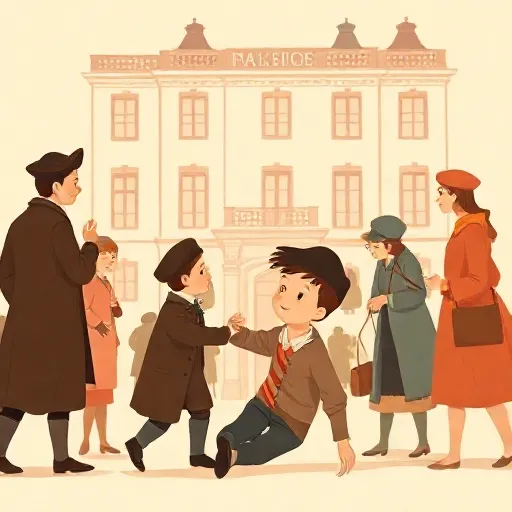
In 1726, a sharp-tongued writer named François-Marie Arouet had a furious quarrel with a powerful French duke. The duke’s servants ambushed him in the street and beat him. When Arouet tried to seek justice, he discovered that a commoner with no noble title meant nothing to the courts. To avoid prison, he agreed to leave France. He boarded a ship for England, not yet knowing that this exile would change his life—and, eventually, the history of philosophy.
François-Marie was born in 1694 to a comfortable Parisian family. His father wanted him to be a lawyer; he wanted to write plays. Even as a teenager he was known for his wit, his sharp tongue, and his ability to charm aristocrats. But his pen kept getting him into trouble. After an earlier stay in the Bastille prison for mocking the government, he adopted a new name: Voltaire. No one is sure why he chose it, but it stuck. When he sailed for England, he was still more a clever poet than a philosopher. That was about to change.
An English Crash Course in Freedom
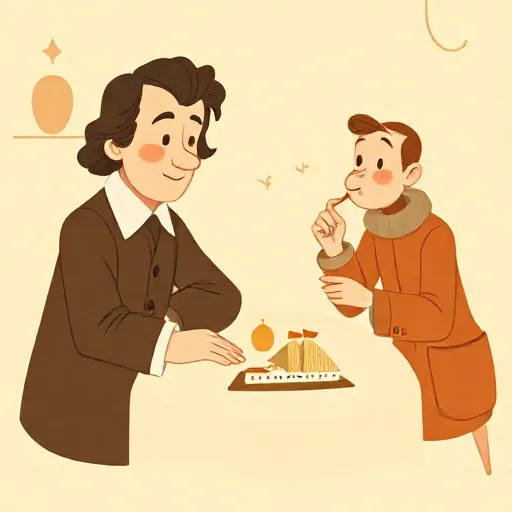
England in 1726 was buzzing with ideas that would have been dangerous to speak aloud in France. In London coffeehouses, merchants, poets, and scientists argued about religion, politics, and the cosmos. Voltaire dove into this world. He visited the estate of the English aristocrat Lord Bolingbroke, who introduced him to writers like Jonathan Swift (1667–1745) and Alexander Pope (1688–1744). They showed him how stories and satire could be weapons for political criticism.
But the biggest shock came from science. Voltaire met followers of Isaac Newton (1643–1727) and absorbed Newtonian philosophy. Newton had described the universe with precise mathematics, showing that gravity worked the same on an apple falling from a tree as on the moon. Newton refused to guess about invisible hidden causes. He stuck to what could be observed and measured. Voltaire also studied the ideas of John Locke (1632–1704), who argued that all our knowledge comes from experience, not from ideas we are born with. Both thinkers practiced empiricism: the view that we should base knowledge on observable facts, not on grand theories spun from pure reason.
Voltaire took notes on everything. He wrote letters about English religious toleration, where different Christian groups lived side by side. He admired the free press and a political journal called The Craftsman that openly criticized the government. When he returned to France in 1729, he was no longer just a poet. He was a man with a mission: to import this English way of thinking and shake France awake.
Burning a Book, Starting a War
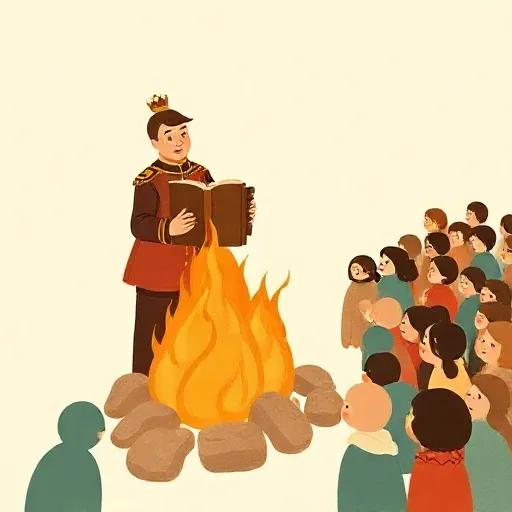
Back in France, Voltaire turned his English letters into a book. He called it the Philosophical Letters (Lettres philosophiques). It praised England’s science, its religious freedom, and its politics—while slyly mocking France for being backward. The book was published in 1734 without royal permission. The French authorities were furious. The royal hangman burned it in the street, and a warrant was issued for Voltaire’s arrest.
He fled to Cirey, the countryside estate of a remarkable woman: Émilie du Châtelet (1706–1749). She was a mathematician and physicist who would later produce the only complete French translation of Newton’s Principia. Together, the couple turned Cirey into a fortress for a new war of ideas. Their enemy was the old French scientific establishment that clung to the ideas of René Descartes (1596–1650).
Descartes had imagined the universe as a giant whirlpool of invisible matter pushing the planets around. Cartesianism insisted that physics must explain why things move by describing invisible causes. Newtonians, by contrast, said: just describe how things move with mathematics, and admit that the hidden causes are still a mystery. Voltaire and du Châtelet waged a campaign of books, reviews, and pamphlets. Voltaire’s Elements of Newton’s Philosophy (1738) became a bestseller designed to teach French readers to think like Newtonians. For nearly a decade they battled the old guard. And by the 1740s, they were winning. The Cartesian universe was fading, and a new, empirical cosmos was taking its place. Voltaire had made himself a hero of Enlightenment science—not just with arguments, but with relentless public campaigning.
Crush the Infamy! The Philosopher as Activist
After du Châtelet’s death in 1749, Voltaire accepted an invitation to the court of Frederick the Great of Prussia. But he quickly fell out with a rival, and a satirical pamphlet mocking a fellow scientist enraged the king. Once again, Voltaire was exiled. This time, he did not seek forgiveness. He bought a chateau at Ferney, on the border between France and Switzerland, and from there he launched the most famous phase of his life: the philosopher as activist.
He called himself a member of the “party of humanity.” His motto was Écrasez l’infâme—“Crush the infamy!” By “infamy” he meant fanaticism, superstition, and the abuse of power by churches and unjust governments. He poured his energy into real-world causes. When authorities tried to suppress the Encyclopédie, a massive dictionary of knowledge edited by Denis Diderot (1713–1784) and Jean le Rond d’Alembert (1717–1783), Voltaire wrote dozens of articles for it and fought for its survival. He saw it as a weapon against ignorance.
Then came the Calas affair. Jean Calas, a Protestant merchant in Catholic France, was tortured and executed in 1762 for allegedly murdering his son, who had converted to Catholicism. Voltaire believed Calas was innocent, a victim of religious hatred. He spent years investigating, publishing pamphlets, and rallying public opinion. Eventually, the king’s council overturned the conviction and cleared Calas’s name. It was a triumph of reason over blind prejudice.
Voltaire didn’t just think philosophy; he did it. He defended liberty, especially the freedom to speak and publish, as sacred. He believed that pleasure and luxury were not vices but natural goods—a hedonistic ethics that rejected old Christian suspicions of worldly joy. And he practiced skepticism: the view that we should question everything, especially claims made by powerful institutions. For Voltaire, the true philosopher was not the one who built the most elegant system, but the one who dared to admit ignorance and fought to keep others from being crushed by dogmatic certainty.
What Voltaire Actually Believed
Despite all his campaigns, Voltaire did have a philosophical toolkit. He never wrote a big, systematic treatise, but scattered throughout his essays, letters, and dictionary articles a set of ideas shines through.
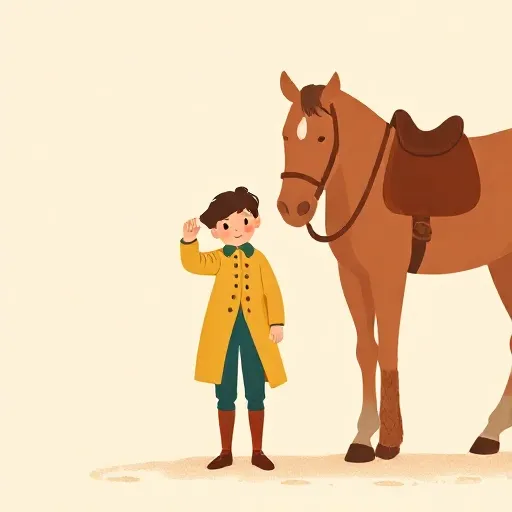
First, on human choice. Voltaire leaned toward determinism: the view that every event, including your own decisions, is caused by previous events. He asked you to imagine someone offering you a horse to ride. You want to mount it because an agreeable idea pops into your head. You cannot resist that idea unless a stronger idea—like fear of falling—pushes back. Your will is not free in the sense of being uncaused. But you can be free if you have the power to act on your wish. For Voltaire, liberty meant “to be able.” You are blameworthy not because your will is magically free, but because your mind can be trained, through moral education, to produce better motivations. If a criminal sees his accomplice suffer and feels horror, he will stop robbing. Human conduct is determined, but we can reshape the causes that determine it.
Second, on hedonism: Voltaire thought the pursuit of pleasure and the avoidance of pain is the natural basis of morality. He wrote poems celebrating good food, love, and luxury, arguing that prosperity and commerce make society better. Third, his skepticism was practical. He admired ancient skeptics who questioned everything and the French essayist Michel de Montaigne. Voltaire didn’t think doubt should paralyze you; it should protect you from pompous certainties. When a philosopher like Gottfried Wilhelm Leibniz (1646–1716) claimed that this is the best of all possible worlds, Voltaire laughed. In his novel Candide he mercilessly satirized that idea by showing a traveler who endures one disaster after another while naively repeating that it’s all for the best. His point: stop inventing comforting stories and look at the facts.
Finally, his greatest debt was to Newtonian empiricism. Voltaire fought to keep metaphysics out of science. He argued that good scientists simply describe what can be observed and measured, and resist the urge to invent hidden causes. Gravity is a fact; why it works is a mystery we can’t yet solve. Pretending we know, he said, only produces “philosophical romances.” That insistence on sticking to empirical evidence became a core value of modern science.
Why Voltaire’s Fight Still Matters

Voltaire died in 1778, a few months after returning to Paris and being cheered as a hero. He was 84. Eleven years later, the French Revolution broke out, and revolutionaries reburied his remains in the Panthéon, saying that he taught them to be free. He hadn’t started the Revolution, but his life had shown that ordinary people could challenge kings and bishops with nothing but pen and reason.
Today, the questions he raised are still alive. Should a society ban hateful speech, or does that endanger free thought? Can we trust authorities if they don’t show us the evidence? Does a thinking person have a responsibility to speak out against injustice, not just to think about it quietly? Voltaire never said the famous line often attached to him—“I disapprove of what you say, but I will defend to the death your right to say it”—but he lived it. He risked his freedom to defend the right of others to publish and argue. In a world where social media can amplify both truth and falsehood, his example reminds us that thinking for yourself, checking the facts, and having the courage to disagree civilly are not old-fashioned ideals. They are the tools we still need to keep the infamy at bay.
Think about it
- Voltaire believed philosophers should use reason to change the world, not just to understand it. Do you think a philosopher has a duty to be an activist, or is it okay just to think and write in private?
- If every one of your choices is caused by something (your brain, your past, your environment), but you still feel like you’re choosing freely, should people be held morally responsible for their actions?
- Voltaire defended the right to publish ideas he strongly disagreed with. Would you defend someone’s right to say something you find deeply offensive? Where, if anywhere, would you draw the line?