The Logic Trap That Made a Famous Philosopher Admit Defeat
A Hilltop School and a Furious Rivalry

In 1136 a young Englishman named John of Salisbury (c. 1115–1180) walked into Paris, a city buzzing with students and teachers. He was looking for the sharpest minds, and he soon found them on a hill called Mont Sainte‑Geneviève. There, in crowded rented halls, master philosophers competed furiously for followers. The most famous was Peter Abelard (1079–1142), a brilliant thinker who had built a whole school around the idea that logic was about words — names, terms, and the way we use them. But John also found another master, Alberic of Paris (active 1130s–1150s), who stood out as Abelard’s “bitter opponent,” a man who insisted logic had to be about things. Their feud was not just a personality clash. It was a fight over the foundations of reasoning itself, and Alberic had discovered an argument so clever that it forced Abelard to admit his whole system was in trouble.
Peter Abelard was a nominalist. He believed that only individual things exist — this cat, that rock — and that words like “cat” or “animal” are just handy labels we invent. For Abelard, a true statement like “Socrates is a human” was strictly a connection between the term “Socrates” and the term “human.” Alberic thought this was backwards. He was a realist. He argued that the word “animal” picks out a real feature that exists in every animal, and that true predication happens when one real thing is genuinely in another. The consequences of this disagreement were enormous. Alberic set out to prove that Abelard’s word‑centered logic, if followed carefully, produced conclusions that even Abelard himself had to call absurd.
The Impossible Conclusion That Made Abelard Blush

Alberic’s trap was an argument so simple it looked harmless. Imagine Socrates, a flesh‑and‑blood man. Abelard accepted that the statement “If Socrates is a man, then Socrates is an animal” is true. Why? Because being an animal is contained in the very definition of being a man — you cannot be a man without already being an animal. Abelard called this a relevant conditional: the antecedent (the “if” part) truly requires the consequent to be true. He also accepted a basic rule of reasoning: if a conditional is true, you can contrapose it, turning “If A then B” into “If not‑B then not‑A.” So “If Socrates is a man, then Socrates is an animal” gives us “If Socrates is not an animal, then Socrates is not a man.”
Now Alberic took these innocent steps and built a chain. Start with: “If Socrates is a man and not an animal, then Socrates is not an animal.” That is just simplification — you can drop one part of a compound. Combine it with the contraposed conditional. Then add a few more moves that Abelard’s own rules require (transitivity and contraposition again), and you end up with something shocking: “If Socrates is a man and not an animal, then it is not the case that Socrates is a man and not an animal.” In logical form, you have a conditional that says: If (p and not‑q) then not‑(p and not‑q). Abelard himself, following ancient traditions, held that no proposition could entail its own opposite — a statement of the form “If X then not‑X” must be false. Yet here was that very form, derived from true premises and accepted rules. The argument was not just tricky; it threatened to make Abelard’s whole logic inconsistent.
According to the anonymous student text that records the debate, Abelard was “compelled to grant its necessity.” He had no escape. The relevant‑conditional approach he had designed to avoid earlier embarrassments had been used against him. Alberic’s clever trap became known as the Embarrassing Argument, and it sparked a crisis that would ripple through the schools for generations.
Alberic’s Secret: Logic Is About Real Things, Not Just Words

Why didn’t the crisis bother Alberic? Because he never accepted the premise that made the trap work. Alberic’s logic was built on thing‑predication (in Latin, praedicatio rerum). When you say “Socrates is a man,” you are not just linking two words. You are claiming that the thing “man” is actually present in Socrates — that his being a man is part of reality. A statement is only genuinely predicated, and therefore a proper subject for logic, if it is true and affirmative. Lies and negations simply fail to express the right kind of connection.
In the Embarrassing Argument, the second premise starts with “Socrates is a man and is not an animal.” But “Socrates is not an animal” is false — and worse, it is a negative statement. According to Alberic, it does not express any real predication at all. There is an incompatibility, a repugnance, between being a man and lacking animality. Because no real connection exists between the thing Socrates and the thing not‑animal, the conditional cannot get off the ground. The argument collapses before it even begins.
Alberic’s approach meant that logic had to be anchored in the way the world actually is. You could not just shuffle words according to tidy rules and expect truth to follow; you had to look at the things themselves. This realist commitment gave the Albricani — Alberic’s followers — a powerful defense against paradoxes.
The Phoenix Problem: Are Universals Real Even if Only One Exists?
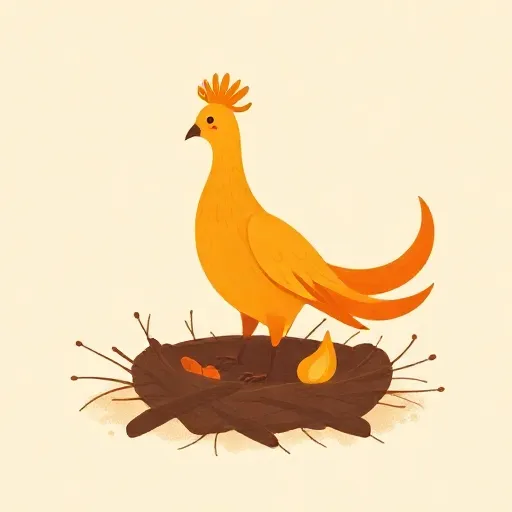
Abelard’s nominalism meant that a universal term like “human” had to be predicated of many actual individuals to count as a universal. If only Socrates existed, “human” would not be a universal at all. Alberic disagreed sharply. For him, a universal is a real thing — an animality that exists fully in each individual animal — and it does not lose its universal status just because the world happens to contain only one instance. The Albricani loved to use the phoenix as their example. The mythical bird was believed to be unique: only one phoenix existed at any given time. Yet, they argued, the statement “Every phoenix is an animal” is true and necessary, because the very nature of being a phoenix includes being an animal. Universality depends on what a thing is, not on how many copies happen to be walking around.
One Albrican text even explained that “the whole being of Animal is in each animal” — meaning that the complete set of properties that make something an animal (having a body, having life, having sense‑perception) belongs to every individual animal. This did not mean, they insisted, that there was some ghostly extra thing called “Animal” floating inside each creature. It meant that what it is to be an animal is fully present in each one. This theory of maneries (sorts of things) tried to walk a middle path: universals are real, but they exist only in ordinary individuals, not in a separate Platonic heaven. John of Salisbury made fun of the strange new word, but the idea that logic needed real kinds was central to Alberic’s school.
Time, Change, and an Infinite Hotel

Alberic’s realism even shaped how he understood time and God. Abelard, a strict presentist, believed that only the present instant really exists. The past is gone and the future is not yet. So a whole day, made of 24 hours that never exist all at once, seemed to him like a fiction — words we use, but not a real thing. Alberic countered by distinguishing two kinds of wholes. A permanent whole, like a statue, has all its parts at once. A successive whole, like a day or a running race, has parts that exist one after another. Successive wholes don’t obey the rule that a missing part destroys the whole. The present day exists even though most of its hours are in the past or the future.
This idea helped Alberic’s school tackle a famously knotty puzzle: divine foreknowledge. If God knows everything, does that force the future to be fixed, destroying free choice? Alberic’s answer was radical — God’s knowledge itself changes as the world unfolds. When you decide to stand up, God’s knowledge that you were sitting is replaced by knowledge that you are standing. But this does not mean God changes in God’s own being. One Albrican text explained it with an analogy that sounds remarkably like a modern thought experiment: an infinite hotel. Imagine a hotel with an infinite number of rooms, all full. A new guest arrives. You simply ask every guest to move one room down, and room 1 opens up. The total number of rooms hasn’t grown. In the same way, new items can be added to God’s infinite knowledge forever without the overall “quantity” of knowledge becoming bigger or smaller. God learns, but God remains infinite. It was a clever medieval version of today’s Hilbert’s Hotel, centuries before Hilbert.
Why Words and Things Still Clash in Your Head

Alberic’s battle with Abelard was not just a dusty dispute. It forced later logicians to choose: should logical consequence be about meaning connections (relevance) or about never letting truth turn into falsehood (truth‑preservation)? The Parisian tradition that grew from this crisis eventually produced the purely truth‑functional logic that much of modern computing relies on. Meanwhile, the British tradition kept insisting that the “if” part of a conditional ought to really connect to the “then” part.
You face a version of their problem every time you think about fictional sentences. When you say “Harry Potter is a wizard,” are you making a true statement? An Alberic‑style answer might say no, because there is no real thing wizardly in a real Harry Potter. An Abelard‑style answer might say it depends on what the words describe in a story. The question of whether truth is about words or about mind‑independent reality remains alive in philosophy of language today.
Alberic’s embarrasing argument showed that even tiny logical moves can have enormous consequences. It also revealed that deciding what logic is actually about — the world or our talk about it — can save you from a trap or make you fall straight into one.
Think about it
- If a logically perfect computer proves that “If a square circle exists, then a square circle does not exist” is a true statement, would you trust the computer or your own feeling that something has gone wrong? Why?
- Suppose you say “Unicorns are gentle.” Is that sentence true, false, or something else? Does it matter whether you are talking about made‑up creatures while you say it?
- Can a whole day exist even if no single moment of it lasts longer than a blink? What makes a “day” real — the fact that we call it a day, or something about the way time flows?