Are You a ‘Self’ or Just a Line of Ants? Vasubandhu’s Radical Idea
The Monk Who Questioned Everything
In the 4th century C.E., a Buddhist scholar named Vasubandhu (4th century) traveled from his home in Gandhāra to Kashmir. He wanted to master the philosophy of the Vaibhāṣika school, the most powerful Buddhist thinkers of the time. The Vaibhāṣikas guarded their teachings so carefully that students had to swear not to share them. Vasubandhu learned everything they could teach — and then did the unthinkable. He went home and started giving public lectures, inviting anyone to debate him at the end of each day.
His teachers were furious. But when they saw the verses he had written summarizing their system — the famous Treasury of the Abhidharma — they were thrilled. That pleasure lasted only until Vasubandhu published his own commentary on those verses, which tore apart many of the Vaibhāṣika ideas from a different Buddhist perspective. Fury returned.
Later in life, Vasubandhu went through another dramatic change. According to traditional stories, his elder half-brother Asaṅga, a quiet meditator who claimed to have received teachings from the future Buddha, eventually convinced him to adopt a new school of thought called Yogācāra. In that system, Vasubandhu would defend a startling claim: the entire world you experience is appearance-only — produced by your mind, like a dream with no dreamer. Some modern scholars doubt this conversion story and even wonder whether one person wrote all the texts attributed to Vasubandhu. But the ideas those texts contain remain electrifying, especially his argument that there is no self.
Is There a ‘You’ Behind Your Eyes?

Buddhists had long taught that a person is made up of five aggregates — constantly changing collections of physical stuff, feelings, ideas, dispositions, and consciousness. There is no permanent soul. But some Buddhists, the Personalists, said there is still a real “person” who depends on those aggregates and carries karma from one life to the next.
Vasubandhu disagreed fiercely. For him, everything real must have a cause you can point to and must produce effects. Anything that lacks that is only a conceptual construction — a useful label, like “milk.” When you taste, smell, and see a white liquid, your mind blends those separate sensations into one idea called milk. The sensations are real; the milk, as one solid thing, is not. In the same way, he said, the separate momentary aggregates are real, but the self you imagine behind them is a fake projection.
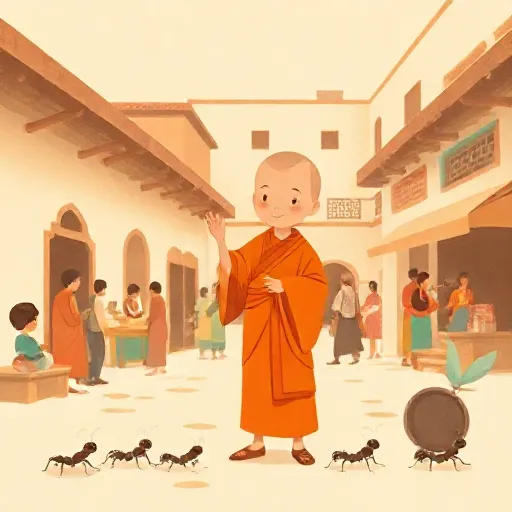
He offered a vivid picture: when you see a marching column of ants, they can look like a single brown stripe. But get close and you see only individual insects, each moving. The self is exactly like that. You feel like a single, steady “I” through the years, but examine your experience carefully and you find only a stream of changing thoughts and sensations. No extra thing hides underneath.
When the Personalists insisted that the person is something “ineffable” — not the same as the aggregates but not different either — Vasubandhu pushed back. If you cannot say clearly what you are perceiving, he argued, how can perception be a reliable way to know anything at all?
Why Everything Must Fall Apart in an Instant
Vasubandhu didn’t stop at denying the self. He held that momentariness is true of everything. Nothing lasts longer than an instant. Change is impossible, he reasoned, because if a thing really changes, it becomes something different — which means it was never one single thing to begin with. A flame doesn’t flicker; a series of different, momentary flames arise and vanish in quick succession.
What makes a thing vanish the instant it appears? Vasubandhu gave a strange answer: things self-destruct. Destruction cannot be caused by something else, he said, because destruction produces a non-existent as its result, and a non-existent can’t be an effect. So everything carries its own annihilation within itself. The moment it exists, its nature already includes vanishing.
That idea created a huge puzzle. If everything is a chain of separate, momentary flickers, how can you remember yesterday? How can a deed you do now catch up with you in a future life? Vasubandhu’s reply was that each moment causally imprints the next moment in the same mental stream. Your consciousness right now arose with the shape of your past moments already “stamped” onto it, which is why you feel like the same person. But the feeling is a trick of the causal flow, not evidence of a permanent thing.
The Dream, the Shared Hallucination, and the Beating Heart
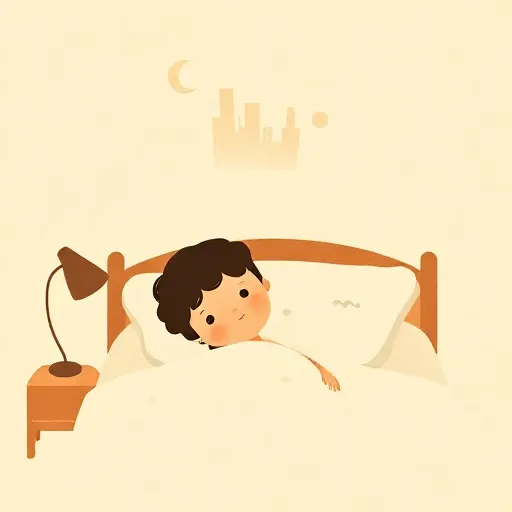
Once Vasubandhu adopted the Yogācāra view, he went further. He claimed that appearance-only (vijñaptimātra) is the true story: everything in the three realms of rebirth is just mind, with no physical objects standing outside it. This sounds impossible at first. An objector in his text Twenty Verses pushed back: physical things are in one place at one time; they are seen by many people at once; they cause real effects. Mental images are not like that.
Vasubandhu was ready. In a dream, he pointed out, you can stand on a beach at a specific moment and feel the sand between your toes, all while lying in bed. So even a purely mental scene can be strictly localized in space and time. As for being shared, he asked his opponent to think about the Buddhist hells. The beings there all see tormenting demons, but those demons cannot be physical — no being with good karma would be born into hell, so no physical body could withstand the flames. Instead, the shared horrors are a mass hallucination generated by the beings’ own negative karma.
The cleverest counter was reserved for causality. A merely imagined event, the objector said, cannot produce a physical result. Vasubandhu answered with a single, memorable example: a vivid nightmare can make your heart pound and your body break into a sweat. A completely unreal monster, conjured purely by the mind, causes very real bodily changes. So why should we assume that our waking actions need a physical world to have effects?
Then he went after the very idea of physical objects. If an object is made of tiny, partless atoms, those atoms couldn’t combine — they would have no sides to touch. If an object is a single thing with no parts, you could never walk across it or see two colors on its surface. The concept of a material world outside the mind, he concluded, just crumbles under close inspection.
The Elephant That Isn’t There
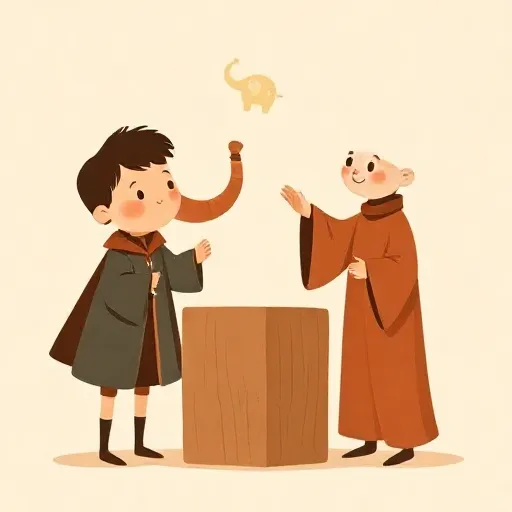
Vasubandhu didn’t just argue against things; he built an elegant picture of how reality works. In his short text Three Natures Exposition, he explained that everything has three natures at once.
Think of a magician who uses a piece of wood and a spell to make an audience see an elephant. The first nature, the fabricated nature, is the elephant as it appears — a huge gray animal with tusks and flapping ears. That is what you take to be real before you know the trick. The second nature, the dependent nature, is the actual causal process: the wood, the incantation, and the way they generate the elephant-appearance inside your mind. The third nature, the perfected nature, is the simple fact that the elephant does not exist at all — the emptiness of that first, fabricated image.
Vasubandhu said the same pattern holds for everything you experience, including your own self. You seem to be a solid “me” looking out at a world of separate “things.” That’s the fabricated nature. The dependent nature is the hidden, mental chain of karmic seeds (stored in a storehouse consciousness, ālayavijñāna) that ripens into that very appearance of a self-and-world split. The perfected nature is the truth that this so-called duality — me here, objects there — was never more than a mind-made show.
So Who Are You, Really?
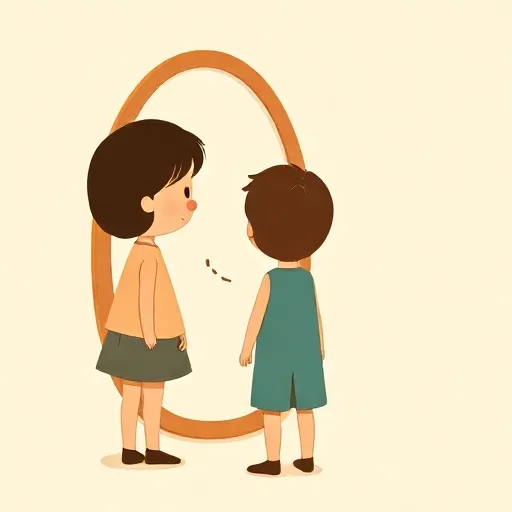
Vasubandhu’s arguments can feel dizzying. He seems to be saying that neither the world outside you nor the “you” inside your head is truly solid. And in a way, that was exactly his point. Even calling everything “mind-only,” he admitted, is just a conventional description — not the final truth, which he believed was beyond words. But by pushing logic as hard as it can go, he hoped to shake people free of habits that cause suffering: clutching at a self that isn’t there, and fending off a world that was never really outside.
These questions are far from ancient history. When you feel a sharp flash of anger and then ask, “Who was angry just now?” you’re asking Vasubandhu’s question. Neuroscientists today discuss whether the feeling of a continuous self is a story the brain tells itself. Meditators often report that when they look closely, they find only buzzing sensations and thoughts, not a stable “me.” Vasubandhu would nod and say: exactly. The ant-line again.
He wasn’t telling you to stop using the word “I.” He used it himself. But he invited his listeners to look more carefully — and to notice that what we call a self might be stranger, more fluid, and more wondrous than any solid soul could ever be.
Think about it
- If you try to find your “self” right now — the one thing that has been you your entire life — what do you actually notice? Is it a thing, or is it a stream of thoughts and feelings?
- Imagine that everything you see and touch is a shared, perfectly consistent dream. What would be different about your life? What would stay the same?
- Vasubandhu believed that seeing through the illusion of a self would reduce suffering. Why might believing you are a separate, permanent self lead to more frustration and pain?