Is the World Just in Your Head? The Buddhist Idealists
You’re Dreaming Right Now — Or Are You?

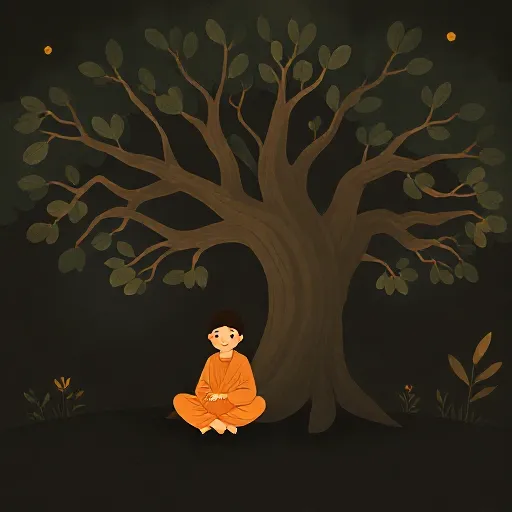
Imagine you’re in the middle of a vivid dream. You’re walking through a forest, the air smells of pine, you can feel the rough bark of a tree. It seems completely, obviously real. Then you wake up. The entire world of the dream — trees, smells, even the feeling of your own body — was nothing but your own mind weaving a story.
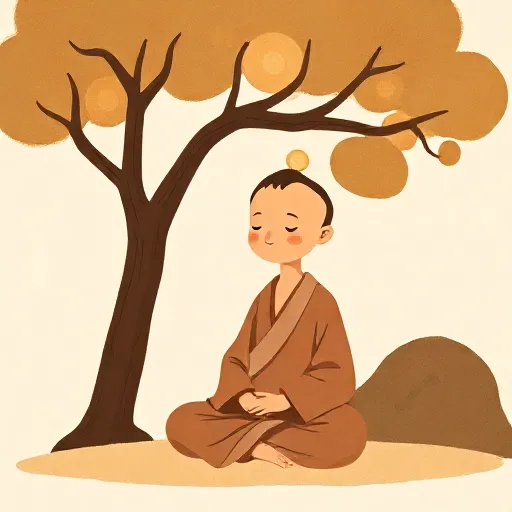
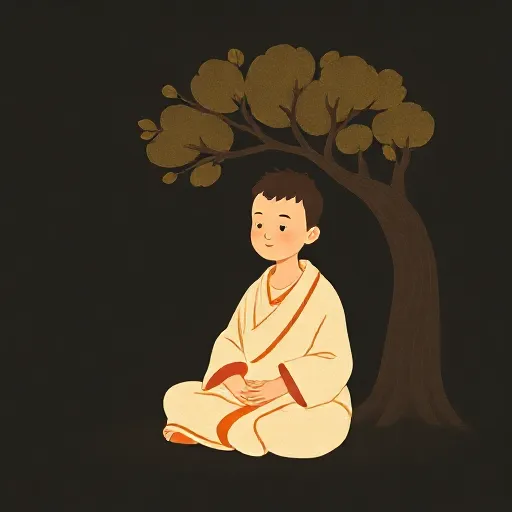
Buddhist philosophers in India, starting around the 4th century CE, looked at that experience and asked a bold question: what if waking life is exactly the same? What if the “real” world you see around you right now is not made of physical stuff at all, but is a projection of your consciousness? This idea is called cittamātra, or “mind-only.” The school of thought that developed it is called Yogācāra, a name that points to the central role of meditation and mental discipline.
The Yogācāra thinkers didn’t say the world is a silly fantasy. They meant something much stranger: that there are no mind-independent objects “out there.” Everything — tables, mountains, even other people’s faces — exists only as an appearance within your awareness. And they had surprisingly clever arguments to back it up.
A Warehouse of Karma Inside Your Mind

To understand why the Yogācāras believed this, you need to know about their model of the mind. Most Buddhist schools at the time recognized six kinds of consciousness: the five senses and a mental consciousness that thinks and judges. The Yogācāras added two more.
The first addition is the ālayavijñāna, or “store consciousness.” Think of it as a vast underground warehouse where every intentional action you perform (every karmic deed) plants a seed. These seeds — the Yogācāras called them bījas — are tiny potentials that, when they ripen, produce your next experiences. Did you help someone kindly? That plants a seed. Did you tell a lie? Another seed. Later, those seeds burst open and create not only your feelings and moods but the very sights, sounds, and textures you seem to encounter in the world.
This solved a puzzle. If there’s no permanent self (as all Buddhists accept), what carries your karma from one moment — or one lifetime — to the next? The store consciousness does. It streams along like a river, constantly changing but never breaking, and it holds your whole personal history. One Yogācāra text, the Saṃdhinirmocana Sūtra, says it’s like a river whose water is never the same but whose flow never stops.
The second addition is the kliṣṭamanas, the “defiled mind.” This is a sneaky inner voice that clings to the store consciousness and whispers, “That’s me. That’s my real self.” It’s the part of you that feels like a solid “I” behind your eyes. The defiled mind doesn’t rest, and it colors everything you perceive with a sense of “me in here, world out there.” Together, the store and the defiled mind build the illusion of a separate self standing opposite a separate world.
The Three Natures: Why Things Feel Real Even When They Aren’t

If the world is just a show in the mind, why does it seem so solid and rule-governed? The Yogācāra school answered with the doctrine of the three natures (trisvabhāva). Every experience has three layers.
First, there’s the imagined nature (parikalpita-svabhāva). This is the ordinary world of separate things — chairs, cars, other people, your own body — that you believe exist independently, out there, with their own fixed properties. The Yogācāras said this is a false overlay, a kind of conceptual mistake. Because of language and habit, you carve the world up into objects and label them, then forget that you did the carving.
Second, there’s the dependent nature (paratantra-svabhāva). This is the actual flow of your experience — the raw sights, sounds, and feelings that arise because of causes. Those causes are seeds in your store consciousness, not physical objects. You see a blue sky because certain seeds ripened, not because a massive physical sky pressed light into your eyes. Everything depends on the mind’s own causal story.
Third, there’s the perfected nature (pariniṣpanna-svabhāva). This is when you see through the trick. You understand that the imagined nature — separate subjects and objects — never existed. What’s left is just the dependent flow of experience, free of the “me versus it” illusion. The texts call this “suchness” (tathatā): seeing things exactly as they are, without adding imaginary extra stuff.
Think of mistaking a coiled rope for a snake in a dark room. The snake is the imagined nature — a fiction laid over reality. The rope itself is the dependent nature — what’s actually there. The perfected nature is turning on the light and seeing that it was always just a rope.
Dreams, Ghosts, and the Argument for Mind-Only

The philosopher Vasubandhu (probably 4th–5th century CE) gave some of the sharpest arguments for mind-only in his short book, the Viṃśikā, or Twenty Verses. A realist might object: “If external objects don’t exist, why do my experiences happen in particular places and times? Why do other people see the same thing I see? And why can real food fill my stomach while imaginary food cannot?”
Vasubandhu’s reply: all three features show up in situations where even the realist admits no physical objects are present. In dreams, you see objects that appear in specific places and moments. A crowd of hungry ghosts — pitiful beings in Buddhist cosmology — all suffer the same gruesome visions of rivers of pus and fire, yet no physical river exists; their shared karma produces identical hallucinations. And an erotic dream or a nightmare can cause very real bodily changes, like sweating or a racing heart, even though nothing physically touches you. So if dreams and hallucinations can explain spatio-temporal order, intersubjective agreement, and physical effects, why invent a whole extra layer of material stuff to explain waking life?
Vasubandhu then turned the tables. He argued that all physical theories of the world — especially atomism — fall apart under scrutiny. The atoms postulated by his rivals couldn’t be the direct objects of perception because they don’t look anything like the smooth, unified objects we actually experience. And if we never perceive atoms, why believe they exist at all? His conclusion: the mind-only view is both simpler and more coherent. It’s a lighter theory — it gets the job done with fewer kinds of entities. Why carry the heavy backpack of physical objects when mind-stuff alone can explain everything?
But What About Other People?

If the world is just my consciousness, does that mean only I exist? That creepy possibility is called solipsism. It’s a nightmare for any Buddhist school, because the whole point of Mahāyāna Buddhism is to help all beings become free. If other minds aren’t real, compassion becomes nonsense.
Vasubandhu never accepted solipsism. He insisted that Buddhas can directly know other minds, and that minds can even harm one another without bodies in between. But the real challenge remained: how can an idealist prove that other minds exist, without appealing to physical bodies as evidence?
The logician Dharmakīrti (c. 7th century CE) took up the challenge. His argument was an inference. I notice that my own intentional actions — speaking, reaching, moving — are always preceded by my own volitions, my inner decisions to act. Now I observe other apparent actions (a voice, a gesture) that I didn’t will. The most reasonable explanation is that those actions, too, are preceded by someone else’s volitions. So I can infer that other minds exist. Crucially, Dharmakīrti pointed out that we never observe physical bodies directly; we only ever experience the appearance of actions. The realist is in exactly the same boat — she, too, only has appearances to go on. Therefore, the idealist can use the same inference the realist does.
But a later philosopher, Ratnakīrti (c. 11th century CE), wasn’t satisfied. He pointed out that we’ve only ever seen the connection between volition and action in one case: our own. How can we generalize from a single instance? And because the volitions of others are by nature imperceptible, we can never check whether the connection holds. In fact, if we never perceive another mind, the simplest conclusion might be that no other minds exist. Ratnakīrti bit the bullet and said that, at the ultimate level, other minds cannot be established. But he, too, held that at the practical, everyday level, we must treat others as real — and walk the path of compassion anyway.
Why Should You Care Today?
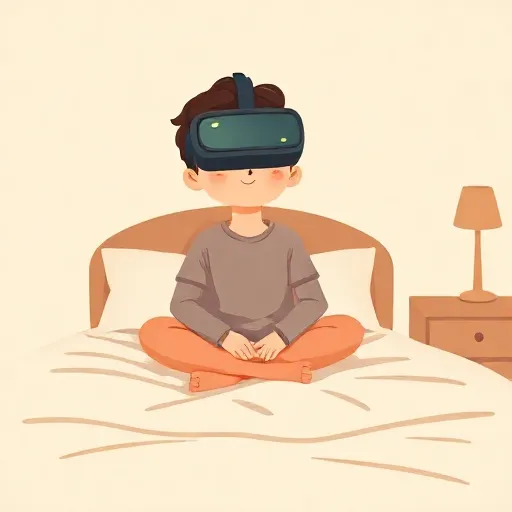
You don’t need to be a meditating philosopher to feel the pull of the mind-only idea. Every time you wake from a dream that felt utterly real, you brush against it. Every time you put on a virtual reality headset and flinch at a falling cliff that isn’t there, you’re tasting what Vasubandhu meant.
The Yogācāra thinkers weren’t trying to depress you or make you doubt everything. They wanted to show that the way we normally see the world — as a collection of hard, separate objects grinding against a lonely self — is a source of suffering. If the boundary between “inside” and “outside” is a mental construction, then the anger, fear, and craving that depend on that boundary can start to dissolve.
Yet the hard problem of other minds remains. If all you ever directly know is your own consciousness, how can you be sure that anyone else has one? This is not just an ancient puzzle. It sits at the heart of conversations about artificial intelligence (how would you know if a robot truly feels?), about extreme loneliness, and about the ethics of how you treat other beings. The Yogācāras looked this question straight in the eye, proposed elegant solutions, and then watched their own successors tear those solutions apart. The debate is still open.
Think about it
- If you were in a virtual reality so perfect that you could never tell it wasn’t the “real” world, what reason would you have to believe that the physical world exists at all?
- You can’t look inside someone else’s head. What is the best evidence you have that your closest friend is actually conscious, and not a very clever machine?
- Vasubandhu thought it was simpler to explain experience without physical objects. But is it simpler to believe in many minds, or just one? If you had to choose, which explanation feels more convincing to you — and why?