
What If Your Whole World Is Just Quick Mind-Flashes?
A Monk Noticed Something Strange

Close your eyes for a moment and just listen to the sounds around you. They seem to flow smoothly, one blending into the next. But what if that smooth flow is an illusion? What if your whole world — every sight, sound, thought, and feeling — is actually made of incredibly fast, separate flickers, like the frames of a movie?
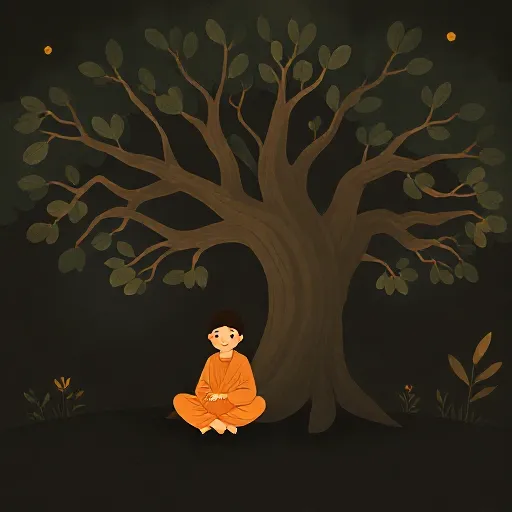
Around fifteen hundred years ago, a monk in Sri Lanka or northern India might have sat under a tree probing exactly that question. He was not daydreaming. He was practicing a systematic investigation of his own mind, using methods developed by a tradition called Abhidharma (or Abhidhamma in the Pali language). The word means “higher teaching” or “further analysis of the Buddha’s teachings.” While the Buddha’s early discourses described the world as constantly changing and full of suffering, the Abhidharma thinkers tried to take that teaching apart and map every piece. Their goal was not just to create a list, but to give meditators a detailed blueprint of how experience is built — and, crucially, how to unbuild it to find peace.
The Abhidharma project grew out of the many early Buddhist schools that had sprouted across India after the Buddha’s death. Two complete sets of texts survive: one from the Theravāda school, which spread to Sri Lanka and Southeast Asia, and another from the Sarvāstivāda, which dominated northern India and Central Asia. Though they disagreed on many points, both schools shared a startling claim: the basic building blocks of reality are not chairs, trees, or people, but momentary mental-physical events called dharmas.
Your Mind is a Movie Made of Separate Frames

Look up from this screen for a second. You probably experience a steady stream of awareness: a lamp over there, a slight hunger, a half-formed thought about tomorrow. But Abhidharma philosophers argued that this stream is actually a succession of individual consciousness moments, each one called a citta. A citta is not a “thing” — it’s a bare act of being aware of something, lasting an unimaginably tiny slice of time.
A citta never occurs alone. It always arises together with a set of mental factors, or cetasikas, like feeling, perception, attention, and intention. Together, a citta and its cetasikas form a complete mind-moment — a single flash of experience that arises, knows its object, and vanishes, making room for the next moment. Think of a pixel on a screen blinking on and off, or a single frame in a film reel. When the flashes happen fast enough, you get the illusion of a continuous movie.
But what are these mind-moments made of? The Theravāda school analyzed experience into 82 basic types of dhammas (their Pali word for dharmas). The Sarvāstivāda school counted 75. The lists included consciousness itself, various mental factors like worry or kindness, and physical qualities like hardness or temperature. Every single occurrence you can ever experience, from sensing an itch to having a generous thought, can be described as a combination of these ultimate events.
One dhamma type stands apart: nibbāna (nirvana), the unconditioned. While all other dhammas arise and pass away depending on causes, nibbāna neither arises nor ceases. It is the ultimate freedom that the Buddhist path aims for. More immediately, this whole analytical machine was built to support a radical insight: no permanent self hides inside this flickering show. The idea of a solid “me” is just a confused habit of perception. In Abhidharma terms, the world is a flow of impersonal dhammas, and anātman (not-self) is not a theory to believe but a reality you can watch.
The Great Time Debate: Past, Present, and Future

If everything is just rapid flickers, how do things change? And how does one moment cause the next? This is where the schools split into a fierce debate about time.
All Abhidharma traditions built on the Buddha’s teaching of impermanence. But they sharpened it into a doctrine of momentariness: phenomena are so transient that they exist for only a single, indivisible moment. The Sarvāstivāda school, whose name means “those who say everything exists,” took a dramatic position. They claimed that a dharma exists as a real entity in the past, present, and future. Its intrinsic nature (more on that soon) never changes, but its activity shifts. In the present, a dharma performs a function — making the next moment happen. In the past and future, it still has the capability to function but is not actively doing so right now.
Critics from the Sautrāntika school found this absurd. If a dharma really exists for only a moment, how can it hang around in the past or future? They argued that only the present exists, and that past and future are just concepts. The Theravādins agreed that dhamma happen only in the present, but they allowed that during its one brief moment a dhamma passes through three sub-phases: arising, enduring, and ceasing. This tiny endurance, they thought, was enough to explain how one thing can condition the next without violating momentariness.
The Sautrāntikas pushed momentariness to its logical extreme: they denied any enduring phase at all. A dharma arises and perishes in the very same instant — so fast that you cannot point to a moment when it “is.” This extreme view forced them to develop a completely new theory of how we perceive anything, which we will touch on later. What matters now is that all three camps were trying to solve the same puzzle: if the world is nothing but a string of vanishing events, why does it feel so solid and continuous?
What Makes Each Flash Unique?

If you want to sort a hundred different kinds of mind-flashes, you need a way to tell them apart. The Abhidharma schools developed the concept of svabhāva (intrinsic nature) to do just that. At first, svabhāva was mainly a tool for categorization. To say that a particular dharma has its own intrinsic nature meant that it has a set of unchanging characteristics that make it exactly that mental event and not another one — a bit like how the definition of a triangle (three straight sides, angles adding to 180°) never varies, no matter what triangle you draw.
The Theravādin commentaries explained that dhammas “bear their own intrinsic natures,” but they also stressed that these natures arise because of conditions, not from some hidden inner core. So, the intrinsic nature of kindness depends on certain mental factors coming together; it is not a little “kindness-atom” floating around independently. In the same way, the Sarvāstivāda used svabhāva to pin down each dharma’s unique identity in their massive taxonomic system.
Over time, though, svabhāva began to sound more like an ontological claim — a statement about what really exists. Some later Sarvāstivāda masters argued that a dharma’s intrinsic nature proves it is a primary existent, a real entity (dravya), as opposed to composite things like a chariot or a person that exist only in a conventional way. The Theravādins moved in a similar direction: they said that dhammas are ultimate realities, while the “wholes” we normally think about are just conceptual fictions.
But this shift created a tension. If dhammas have a fixed nature that lasts, can they truly be momentary? Scholars today note that the earliest Abhidharma was more concerned with how you discern and classify experience than with what exists in an abstract sense. Watching dhammas was meant to be a meditative skill: you learn to see that what you thought was a solid emotion is actually a rapid succession of distinct, impersonal events. The map was meant to be used, not just admired.
Why This Ancient Puzzle Still Matters

You might wonder what a 2,000-year-old debate about mind-flashes has to do with you. Quite a lot, as it turns out.
When you feel overwhelmed by an emotion — say, a sudden wave of anger — it feels like one solid thing that takes you over. The Abhidharma practice suggests something different: if you could slow down your experience, you might see that “anger” is actually a series of fast mental events, each with its own flavor and trigger. Between those events, there are tiny gaps. Learning to notice those gaps can give you a choice. Instead of being carried away, you can simply observe: “Oh, a moment of irritation — there, gone. Now another.” This is strikingly similar to what modern mindfulness training and some forms of cognitive therapy teach.
Scientists who study consciousness also grapple with the very same problem the Abhidharma faced: how does the brain stitch together discrete signals from the senses into a seamless experience of a world? Researchers talk about “perceptual moments” and debate whether consciousness is continuous or pulsed. The Sautrāntika idea that we never directly perceive the outside world, but only mental representations of it, sounds a lot like contemporary theories of perception in neuroscience.
More fundamentally, the Abhidharma tackles a question that never goes out of style: Are the things you take for granted — your self, your stuff, your steady world — as solid as they seem? The Buddhist answer is a gentle but relentless “look for yourself.” The shelves of dharmas were never meant to become intellectual clutter. They were offered as a tool for undoing confusion. In your own life, the next time something makes you upset, you might experiment with this old idea. Try to watch the experience as a stream of very brief, impersonal events — sensations in the body, flickers of thought, tones of feeling. Does the “upset” dissolve into a series of manageably tiny moments? That’s the experiment the Abhidharma thinkers handed down.
Think about it
- Imagine a musician playing a fast melody, note after note. Does the music exist in any one single note, or only in the series as a whole? What does that say about the “self”?
- If someone told you that your anger is nothing but a sequence of rapid mental flashes, would that make it easier or harder to handle? Why?
- Can something be real if it lasts only a thousandth of a second? What makes anything “real” in the first place — how long it sticks around, or how it affects other things?