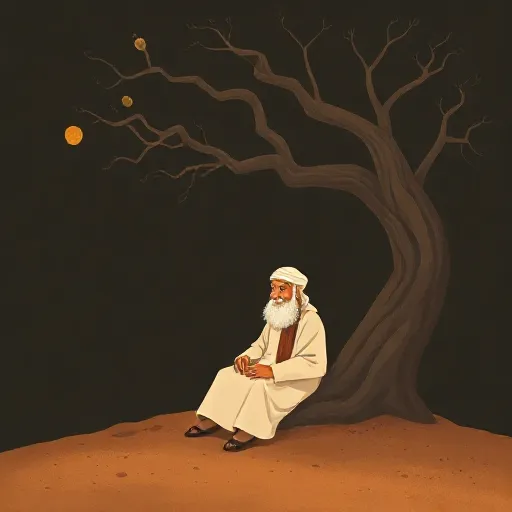
Why Did a Brilliant Mathematician Write Poems Full of Doubt?
A Man With Two Voices
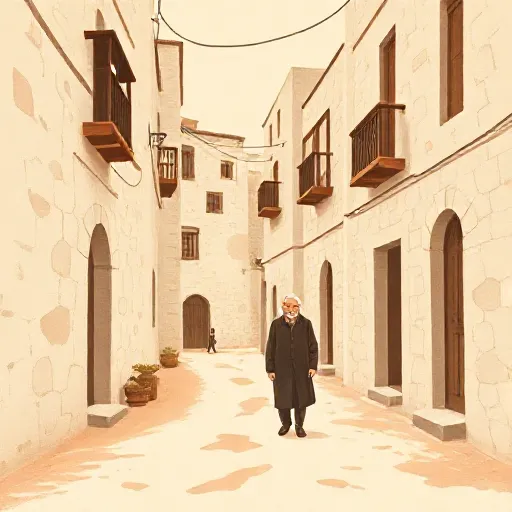
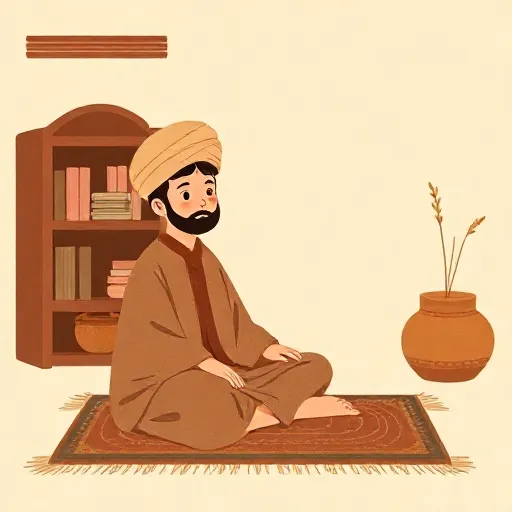
In the streets of Nishapur, around the year 1120, an old man with a white beard walked slowly home. Umar Khayyam (1048–1124 CE) was famous across Persia. He had mapped the stars, built an observatory, and designed a calendar more accurate than the one we use today. But lately he had been writing short, four-line poems — the Rubā‘iyyāt, or quatrains — that seemed to tear down everything his careful philosophy had built.
Some people called him a dangerous skeptic. Others saw a wise man who refused to pretend. The strange thing is, Khayyam never tried to merge his two sides. His philosophical treatises are calm, logical, and faithful to the teachings of the great Muslim thinker Ibn Sīnā (Avicenna). His poems are wild, doubtful, and full of wine, clay, and the ache of passing time. This article asks: how could one person think both things at once?
The Philosopher’s God and the Problem of Evil
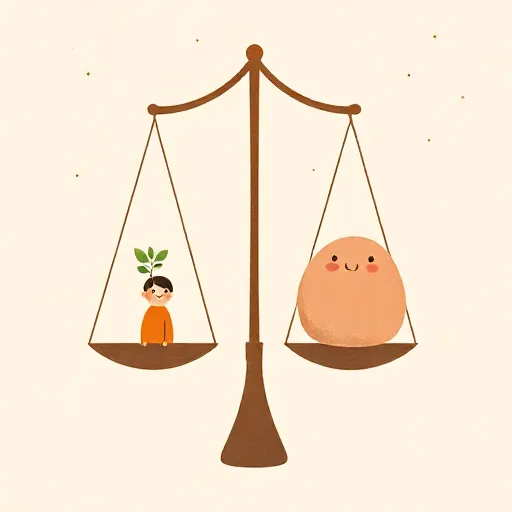
Khayyam’s philosophical writings follow the tradition of Ibn Sīnā (Avicenna), whom he called “the master of all who came before him.” In these treatises, God is the Necessary Existent — the one being who must exist, not caused by anything else, simple, timeless, and without parts. Khayyam offers several proofs for God’s existence, grounding them in the order of the universe.
The most gripping problem he tackles is theodicy: if God is perfectly good and all-powerful, why does the world contain so much evil and suffering? A statesman named Qāḍī Abū Naṣr once posed this to him as a sharp challenge: doesn’t it follow that God is the cause of evil? Khayyam answers by drawing a careful distinction.
He argues that God creates the essences of things directly, and those essences are good simply because they are. Evil is not a substance you can hold; it arises as a concomitant — a necessary side-effect — of the contrary relations between things. Fire warms your hands, but it can also burn a forest; the same flame does both. God essentially causes the fire, but the burning is an accidental result of the fire bumping against something else. So God is only the accidental cause of evil, not its essential and intentional source. On top of that, Khayyam adds, the benefits of creation massively outweigh the harms. Withholding all that good to avoid some side-effect would itself be a huge evil.
Still, even as he wrote this argument, Khayyam the poet was not convinced.
Are Your Choices Really Yours?

Khayyam is often called a predeterminist — someone who believes that your actions were set in place long before you were born. In one famous quatrain, he writes of a moving finger that writes your fate and, once it has written, moves on; no amount of tears can wash out a single word.
But his philosophical works are more careful. He describes three layers of determinism (the idea that past events and laws fix what happens next). First, a universal-cosmic determinism: you never chose when and where to be born, nor when you will die. Second, a socio-economic determinism: you need food, clothing, and shelter just to survive, so the society you land in shapes your options from the start. Third, an ontological determinism: your very nature, like the nature of a seed, sets limits on what you can become.
When a correspondent asked him whether the predestinarians or the free-will theorists were closer to the truth, Khayyam replied that at first glance the predestinarians seemed nearer, provided they did not push their view into absurdity. He never fully endorsed the idea that everything is forced. Instead, he seemed to lean toward a soft determinism: your path is fenced in, but you can still walk within it. The tension is alive in his writing — as if he desperately wanted some room to move, even while feeling the walls close in.
The Secret of the Wine Cup: What the Poems Say
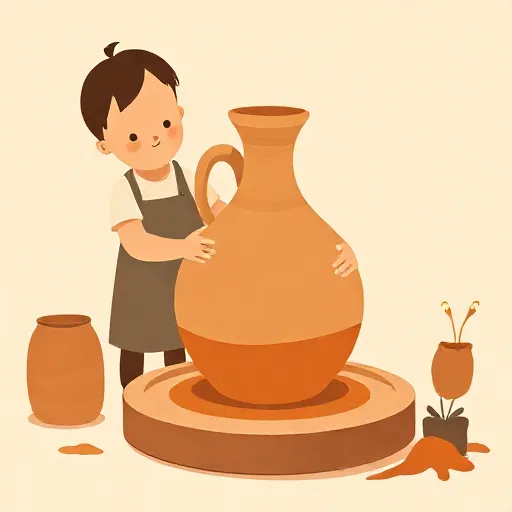
Now flip to the Rubā‘iyyāt, and the tone changes completely. Here the poet Khayyam stares at the world and sees only impermanence. He uses the image of the potter again and again: the clay that makes a wine jug was once a human being, and one day you will be clay yourself. In one scene, he watches a potter pounding a piece of clay and imagines the clay begging: treat me gently, for once like you, now I am clay.
This is not a philosopher defending God’s justice. It is a person crying out that life is unbearably short, suffering is everywhere, and nobody really knows what comes after death. He mocks those who claim certainty about heaven and hell. Instead, he urges living fully in the present: drink wine, enjoy the company of friends, and don’t waste your breath counting on a tomorrow that may never come. In one quatrain, a voice from the “Tower of Darkness” shouts, “Fools! your reward is neither here nor there!”
Notice the deep mismatch. The philosopher Khayyam had argued that evil is rationally justified and God is blameless. The poet Khayyam finds the same evil so painful that no explanation feels adequate. This is not a tidy debate he solves; it is a split inside one human being. He gives no final answer — he simply lets the two voices speak.
The Mathematician Who Drew Curves to Solve Equations
Even while his mind wrestled with life’s deepest puzzles, Khayyam was a first-rate mathematician. He wrote that mathematics is the easiest part of philosophy because its truths are clear to anyone with a sharp eye.
His most striking achievement was solving cubic equations — equations that contain an x cubed, like x³ + 200x = 20x² + 2000. He did this not with symbols alone but by drawing two conic sections — a circle and a hyperbola — and finding where they intersected. The length of a line in that diagram gave the answer. This method linked algebra and geometry centuries before Descartes built his famous coordinate system.
Khayyam also worked on the foundations of geometry. In his Commentary on the Difficulties of Certain Postulates of Euclid’s Work, he tackled the troublesome parallel postulate. Instead of trying to prove it (which many had failed to do), he replaced it with simpler, more obvious statements about lines converging. This led him to study a shape now called the Khayyam-Saccheri quadrilateral, a rectangle hidden inside the logic of parallels.
He rethought the very idea of ratio, especially for numbers that cannot be written as neat fractions. By defining equality of ratios through a repeated division process, he helped pave the way for treating irrational numbers as genuine numbers — a huge step toward the real number line you use today.
And for good measure, he helped create the Jalali calendar, which stays accurate to within one day every five thousand years — better than the Gregorian calendar that much of the world relies on.
Why the Split Still Matters

So why should a twelve-year-old care about a Persian philosopher-poet who died almost a thousand years ago? Because Khayyam’s split is your split. You live in a world where science explains lightning and bacteria with astonishing precision, yet you can still feel that a friend’s betrayal or the loss of a beloved pet has no satisfying explanation at all. The same mind that aces a geometry test can be flattened by grief and scream that life is unfair.
Khayyam didn’t try to erase the tension. He let his philosophical arguments and his anguished poems sit side by side, each true in its own voice. When Edward FitzGerald translated the Rubā‘iyyāt into English in 1859, the poems caught fire across Europe and America, inspiring writers like Mark Twain and entire Omar Khayyām Clubs. People didn’t love him because he handed them a comfortable answer. They loved him because he showed them that it is possible to hold two opposite thoughts at once: the universe can be rationally understood, and yet existence can still feel absurd.
Today, you carry that same possibility. You can build towers of logic and still honor the part of you that aches without a reason.
Think about it
- If a scientist could prove that every choice you will ever make was already fixed by your brain chemistry and past events, would you still feel proud of your achievements? Why or why not?
- Have you ever felt that a beautifully ordered system — like a perfect math proof or the rules of a game — suddenly seems meaningless when something deeply unfair happens to you? How did you make sense of that clash?
- Khayyam’s philosophy said evil has a good reason; his poetry said it doesn’t feel that way at all. When you face something unjust, which voice inside you speaks louder — the one that wants a logical explanation, or the one that simply feels the hurt?