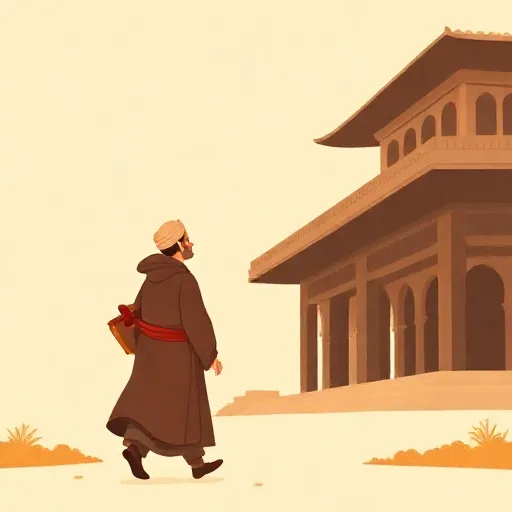

The Philosophers Who Thought Reason Wasn’t Enough
A Puzzle Even Logic Couldn’t Solve

In a courtyard school of 10th‑century Baghdad, a young student named Layla closed her logic book in frustration. She could prove that two plus two equals four, but that didn’t help her understand something bigger: how could a single, invisible God create a universe of billions of stars, wildly different animals, and seven billion people? The question wasn’t just about numbers — it was about meaning.
The first Muslim philosopher to take that puzzle seriously was Abū Naṣr al-Fārābī (c. 872–950). He is often called the father of logic in the Islamic world, yet he realized that pure logic couldn’t explain where everything came from. Al-Fārābī turned to Neoplatonism, an ancient Greek idea that everything flows out from a single source like light pouring from a lamp. He used the image of emanation: God doesn’t build the world piece by piece; the world overflows from God the way heat radiates from the sun.
That was a bold move. Al-Fārābī went further: he described four levels of intellect. The highest intellect, he said, doesn’t just reason — it witnesses truth directly, the way you recognize your own mother’s face. In his political writings he even replaced Plato’s philosopher‑king with a spiritual leader, an Imam, who knows truth not only by argument but by a kind of inner vision.
Al-Fārābī never claimed to be a practicing mystic himself. Reports of him joining a Sufi order are hazy. But his ideas opened a door. Muslim philosophers after him had to face a new and difficult question: can you reach the deepest truths by reasoning alone, or does real knowing require something more — something that feels like a light turning on inside you?
The Genius Who Abandoned His Books

If al-Fārābī cracked the door, the next giant — Abū ʿAlī Ibn Sīnā (Avicenna, 980–1037) — built a whole palace out of reason. Avicenna was one of the most powerful rationalist philosophers in history; he believed logic, careful definitions, and tight proofs could explain almost everything. Yet even Avicenna couldn’t shake the mystical question. Scholars still argue: did the older Avicenna turn toward mysticism? Some late works, like his story of Ḥayy ibn Yaqẓān (Son of the Living Awake), use dream‑like language and speak of a journey to God. Others insist he stayed a pure logician his whole life. The evidence is disputed.
Then came someone who made the choice crystal clear. Abū Ḥāmid al-Ghazzālī (1058–1111) was a superstar professor, a respected jurist, and a master of logic. But at the height of his career, a terrifying doubt seized him: what if all his careful arguments were just clever tricks, unable to touch the truth? He later wrote that his soul felt parched, thirsting for something more. So he did something shocking. He quit his job, gave away his possessions, and spent years wandering as a silent, fasting wanderer — an ascetic — practicing Sufism, the mystical tradition of Islam.
Ghazzālī discovered that direct spiritual experience could give him the certainty that logic never could. He compared the experience to a taste that no definition can capture., like trying to explain the sweetness of honey to someone who has never eaten it. In his book The Niche of Light, he described God as a light that shines into the heart. His earlier attack on philosophy, The Incoherence of the Philosophers, argued that reason alone was too wobbly to carry the weight of the biggest questions. Ghazzālī didn’t just think about mysticism — he lived it, and in doing so he changed Islamic thought forever.
Light That Teaches Without Words

A century after Ghazzālī, a young philosopher named Shihāb al-Dīn Suhrawardī (1154–1191) gave the mystical approach a whole new vocabulary. He was trained in logic and wrote several books in the style of Aristotle. But his most famous work, The Philosophy of Illumination, pushes ordinary philosophy aside. Instead of talking about “being” and “existence,” Suhrawardī talked about light and illumination (in Arabic, ishrāq).
Suhrawardī’s key idea is that some knowledge arrives directly, like a beam of sunlight — you don’t reason your way to it; you are simply lit from within. He called this knowledge by presence (‘ilm al-ḥuḍūrī). In ordinary knowledge, there is a knower, a thing known, and a gap between them. But in knowledge by presence, the three melt into one. It is like the difference between reading about cold water and plunging your hand into a stream.
This wasn’t just theory. Suhrawardī believed you had to prepare your soul through practice. In the introduction to his masterpiece, he warned readers that the book’s secrets would stay hidden unless they fasted for forty days and avoided meat. He wrote short allegories — such as The Red Intellect, where a wise figure leads a seeker through a landscape of symbols — that work like maps for the inner life. For Suhrawardī, philosophy wasn’t just thinking clearly; it was an art of becoming clear, polishing the mirror of the soul until it could reflect the divine light.
Rumi and the Stilts of Logic

The most famous voice in this conversation belongs to a poet, not a textbook philosopher. Jalāl al-Dīn Rūmī (1207–1273) wrote tens of thousands of verses, and in many of them he poked fun at people who trust only their brains. “Rationalists’ legs are just like stilts,” he wrote. “How unfixed and stolid are feet of wood!”
Rūmī divided the intellect into two layers. The particular intellect toils over what you can measure, deduce, and memorize. It is useful for building houses or calculating an allowance — but it cannot climb to the highest truths. The universal intellect, by contrast, is a gift that wells up inside you like a spring. Rumi described it this way:
“The other intellect is a gift from God, Whose source is like a spring within the soul. When the water of knowledge gushes forth from the heart, It neither becomes fetid, grows old nor wilts.”
For Rumi, the heart isn’t just a pump; it is an organ of supersensory perception. He taught that just as you have five outer senses (sight, hearing, and so on), you have five inner spiritual senses. Waking them up takes steady spiritual practice — silence, music, fasting, love — not word games. He didn’t reject reason entirely, but he insisted that reason without direct experience is as useless as reading a menu without ever eating. and thinking you’ve eaten dinner.
The Map of Your Soul’s Journey

The centuries‑long argument between reason and mysticism didn’t stay stuck in a deadlock. The grand synthesizer was Mullā Ṣadrā (1571–1640), often called the greatest metaphysician in Islamic history. Mullā Ṣadrā had spent years in strict reasoning, but he also went into retreat to purify his heart. He claimed that truth was finally “unveiled” to him — not as a rejection of logic, but as its completion.
His enormous book The Four Journeys of the Intellect describes the soul’s entire path. Journey one: the fall from unity into the scattered, many‑colored world. Journey two: everyday life in that world, with its ache of separation. Journey three: the climb back toward God through spiritual practice, moral effort, and flashes of divine light. Journey four: a resting place in the source, where the traveler sees that the many were always, somehow, one.
What made Mullā Ṣadrā’s synthesis stick was his insistence that reason and mystical intuition are partners. He used fierce logic to build a bridge that walkers of the mystical path could cross. After him, a philosopher who ignored mysticism was like a cook who refused to taste the food.
Why does this ancient debate still matter? Because you already live inside it. You have felt a fact that no one proved to you: the sadness of a friend before they speak, the hugeness of a starry sky, the quiet click when a poem makes sense. Those moments aren’t irrational — they’re a different kind of knowing. The Muslim philosopher‑mystics spent a thousand years mapping that territory, not to replace thinking but to remind us that some truths are only reached by the whole human being — mind, heart, and body together.
Think about it
- If you feel absolutely sure that something is true but can’t give a proof, should you trust that feeling? What might make it trustworthy — or not?
- Is there a kind of knowledge that only experience can give you — like what it’s like to be someone else — that no lecture or book could ever deliver?
- Suppose a brilliant logician proved that beauty isn’t real. Would you stop finding sunsets beautiful? Why might logic fail to capture your own experience?