
Can You Learn All About God Just by Thinking?
The Boy Who Talked to the Stars

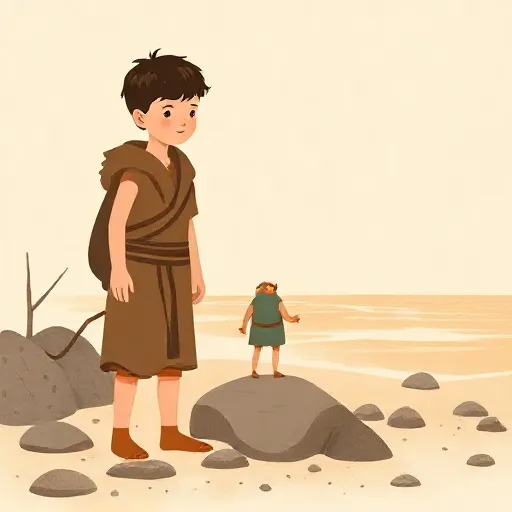
Imagine you are the only human on an island, raised from infancy by a deer. You have no parents, no teachers, no books—just your eyes, your hands, and a mind that keeps asking why. This is exactly what happens in a story written by the Muslim thinker Ibn Ṭufayl (died 1185). His character Ḥayy ibn Yaqẓān grows up entirely alone, yet over many years he works out deep truths: that the world has a cause, that this cause must be one and perfect, and that living a good life means imitating that perfection. When he finally meets people from a far‑off religious community, he is startled—they already know, through their prophet, much of what he found on his own. But they also believe things he never reached, and they do not welcome his style of careful reasoning.
Ibn Ṭufayl’s novel planted a huge question in the soil of the Islamicate world: Can unaided human reason discover everything religion teaches, some of it, or almost nothing? For centuries, Muslim philosophers and theologians fought over the answer, and their fight still echoes today whenever someone asks, Should I just think for myself, or should I trust a sacred source?
Three Camps, One Big Question
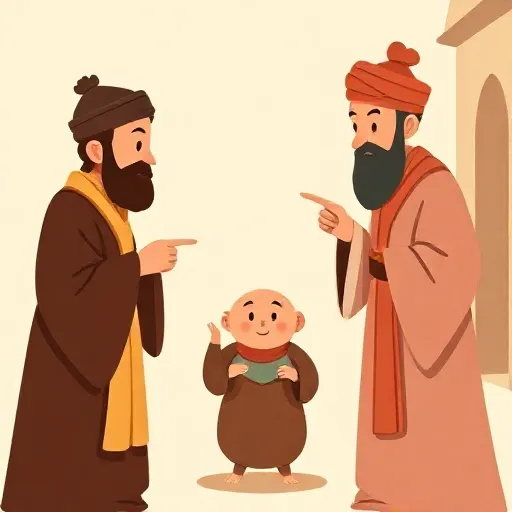
Muslim thinkers did not speak with one voice. You can sort their answers into three broad camps.
At one extreme stood the physician and philosopher Abū Bakr al‑Rāzī (865–925). Reports say he believed that human reason is fully sufficient for a devout life. If that were true, scripture would be unnecessary—or even misleading. Al‑Rāzī’s position was considered radical, and few fully joined him.
At the opposite extreme, some traditional scholars dismissed independent reasoning about religion altogether. For them, a prophet’s message is the only reliable guide; the unaided mind simply cannot reach the truths that God reveals. This camp warned against oversophisticated interpretations and insisted on accepting sacred texts as they are.
Most thinkers, however, staked out the middle. Two influential theological schools—the Muʿtazilites and the early Māturīdīs—argued that a mentally sound person who reaches the age of discernment is already accountable for knowing certain basics by reason alone. Before ever hearing a prophet, you can and should figure out that God exists, that God is just, that God sends messengers, that there is life after death, and that you ought to lead a morally good life. The theologian al‑Qāḍī ʿAbd al‑Jabbār (died 1025) and Abū Manṣūr al‑Māturīdī (died 944) taught that once you grasp these truths with your own mind, you will naturally look for a genuine prophet, test any who claims that title, and then accept the rest of what he brings. So reason gets you to the doorstep; revelation carries you inside.
Philosophers, Prophets, and Pictures

The most famous Muslim philosophers added a twist to the middle position. Al‑Fārābī (died 950), Avicenna (Ibn Sīnā, died 1037), and Averroes (Ibn Rushd, died 1198) argued that a small number of people can, in principle, demonstrate every essential religious truth using pure intellect. A demonstration starts from absolutely certain premises and arrives at a conclusion that cannot be false. But—and this is the giant “but”—almost no one can follow such proofs. Most people need pictures, stories, and emotional hooks.
So al‑Fārābī divided humanity into three classes. The first class is persuaded by demonstration alone; they are the rare philosophers. The second class is moved by dialectical proofs, which yield only highly probable beliefs, so scripture helps them confirm what is true and correct what is false. The third and largest class responds only to rhetorical proofs—vivid images of reward and punishment, simple parables, and concrete commands. For them, the prophet’s message wraps the truth in a coat of symbols. The truth inside is the same, but the wrapping is what lets them grasp it.
Averroes went further: if a demonstrated conclusion of philosophy ever seems to clash with a literal reading of the Qurʾān, the problem is not with philosophy but with the literal reading. Those who are capable of demonstration must interpret the text metaphorically, so long as they do not confuse the general public with those deeper readings.
The Proof That Shook the World

To see how far reason could travel alone, Muslim theologians developed a brisk, powerful argument for the existence of God. In its simplest form, the kalām cosmological argument runs like this: (1) everything that begins to exist after not existing has a cause, and (2) the world itself began to exist after not existing. Therefore the world has a cause, which they identified with God.
The real fight was over premise (2). Philosophers like Avicenna and Averroes insisted that the world has existed eternally into the past—no beginning, no first moment. The theologians, however, fired back with clever arguments. At the time, astronomers believed the sun and moon orbit the earth. If the world were eternal, the moon would have made twelve times as many revolutions as the sun—an actually infinite number of orbits, and one “twelve times infinity,” which seemed to be a number larger than infinity. That, they said, is absurd. Another argument piled up human souls: if the human species is eternal and every death releases an immortal soul, the number of souls existing right now would be actually infinite, and constantly growing—also absurd. From such puzzles they concluded that the world must have had a beginning.
Philosophers replied that the infinity involved is only a potential infinity, not an actual completed set. The debate over whether an infinite past is possible rumbled on for centuries and remains one of the most discussed topics in philosophy of religion.
Even when the theologians thought their proof was solid, they faced a new challenge from al‑Ghazālī (died 1111). In his book The Incoherence of the Philosophers, Ghazālī argued that the philosophers’ own “demonstrations” about God were not truly certain. He wanted to protect the faith of ordinary people who, dazzled by impressive‑sounding proofs, might think they could toss religion aside. Ghazālī believed a rational defense of basic beliefs was good, but only in the hands of properly trained scholars—and even then, it never made scripture unnecessary.
When the Book and the Brain Disagree

What happens when a Qurʾānic verse, read literally, contradicts something that seems absolutely certain to reason? The theologians and philosophers gave strikingly similar answers—up to a point.
Al‑Ghazālī insisted that any statement that “the intellect judges impossible” must be read metaphorically. His favorite example was verses that speak of God sitting on a throne or having hands. Reason, he believed, proves that God cannot have a body, because anything bodily is limited and subject to time. Since God is unlimited, those verses cannot be literal. The general public should simply be told not to worry about such passages; scholars could explore their symbolic meanings. But miracles that the Qurʾān recounts, like raising the dead, he refused to treat as impossible. As long as there was no airtight proof that they couldn’t happen, he kept them.
Averroes, a fierce critic of Ghazālī on other points, largely agreed about interpreting scripture. Any conflict between a demonstrated conclusion and a religious text means the text must be taken metaphorically. And since scholars have never agreed on exactly which verses must be taken literally and which metaphorically, Averroes thought we should not bind anyone’s conscience to a single reading. But, like his predecessors, he warned that the deepest interpretations should not be shared with people who cannot follow the proofs behind them.
The mystical thinker Ibn ʿArabī (died 1240) pushed this openness even further: he held that every word of the Qurʾān carries countless intended meanings, and God intends them all. To him, someone who reads a verse and finds only one meaning has not yet read it properly.
So what began as a simple question—can I figure out God on my own?—spiraled into a rich, living argument about how we know anything at all. Those medieval Muslims were not asking a dusty academic riddle; they were wrestling with whether your own mind is a trustworthy guide, when it makes sense to rely on a teacher or a book, and how to live honestly when the two seem to pull in opposite directions. That is exactly the same puzzle you face whenever you hear a fantastic claim from a friend, an app, or a tradition and have to decide: Do I trust it? Do I think it through? And what if my thinking says one thing and everyone around me says another?
Think about it
- If you were left alone on an island at age two, with no human contact, what do you think you could figure out about right and wrong, and what would you never be able to figure out on your own?
- Imagine a holy book says something that clashes with a scientific theory you are convinced is true. Should you reinterpret the book, question the science, or hold both in a kind of mental waiting room? What would you actually do?
- Is it fair to keep certain complicated ideas about God out of the reach of most people, as al‑Fārābī and Averroes recommended? Or does everyone have a right to hear the rawest version of the truth?