Why "I Was Drawing a Circle" Doesn't Mean I Drew One
Halfway Across the Road

Imagine you are telling a friend a story. You say, “Lena was crossing the street.” Then your phone buzzes and you forget to finish the sentence. Did Lena ever reach the other side? Your words do not say — and that is the puzzle. Language has an invisible system that marks not only when something happens but also how the action unfolds, whether it is wrapped up like a finished package or still spread out like an open map. Philosophers and linguists call this system tense and aspect. At its heart is a strange riddle: why do some sentences about ongoing actions seem to hide whether the action was ever completed?
Tense: Pointing to When
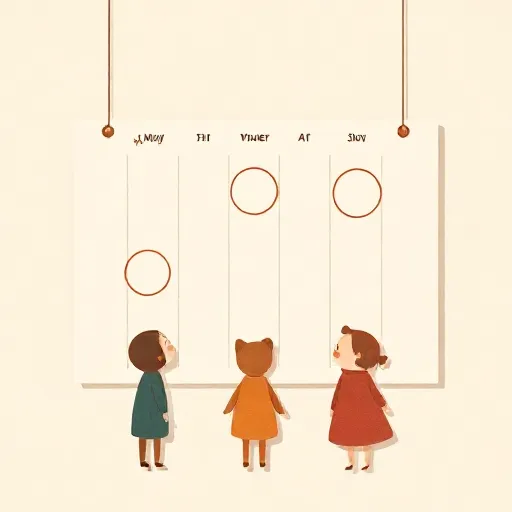
Tense is the part of language that points to a moment in time. In English we distinguish mainly between past and non-past. “I walked to school” puts the walking before now; “I walk to school” or “I am walking to school” locates it around now; and “I will walk to school” pushes it into the future. But linguists often deny that English has a pure future tense, because the word will can also signal a person’s wanting to do something (“He will swim in dangerous water”), not just time.
Things get trickier when we look at relative tense. The philosopher Hans Reichenbach (1891–1953) noticed that sentences need three pieces of time: speech time (the moment you speak), event time (when the action happens), and reference time (the narrator’s spotlight moment). For simple past, reference time and event time both sit before speech time. But for the present perfect (“I have lost my watch”), the reference time is the present — you are looking back at the event from now. That is why “I have lost my watch” feels close and relevant, while “Yesterday I lost my watch” pushes the whole story away from you.
Aspect: The Camera Angle
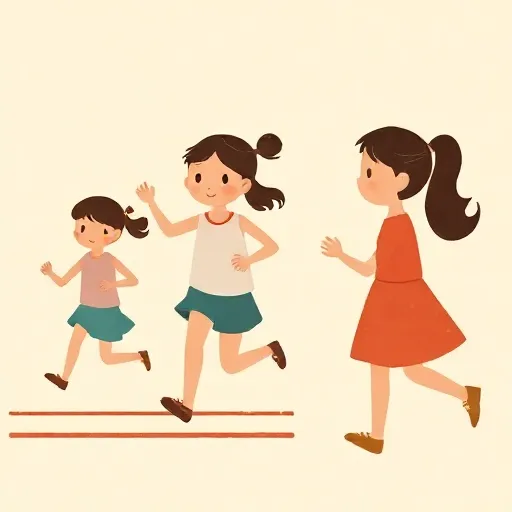
If tense is about when, aspect is about how the event is shaped inside time. The linguist Bernard Comrie famously described it as a difference between viewing a situation as a single whole, without looking at its inner phases, and paying close attention to its internal structure. Think of a movie. Perfective aspect is like a DVD cover: a single, complete image. Imperfective aspect is like a film scene: you are inside the action while it is still unfolding.
English uses the progressive form (be + ‑ing) to create imperfective meaning. “She closed the door” is perfective — you imagine the door shut. “She was closing the door” is imperfective — you picture a hand on the knob, the door still moving, and you do not know if it ever latched.
But not all verbs behave the same. The philosopher Zeno Vendler (1920–2004) gave us a helpful sorting of event types. States like know or believe describe conditions that just hold; they rarely appear in the progressive (I am knowing French sounds wrong). Activities like run or push a cart describe ongoing processes without a natural endpoint. Accomplishments like draw a circle or build a house have a built‑in finishing line. Achievements like recognize or find happen in an instant. The trouble — the deep philosophical puzzle — lives inside the accomplishments.
The Unfinished Action Paradox

Here is the riddle. Compare two sentences:
(a) Sam was pushing a cart.
(b) Sam was building a house.
If Sam was pushing a cart, you can safely conclude that Sam pushed a cart. But if Sam was building a house, you cannot safely conclude that Sam built a house. The house might never have been finished — a thunderbolt, a broken leg, or a lost bank loan could have stopped everything. This asymmetry is called the imperfective paradox, and it is not a real paradox in the sense of a contradiction; instead it is a sharp puzzle for anyone trying to write down the exact rules of meaning.
Why should one kind of verb pass the finish-line test while another fails? Activities like “pushing a cart” are cumulative: any part of a pushing still counts as pushing. Accomplishments have two layers — a doing part and a result part. The doing part alone is not enough; you need the final state (the completed house) to make the full claim true. So when you say “was building a house,” you are describing only the doing part, and the result remains hanging in the air.
Solutions: Normal Worlds and Surprises
One famous solution was offered by the linguist David Dowty (1942–2017). He suggested treating the progressive as a kind of modal operator — a word that talks about possibilities, not just plain facts. When you say “Sam was building a house,” you are claiming that in every normal world, where nothing extraordinary interrupts, the house would get built. These orderly possible worlds are called inertia worlds. They run like the real world right up to the time you are talking about and then continue along the most ordinary path: no earthquakes, no thunderbolts, no unexpected trucks.
This works beautifully for many cases. An activity like pushing a cart holds true in all those normal continuations, so the entailment goes through. But critics have poked holes in the “normal” idea. Suppose someone says, “John was crossing the street, when he was hit by a truck.” What if the truck was already so close that no normal world could avoid the crash? Intuitively, the sentence still feels true even though the crossing was doomed from the start. The notion of normal can be slippery. Other philosophers, such as Fred Landman, noticed that some scenarios, like “Rebecca was running across a minefield,” do not presume that runners normally survive — yet the progressive still feels fine.
Artificial intelligence researchers bumped into a cousin of this puzzle when they tried to build computers that understand stories. In the famous Yale Shooting Scenario, a gun is loaded, someone smokes a cigarette, then fires. A reader automatically assumes the victim dies, but a computer, unless it is told that unexpected events do not happen, might imagine the gun becoming mysteriously unloaded during the smoke break. The frame problem — how to ignore irrelevant possibilities — is the AI version of the imperfective paradox. One answer is to use non-monotonic reasoning: you make a default guess that the action succeeds, but you stay ready to take that guess back if new information (like a truck) arrives. This is how human minds seem to work: we imagine a goal will be reached unless something stops it.
Why This Still Matters
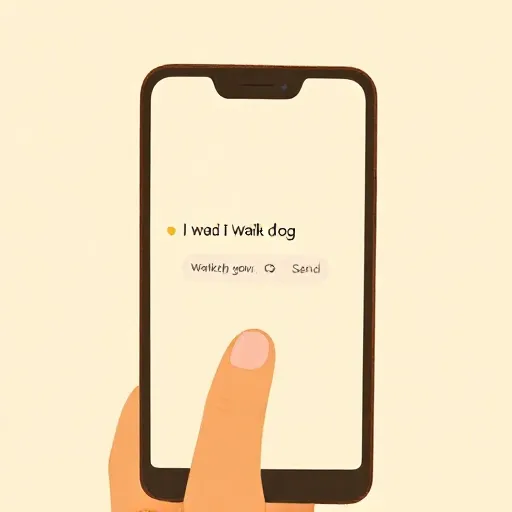
You have probably never said, “I am going to deploy non-monotonic reasoning now,” but you do it all the time. When a friend texts, “I was baking a cake and the power went out,” you instantly understand that the cake probably never made it into the oven — or at least that the outcome is unknown. You do not need the sentence to be finished; you use your built‑in sense of aspect to read the invisible question mark at the end. The same skill helps you plan your own day. You assume you will finish your homework unless something interrupts, and you adjust your beliefs the moment an interruption appears. Language gives us not just labels for completed facts but flexible tools for living inside half‑finished stories.
Philosophers continue to argue about the best way to model this mental machinery. Some build on Dowty’s possible worlds; others, following events‑first thinkers like Bertrand Russell and Hans Kamp, suggest that time itself might be built out of events that overlap and precede one another, making moments a kind of abstraction. Still others, like Bridget Copley and Heidi Harley, see forces and causes as the basic building blocks. The debate is alive because it touches everything from how children learn to speak to how we might one day teach a robot to truly understand a bedtime story.
Think about it
-
If a friend tells you “I was walking to the library when…” and then the call drops, do you assume they arrived? What if they said “I was building a model airplane when…”? What changes?
-
Imagine a language that has no way to say “I am doing X” — only “I did X” or “I will do X.” How would that change the way people tell stories, make plans, or apologize for interruptions?
-
Could a computer ever truly understand the difference between “I crossed the street” and “I was crossing the street”? What would it need to know about the world to get it right?