Can Your Hands Show What Words Keep Hidden? The Logic of Sign Language
The Mystery of the Missing “He”
Imagine you read this sentence in English:
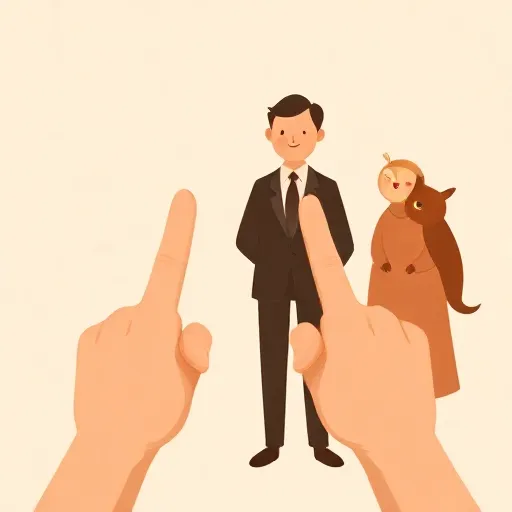
Sarkozy told Obama that he would be re‑elected.
Who is “he”? It could be Sarkozy, or Obama, or some third person not even mentioned. The sentence is genuinely confusing — unless you know French Sign Language.
In French Sign Language (LSF), a signer can set up two invisible spots in the air: one on the left for Sarkozy, one on the right for Obama. Then, when the signer says the rest of the sentence, the verb “tell” moves from the left spot to the right spot, and later a pointing finger aims either left or right. Point left, and “he” clearly means Sarkozy; point right, and it’s Obama. The spots in space — called loci — act like visible labels that track who is doing what.
This is not just a neat trick. It raises a huge question: are sign languages showing us the hidden logical skeleton that spoken languages keep invisible?
When a Spot in Space Becomes a Logical Variable
Many linguists think that every sentence has a secret structure, often called Logical Form. In that structure, pronouns like “he” get something like algebraic variables: x, y, z. The idea is that when we understand “Sarkozy told Obama that he would win,” our minds silently assign a variable to each person and check which variable the pronoun is tied to.
In spoken languages, these variables are never actually pronounced. You never say “x told y that z would win.” But sign languages, some researchers argue, make them visible with loci. This claim is called Logical Visibility: signs can bring out parts of the logical machinery that are only hypothesized in speech.
Not everyone agrees that loci work exactly like pure variables. In English, words like “he” and “she” also help us track who is who, not by being variables but by carrying gender features — “he” usually picks out a male person. Some linguists argue that loci are more like gender features than logical variables. The debate is alive: loci seem flexible and unlimited, like variables, but they also sometimes get “overlooked” in sentences where a pronoun is bound by a quantifier, which is a behavior associated with features.
When Time and Situations Get Their Own Spots
The power of loci goes beyond people. In American Sign Language (ASL), you can sign:
SOMETIMES WIN (at locus a). IX-a HAPPY.
This means “Sometimes I win. In those winning situations, I’m happy.” The pointing sign IX‑a refers back to the times of winning, not to a person. Here, a locus marks a temporal situation — basically, a slice of time. Even modal situations work this way: “I might get infected (at locus a). Then (IX‑a) I have a problem.” The pointing sign hooks onto a possible scenario.
This is huge because it suggests that the same variable‑like system handles people, times, and possibilities. If loci are indeed visible variables, then sign languages give us direct evidence that natural language treats all these things with a unified logical toolkit — something spoken languages only hint at.
How Signs Can Act Like Pictures: GROW and DIE

Sign languages don’t only make logic visible. They also weave iconicity — resemblance between a sign’s form and its meaning — directly into grammar.
Take the ASL verb GROW. In its basic form, the two hands move upward and apart. But a signer can stretch that movement: moving the hands faster suggests the growth happened quickly; starting narrow and ending extremely wide suggests a huge increase in size. These are not random gestures — they are systematic, rule‑governed iconic modulations. And they can be embedded in logical sentences. If someone signs “IF the plant GROW‑big‑fast…” the iconic part (big, fast) gets sucked into the “if” condition just like a normal word would.
A starker example is the verb DIE in ASL. Normally the dominant hand flips from palm‑down to palm‑up. But if the hand only turns partway, the meaning becomes “almost die.” The sign’s incomplete movement iconically mirrors the event’s incompleteness. Such modulations don’t just add description; they alter the event structure, much like English adverbs such as “almost” or “nearly.”
These facts challenge the century‑old idea that language is made of arbitrary symbols. Here, the shape of the sign honestly pictures what it talks about, and that picture is a real part of the sentence’s truth conditions.
The Airplane That Flies Where You Put It: Classifier Predicates

Some signs are neither fully conventional nor fully iconic; they are a hybrid. These are called classifier predicates. In ASL, a particular handshape — the thumb and pinky stretched out, the other fingers curled in — is the conventional sign for “airplane” when used as a classifier. But this handshape’s position, orientation, and movement are not fixed. If you place two such classifiers close together and move them forward in parallel, the sentence means “two airplanes took off side‑by‑side.” If you use the ordinary noun PLANE instead, you lose that precise spatial information — it just means two planes took off, possibly far apart.
Pic‑ture‑like meaning is built into the lexical entry. For a classifier token with a specific phonetic shape Φ, the sign is true of an object x only if x, from a certain viewpoint, projects onto that very Φ — in other words, if the object and the sign look alike in the relevant respects. This idea comes from formal pictorial semantics, where a picture’s truth is defined by a projection rule. Classifier predicates are living proof that a language can have a conventional vocabulary and still let your hands paint a scene.
What This Tells Us About All Language
Sign languages are not just “hands doing what mouths do.” They force us to rethink what human language is made of. They reveal a dual nature: a logical, discrete system that can make variables, operators, and event structure visible, and an iconic, picture‑like system that lets signs resemble the things they mean. And the two systems interact — iconic modulations can be part of the at‑issue content of a sentence, and iconic classifiers can drive word order choices.
This matters far beyond the Deaf community. It matters for the philosophy of language itself. A view that says all words are arbitrary must now explain how deeply systematic iconicity can be. It also blurs the line between language and gesture. When hearing people gesture, they sometimes use the same visual logic that sign languages have grammaticalized — for instance, placing pantomimed objects in space in an order that matches how our eyes see events. The human mind seems ready to build meaning out of shapes and movements, not just out of sound.
Sign languages are a window into the full architecture of language. They don’t just translate the same thoughts into a different medium; they show us thoughts that visible space can express in a way invisible speech cannot.
Think about it
- If you had to invent a sign for “grow,” how would you use your hands to show fast growth versus slow growth? Would that be more like a word or more like a drawing?
- Why do you think spoken languages, even with gestures, rarely use the kind of spatial grammar that sign languages have? Is there something about sound that makes iconic depiction harder, or is it just a historical accident?
- Could a language that is partly picture‑like make it harder to lie, or easier? (Imagine describing a car crash: if your hands must show the movement iconically, can you still twist the story?)