
The Infinite Hotel and the Race That Never Ends
A Hotel With No Empty Rooms — and Plenty of Space

It is the busiest night of the year. Every room in the Grand Hilbert Hotel is occupied — and the hotel has no last room. The corridors stretch on forever, with a door for room 1, room 2, room 3, and so on without end. A traveler arrives and asks for a bed. “No problem,” says the manager. She picks up a microphone and asks the guest in room 1 to move to room 2, the guest in room 2 to move to room 3, the guest in room 3 to move to room 4, and so on forever. Everyone shifts by one door. Suddenly, room 1 is empty. The traveler checks in.
This story, told by the mathematician David Hilbert (1862–1943) in a 1924 lecture, is a supertask: a task with infinitely many steps completed in a finite time. The hotel has a countably infinite number of rooms — you can list them like the counting numbers, even though they never stop. The manager’s announcement is a single instruction, but it sets off an endless chain of movements that somehow settles. Infinity behaves in strange ways, and supertasks show us just how strange.
The Race With No Final Step: Zeno’s Runner
The ancient Greek philosopher Zeno of Elea (5th century BCE) imagined a runner in a race. To reach the finish line, the runner must first cover half the distance. Then half of the remaining distance, then half again, and so on without end. Zeno argued that since you cannot finish an infinite number of steps, motion is impossible.
Modern mathematics gave a different answer. The distances the runner covers — 1/2, 1/4, 1/8, … — form a geometric series. Add them all up and the sum gets closer and closer to 1; mathematicians say the series converges to 1. Using the idea of a limit, we can say the runner completes the whole distance in a finite time. The philosopher Max Black (1909–1988) still objected: there is no final step, so the task can never be complete. But J. F. Thomson (20th century) and others pointed out that “complete” can mean two different things. Finishing every step in a list (which the runner does) is not the same as taking a last step (which the runner does not). For ordinary, finite tasks the two meanings agree. Supertasks force us to pull them apart. Achilles reaches the line, even though he never makes a final half-step.
The Lamp That Can’t Make Up Its Mind

Imagine a lamp with a switch. Start with it off. After 1 minute, flip it on. After 1/2 minute more, flip it off. After 1/4 minute, on. After 1/8 minute, off. Keep going. The total time adds up to 2 minutes. At exactly 2 minutes, is the lamp on or off?
This is Thomson’s lamp, introduced by the philosopher J. F. Thomson in 1954. The lamp’s state jumps between 0 (off) and 1 (on) forever: 0, 1, 0, 1, … That sequence never settles down to a single number. It has no limit. So the description alone does not tell us what happens at 2 minutes. That feels like a paradox — but the philosopher Paul Benacerraf (1931–2025) argued that the description is simply incomplete. We need to add a physical story.
John Earman and John Norton gave such a story in 1996. Picture a metal ball bouncing on a conductive plate, each bounce a little lower than the last, following the same 1-minute, 1/2-minute, 1/4-minute pattern. When the ball hits the plate, it completes a circuit and switches the lamp on. After 2 minutes, the ball comes to rest on the plate. The circuit stays closed. The lamp is on. If we wire it the opposite way, the resting ball breaks the circuit and the lamp ends up off. Both outcomes are possible. The supertask is not impossible — we just have to choose which world we are in.
The Jar That Ends Up Empty — or Maybe Full
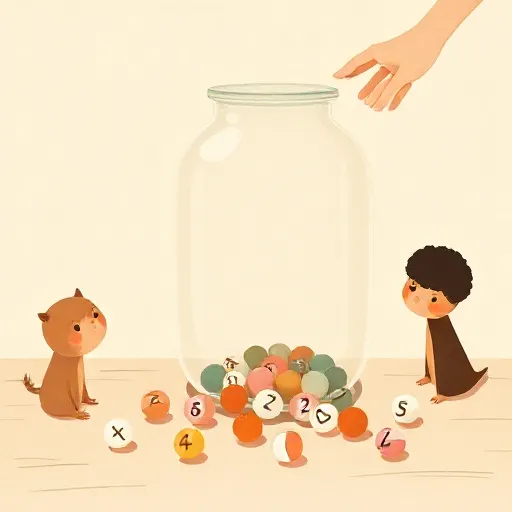
John Littlewood (1885–1977), a mathematician, and later Sheldon Ross (born 1943) described a supertask with balls and a jar. You have an infinite supply of balls numbered 1, 2, 3, … . You work faster and faster so that the entire infinite process finishes in a finite span.
Step 1: drop balls 1 through 10 into the jar, then remove ball 1. (Nine balls remain.) Step 2: drop balls 11 through 20, then remove ball 2. (Eighteen remain.) Step n: drop balls with numbers from 10n‑9 to 10n, then remove ball n.
Now ask: after every step, how many balls are left? After step n, the number is 9n, which grows without bound — it seems the jar should end up with infinitely many balls. But think about the fate of each individual ball. Ball 1 leaves in step 1. Ball 2 leaves in step 2. Every numbered ball n leaves at step n. So no ball stays in the jar forever. The answer zero is just as reasonable as the answer infinity.
Both answers are supported by a different kind of continuity. If the path of each ball through space and time — its worldline — must be continuous, then once a ball is outside the jar it cannot teleport back; the jar ends empty. But if the number of balls is a continuous function of time, the jar should end full. The supertask forces a trade‑off: you cannot have both kinds of continuity. That does not make the supertask logically impossible; it just shows that our ordinary assumptions clash.
Can a Real Machine Do an Infinite Task?
So far, supertasks have been thought‑experiments. But what if physics allows a real machine to carry one out?
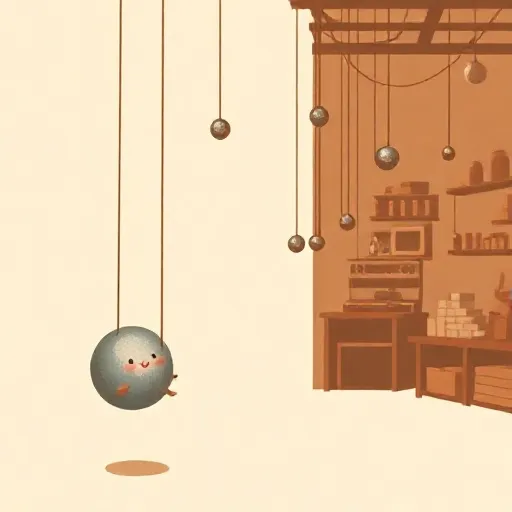
In 1996, the philosopher Jon Pérez Laraudogoita imagined an infinite row of identical metal balls, hung so that the gap between each pair shrinks: 1/2 meter, 1/4 meter, 1/8 meter, and so on. Roll the first ball toward the second. They collide elastically — the first stops, the second moves. Then the second hits the third, stops, and the third moves. Because the gaps shrink, the collisions happen faster and faster: 1/2 second, 1/4 second, 1/8 second, … . After exactly 1 second, the entire chain has stopped. Every ball is at rest.
This is a genuine supertask. It stays within a bounded region and never requires speeds greater than the original ball’s. Yet the total kinetic energy of the system vanishes — energy is not conserved globally, even though every local collision conserves it. The puzzle does not disappear: to make the balls fit, their sizes must shrink without limit while their masses stay the same, which means the mass density must grow without bound. So a real machine like this may not be physically constructible.
Other classical supertasks demand particles that accelerate to unbounded speeds and literally escape to infinity, leaving empty space behind. Classical physics does not obviously forbid them, but they strain our sense of what is “reasonable.”
How to Use Infinity to Answer an Impossible Question
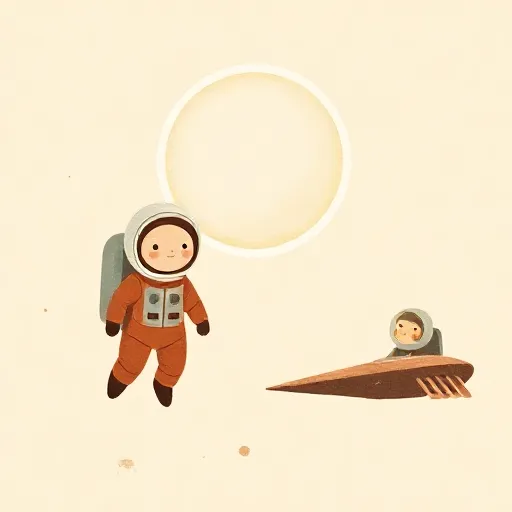
Relativity offers an even wilder kind of supertask. In Einstein’s theory, the time that passes for you depends on the path you take through spacetime. Two people who start and end together can age by different amounts. This opens up a Malament‑Hogarth spacetime, named after the philosophers who studied it. Imagine Alice and Bob. Bob follows a worldline that gives him an infinite amount of personal time, while Alice’s worldline brings her to the same finish event in only two hours. Bob uses his endless time to check every case of Goldbach’s conjecture — the unproven claim that every even number greater than 2 is the sum of two primes. If he ever finds a counterexample, he sends a signal to Alice. If no counterexample exists, he never signals. Alice waits two hours: if she receives a signal, the conjecture is false; if not, it is true. A single afternoon reveals the answer to an infinite search.
The simplest models of such a spacetime, like a flat plane that opens its light‑cones wider and wider, demand that Bob undergo infinite acceleration — he would need unlimited fuel. Other models, like a universe rolled into a cylinder, let Bob coast without acceleration, but they allow paths that loop back in time, creating the possibility of time travel. Worse, all Malament‑Hogarth spacetimes appear to contain naked singularities — places where the laws of physics break down in a way that is not hidden behind an event horizon. Many physicists suspect such spacetimes are not physically reasonable, but the debate is not settled.
Supertasks push us to ask how the universe really works. Could a machine finish infinity? Could we outrun the limits of a finite life? We do not yet have a final answer. The puzzles keep running.
Think about it
- If you could build a machine that completes an infinite number of bounces or collisions, how would you test whether it really finishes? What would count as a fair test?
- If Alice can learn the answer to any yes‑or‑no question in two hours by using a Malament‑Hogarth spacetime, would every true mathematical statement eventually become known? Why might some questions still be out of reach?
- In the jar supertask, both “zero” and “infinity” seem to have good reasons behind them. Can a single question have two equally correct answers, or must one be mistaken? How would you argue your case to someone who chose the other answer?