Zeno Said Motion Is Impossible. Here’s Why You Still Can’t Ignore Him.
A Race That Swallows Itself

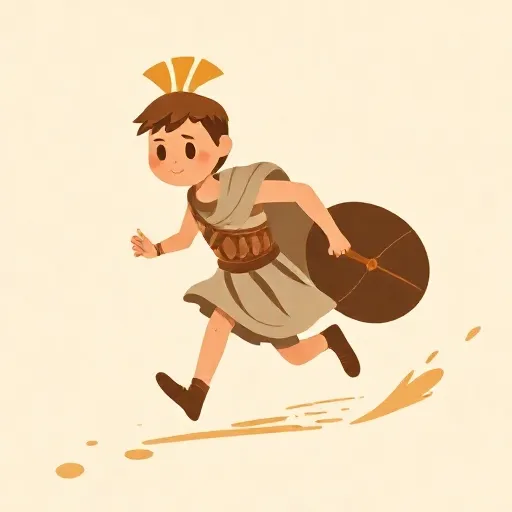
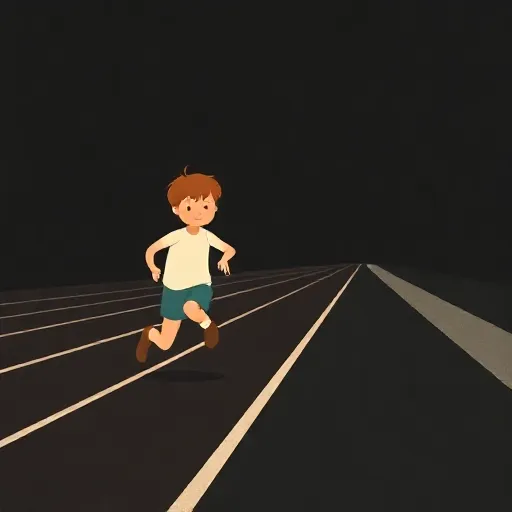
Imagine you’re at the start of a race. The finish line is ten meters away. Easy, right? But before you can reach it, you must cross the halfway point — five meters. And before that, the 2.5‑meter mark. And before that, 1.25 meters. No matter how small the distance gets, there’s always another half‑step you have to take first. This isn’t just a brainteaser: over 2,400 years ago, a philosopher named Zeno of Elea (5th century BCE) used exactly this kind of argument to claim that motion is logically impossible. He wasn’t joking — he was defending a deeply strange idea.
The Philosopher Who Wanted Motion to Be a Lie
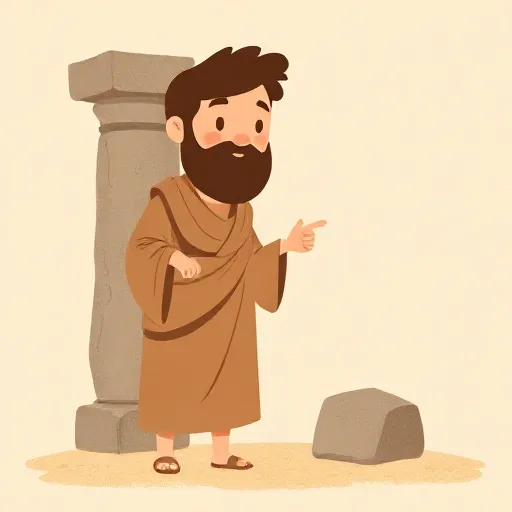
Zeno’s teacher, Parmenides, held that reality is one single, unchanging thing. Movement, change, even having many separate objects — all of that must be an illusion, because reasoning shows it can’t exist. Critics laughed at this, so Zeno set out to defend Parmenides in a brilliant way. He would temporarily accept his opponents’ own ordinary beliefs — that many things exist, that motion happens — and then show that those beliefs lead to an absurd contradiction. This method is called reductio ad absurdum, or “reducing a claim to absurdity.” If the reasoning was valid and the conclusion was impossible, you had to give up the starting beliefs. Zeno designed several famous paradoxes to prove that our common‑sense picture of the world just can’t be right.
The Dichotomy: No First Step, No Finish
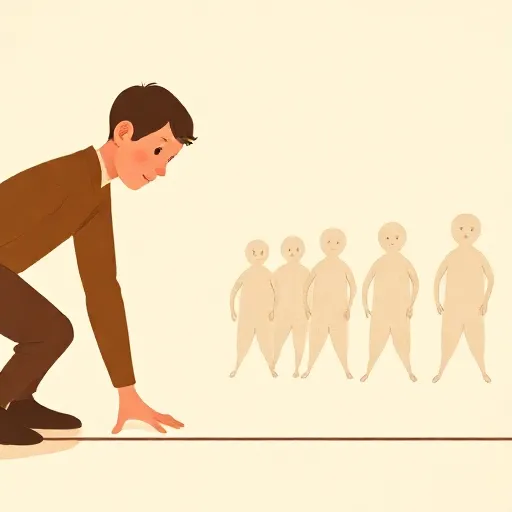
The Dichotomy paradox captures the race we started with. To travel any distance, you must first go half of it; then half of what remains; then half again — and so on forever. The series of distances you have to cover looks like this: 1/2 + 1/4 + 1/8 + 1/16 + … . Zeno assumed that completing infinitely many tasks would require infinite time, so motion could never even begin. For centuries this seemed like a real problem.
The breakthrough came in the 19th century, when mathematicians like Augustin‑Louis Cauchy (1789–1857) developed a rigorous theory of infinite sums. They showed that some infinite sums, where the terms shrink fast enough, add up to a perfectly finite number. The sum 1/2 + 1/4 + 1/8 + … equals exactly 1. So the runner does cover the whole distance in a finite time — no magic required. Zeno’s hidden mistake was assuming that any infinite sum must be infinite. But notice that this solution only works if we define infinite addition very carefully, and that took two thousand years to get right.
Zeno had a related worry: if you could slice an object over and over, you’d eventually get pieces of zero size. How could a whole thing be built out of nothing? Modern mathematics answers that a line isn’t simply a bag of points; it also carries a built‑in distance function that gives it length. Points have zero length, but the continuum has length because of the structure that connects those points. So a stick doesn’t break into nothing.
Achilles and the Tortoise: The Chase That Never Ends
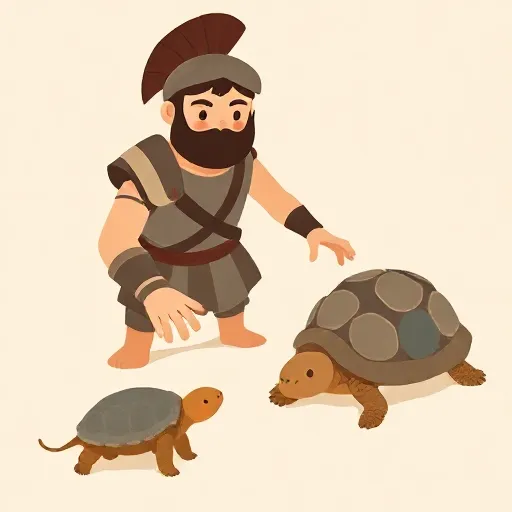
Zeno’s most famous paradox sends the swift warrior Achilles after a very slow tortoise. Suppose Achilles runs 1 meter per second, the tortoise crawls 0.1 meters per second, and the tortoise gets a head‑start of 0.9 meters. To catch the tortoise, Achilles must first reach the spot where the tortoise started. But by the time he gets there, the tortoise has crawled 0.09 meters farther. Achilles must then reach that new spot, but the tortoise has moved another 0.009 meters. This repeats endlessly, so it seems Achilles never catches up.
Look at the distances Achilles has to cover: 0.9 + 0.09 + 0.009 + … = 1.0 meter. The sum is finite, so Achilles does catch the tortoise after exactly 1 second. So why does the felt impossibility persist? The infinite list of catch‑up points (0.9, 0.99, 0.999, …) never includes the 1‑meter mark itself. That final moment comes after the entire infinite sequence. Mathematicians using Georg Cantor’s (1845–1918) ordinal numbers can describe orders of events that contain an infinity of steps followed by a final step — it’s logically consistent.
But some philosophers argue that the real problem isn’t about math; it’s about supertasks — completing an infinite number of separate actions in a finite time. Can you really tick off an endless to‑do list? If not, then maybe a run can never be fully described as an infinite series of separate half‑runs. Others reply that a smooth run isn’t a list of stops and starts; it’s one continuous motion. The debate isn’t neatly settled.
The Arrow: Frozen in Mid‑Flight
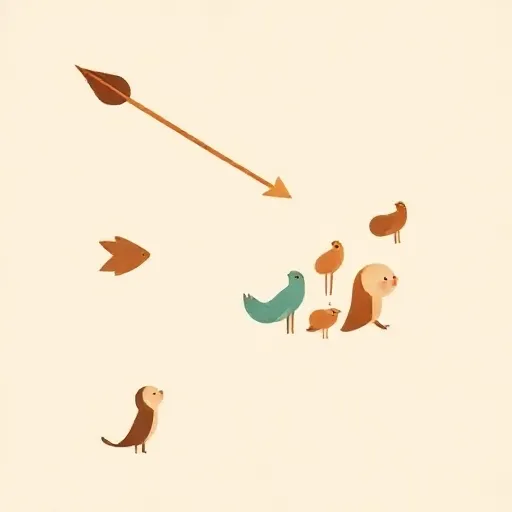
Zeno also aimed his logic at a flying arrow. At any single instant of time, the arrow is exactly where it is — not moving. Since time is composed of nothing but such instants, he concluded the arrow never moves at all; it’s frozen at every moment. The mistake here is thinking that motion must happen during an instant. An instant has zero duration, so nothing can move in zero time. But velocity is defined as distance traveled over a time interval, not at an instant. The arrow’s motion is a pattern: it is at one place at one instant, a slightly different place at the next instant, and so on.
Philosophers call this the at‑at theory of motion: an object is at one location at one time, and at another location at a later time — that’s all motion is. Think of a movie. Each frame is a still picture, yet when the frames flash past quickly, you perceive movement. The arrow is “frozen” in each instant, but the whole sequence creates the flight. So Zeno’s arrow paradox only works if you insist that motion must be located inside a durationless instant, which it doesn’t have to be.
Why Zeno Still Haunts Us Today
You don’t need to worry that walking across a room is logically impossible — you do it all the time. But Zeno’s paradoxes matter because they forced us to ask what motion and space really are. Are space and time infinitely divisible, like a smooth line? Or do they have a smallest grain that you can’t cut in half? Some modern theories of quantum gravity suggest that spacetime might be “grainy” at the tiniest scales — a kind of digital grid. If that turns out to be true, Zeno’s endless division would eventually stop, and his paradoxes would look different.
Even the puzzle of supertasks lives on: can a machine ever complete infinitely many operations in a finite time? And the mathematics that resolved Zeno’s paradoxes — the careful handling of infinite sums, continuous lines, and distance functions — is baked into everything from your smartphone’s GPS to the physics of waves. So the next time you casually stroll across your room, you’re relying on ideas that took two millennia of brain‑twisting logic to pin down.
Think about it
- If you filmed yourself walking across a room and played it back frame by frame, you’d never see movement — just still images. Does that mean real motion is just an illusion too? Why or why not?
- Imagine you build a Lego tower by stacking an infinite number of pieces, each one half as thick as the last. Could the tower ever reach a certain height? How would you know?
- If a clever time‑traveler could stop you at every halfway point before you reach the door, would you ever get through? Can you think of a way to dodge this trap?