Can Something Change and Still Be the Same?
The Car at the Lights
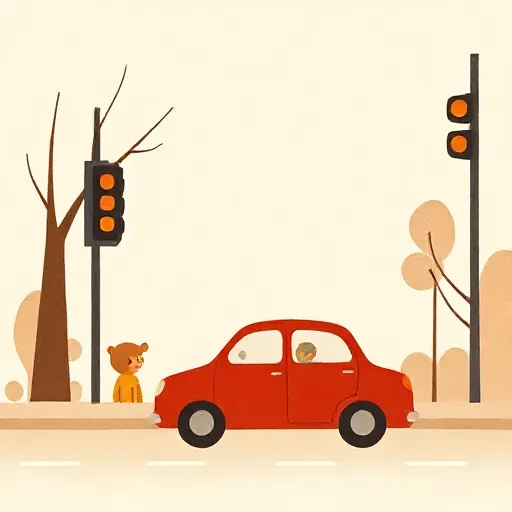
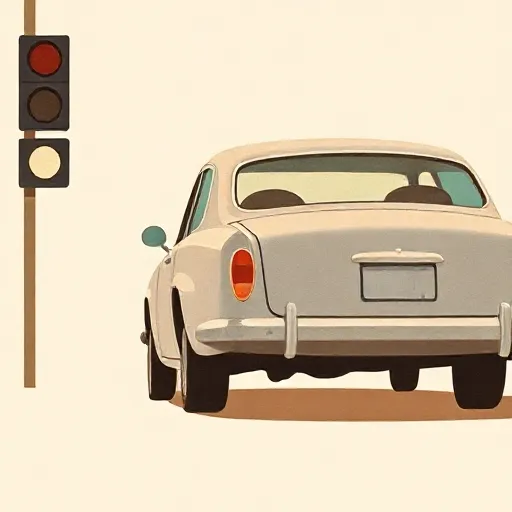
You see a red car sitting at a stop sign. The light turns green and the car rolls forward. It is the same car, right? Something moved, but it did not turn into a different car. Yet think: at one moment the car was at rest, and a moment later it was in motion. The property ‘rest’ and the property ‘in motion’ are opposites. If the very same thing exists at both times, how can it have incompatible properties? This is the puzzle of change.
Take it a step further. What is the car doing at the exact instant the light turns green? If it is already moving, when did it begin? If it is still not moving, how can it ever start? This is the instant of change problem. It is so puzzling that some philosophers concluded change cannot be real at all.
The Philosophers Who Tried to Wish Change Away
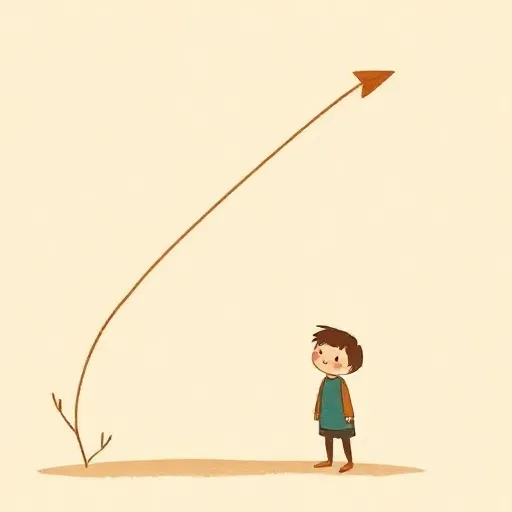
Parmenides (c. early 5th century BCE), a Greek thinker, argued that change is impossible. He claimed that talking about something not existing is talking about nothing — and that is empty. So nothing can come into being or go out of being. Everything that exists must be eternal and unchanging. His student Zeno (c. 490–430 BCE) defended this with puzzles. The most famous is the arrow paradox: imagine an arrow flying through the air. At any single instant, Zeno said, the arrow fills a space exactly its own size, so it is not moving. If it is motionless at every instant, the whole flight is motionless. Motion must be an illusion. Zeno’s reasoning is still hard to dismiss cleanly.
Much later, J. M. E. McTaggart (1866–1925) attacked time itself. He distinguished two ways of ordering events: the A‑series (past, present, future) and the B‑series (earlier, later, simultaneous). He argued that the B‑series can never capture real change because ‘earlier than’ is a fixed relation that never changes. Only the A‑series feels dynamic. However, McTaggart saw a problem: any event is past, present, and future, which looks contradictory. You can only escape by saying it has those properties at different times, but then the same question arises about those new times. Therefore time and change are unreal. Most philosophers reject this radical conclusion, but it forces us to ask what change actually is.
Building Change Out of Still Frames
Aristotle (384–322 BCE) tried to save the idea of change by saying that a thing keeps its substance (what it is) while gaining or losing accidental properties (how it is). A car remains a car even when it moves; motion is just an accident. This is helpful, but it does not explain how the very same substance can first have one property and then its opposite.
The Buddhist logician Dharmakirti (c. 7th century CE) took the logical problem more seriously. He used the Law of the Indiscernibility of Identicals: if two things are truly identical, they must share all their properties. A car-at-rest and a car-in-motion have different properties, so they cannot be the same thing. Dharmakirti concluded that nothing lasts more than an instant. Reality is a sequence of momentary time‑slices. The ‘car’ is just a collection of short-lived stages we group together for convenience. This is the Buddhist doctrine of moments.
The 20th‑century philosopher David Lewis (1941–2001) revived a similar idea, calling it perdurance. Objects are four‑dimensional ‘space‑time worms’ made of temporal parts. Change is simply a difference between one temporal part and another. No single thing ever has contradictory properties. This solves the logical puzzle neatly, but it is hard to accept that you are not really the same person from one moment to the next.
What if Change Really Is a Contradiction?

Some thinkers bite the bullet and say change is genuinely contradictory. G. W. F. Hegel (1770–1831) declared that movement is “existing contradiction itself.” Something moves, Hegel said, not because it is here at one time and there at another, but because at one and the same moment it is both here and not here.
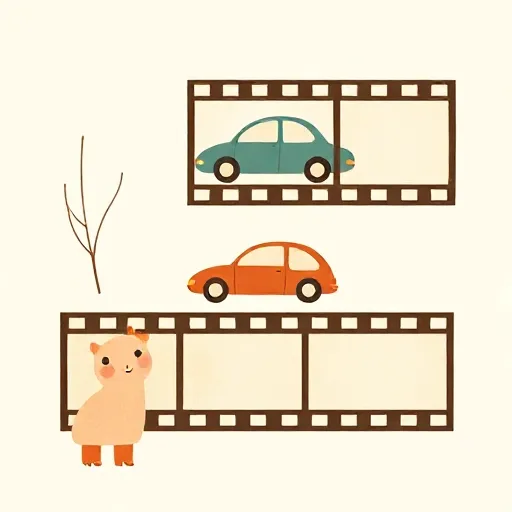
The modern logician Graham Priest (b. 1948) developed this into a full theory. He argues that at the instant a body moves, its position is inconsistent: it smears across a tiny region of space, occupying incompatible locations. Velocity becomes a measure of how spread‑out the contradiction is. This view, called dialetheism, treats some contradictions as true. Priest says that if you try to describe motion without contradiction, you end up with a cinematic view — a series of stills with no real change at any single instant. His approach makes change something that happens right now, not merely a relation between moments.
The philosopher Georg Henrik von Wright (1916–2003) offered a different route. If time is made of intervals rather than points, a period of change might be one where opposite states are so densely interwoven that they cannot be separated without a contradiction. In such intervals, a contradictory description might be the only accurate one.
Your Brain’s Contradictory Movie
It turns out your own brain may already treat change as contradictory. When you see a dot move across a screen, your visual system does not simply compare snapshots. It builds an experience of one single dot that endures while changing place. Psychologists call this the phi phenomenon. If two lights flash in sequence, you see a single moving light, not two separate blips. Your brain identifies the first flash with the second, even though they occur at different times and places.
Motion‑detecting cells (Reichardt detectors) in the brain work by holding onto a signal from one moment and comparing it with the next, creating a kind of superposition of past and present. The result is a perception of something lasting through change that is, on paper, logically inconsistent — but perfectly natural for a brain. This might explain why motion feels immediate and why the sense of a flowing ‘now’ refuses to go away, even if physics treats time as a static four‑dimensional block.
The Riddle Inside You

Why does this ancient riddle matter today? Because you are a changing thing too. Your body grows, your thoughts jump around, and your memories fade. If change were impossible, you could not be the same person from morning to night. But if change is just a bunch of disconnected time‑slices, then what makes you you over time? The philosopher Derek Parfit (1942–2017) argued that personal identity is not a deep fact — there are only psychological connections between your past and future selves. That idea can change how you think about promises, responsibility, and even death.
On the other hand, if your life really is riddled with contradictions, then the world is stranger than any simple logic can capture. The question of change sits at the heart of what you are and what the universe is like. Next time you watch a car pull away or a bird take flight, you will know: under that ordinary event is a riddle that philosophers have not yet solved.
Think about it
- If you were frozen in time for a single instant, would you be moving or still? Could you ever know the difference?
- If you are not the same self you were five minutes ago, can you still be held responsible for a promise you made earlier?
- Can you imagine a universe where nothing ever changes? Would it still have time?