You'll Never Reach the Finish Line: Zeno's Tricky Paradoxes
The Stranger’s Book: A Challenge to Common Sense

It’s a bright morning in Athens around 450 BCE. A crowd has gathered to hear a visitor from southern Italy, the philosopher Zeno of Elea (born around 490 BCE, died perhaps in the 430s BCE). He unrolls a papyrus scroll and begins reading arguments that twist ordinary thinking into knots. In the audience sits a young Athenian named Socrates, barely twenty, listening intently. When Zeno pauses, Socrates asks Zeno whether, if many things exist, they must be both like and unlike, and since that’s impossible, there aren’t really many things at all. Zeno nods. That’s exactly what his book was meant to show: common sense says the world is full of separate moving objects, but Zeno claims he can prove that “many things” leads straight to a contradiction.
One of his most famous attacks on plurality goes like this. If many things exist, they must be exactly as many as they are — no more, no less — so they are limited. But if there are many things, between any two there is always some other thing. And between that new thing and the original ones, there is yet another, and so on without end. That means there are unlimited things. Suddenly the same assumption — that many things exist — forces us to say that things are both limited and unlimited at the same time. That kind of paradox (a conclusion that clashes with what we normally believe) was just the start. Zeno also had even more shocking arguments about motion.
Can You Ever Reach the Finish Line? The Dichotomy and Achilles
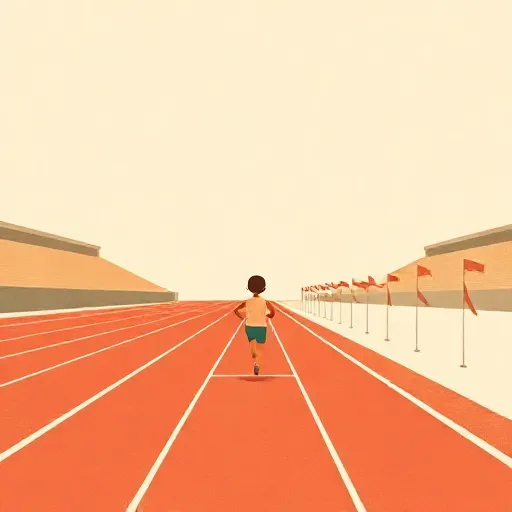
Zeno produced a pair of arguments about races. The first, called the Dichotomy, works like this. Imagine you want to walk across a stadium to the far side. To get there, you must first reach the halfway point. But before you can reach that point, you must first reach the point halfway to it — that’s one-quarter of the way. And before that, you must reach the one-eighth point. Since you can keep dividing any distance in half forever, there are infinitely many halfway points to pass. Zeno argued that you cannot complete an infinite number of tasks in any finite time. So you can never even truly start moving — or, if you somehow start, you can never finish.
Then Zeno turned to a race between the swift hero Achilles and a tortoise. The tortoise gets a head start. Zeno claimed that Achilles can never overtake it. Here’s why: by the time Achilles reaches the spot where the tortoise started (call it point T₀), the tortoise has crawled forward a little to T₁. When Achilles reaches T₁, the tortoise has already shuffled a bit farther to T₂. Every time Achilles arrives at the tortoise’s last position, the animal has moved on. So the tortoise always stays ahead, even as the gap shrinks. This argument uses only the ordinary idea of “getting to where the other started from,” yet it seems to prove that the fastest runner can never pass the slowest. Both arguments feel airtight, but we all know we can walk and win races. So where did Zeno’s reasoning go wrong?
The Arrow That Never Moves

Zeno didn’t stop with runners. He also challenged the idea that a flying arrow actually moves. According to Aristotle, Zeno’s Arrow argument runs like this: at any single instant of time, the arrow occupies a space exactly equal to its own length — it is “against what is equal.” And, Zeno assumed, anything that fills a space exactly equal to itself is at rest. So at every instant during its flight, the arrow is motionless. If the arrow never moves at any instant, the whole flight is just a pile of resting moments. Therefore the arrow never moves at all.
Aristotle objected that Zeno wrongly supposed time is made up of separate, indivisible “nows.” But the puzzle still stings: think of a movie. Each frame is a still picture, yet when the frames flash by fast enough, we see smooth motion. If real time is like a movie, does motion happen within the instants, or only between them? Zeno’s arrow forced philosophers to see that our ordinary picture of time may hide a deep puzzle.
The Real Zeno: Troublemaker, Not a Believer

So what was Zeno really up to? For centuries, people assumed he was defending his teacher Parmenides (born around 515 BCE, died perhaps around 450 BCE), who claimed that only one unchanging thing exists — and that motion and variety are illusions. In Plato’s dialogue Parmenides, the young Socrates suggests that Zeno’s arguments against “many” are just a sneaky way of saying the same thing as Parmenides’ “one.” Zeno immediately corrects him. His book, he explains, was written when he was young, in a spirit of “contentiousness.” He didn’t care about building a grand system; he wanted to show that if people mocked Parmenides for his strange views, their own everyday belief in many moving things led to even more ridiculous contradictions.
Zeno, in other words, was a paradox-monger who loved to make people’s heads spin. Later, Aristotle called him the inventor of dialectic — the art of arguing by setting ideas against each other. Zeno’s clever puzzles didn’t defend a fixed doctrine, but they forced Greek thinkers to sharpen their ideas about space, time, and infinity. The young man who wrote that scroll of forty arguments was, above all, a brilliant troublemaker.
Why Zeno’s Puzzles Still Matter Today

Zeno’s arguments didn’t just stump people in ancient Greece; they changed the course of science. The early atomists Leucippus and Democritus (5th century BCE) decided that matter must be made of tiny, uncuttable pieces — atoms — because if you could keep dividing forever, Zeno’s paradox would seem to make motion impossible. Aristotle himself developed a careful theory of the continuum, distinguishing between a potential infinity (you can always imagine dividing further, but you never actually finish an infinite number of divisions) and an actual infinity (having an infinite set of things already there).
Centuries later, mathematicians invented calculus to sum infinite series and show that Achilles catches the tortoise in a finite time, because halves keep adding up to a whole. Yet the philosophical puzzle remains: if space and time are made of points and instants with no size, how can motion happen at all? Zeno’s paradoxes keep challenging us to look more carefully at the world. They remind us that what seems obvious — like walking across a room — can hide deep mysteries once you start asking, “But why, exactly, does anything move?”
Think about it
- Imagine you’re playing a board game where each turn you move your piece half the remaining distance to the goal. Will your piece ever land exactly on the finish square, or will it inch forever? Why?
- A video-game character leaps from one platform to another. Within each frame, the character is frozen. Does the character actually move, or is the motion just an illusion created by a rapid sequence of still pictures? What does that tell you about real life?
- Zeno’s arguments seem to show that motion is impossible, but you can plainly see yourself moving right now. Which should you trust more — a logical argument or your own eyes? How would you decide?