Why Some Infinities Are Bigger Than Others
A Hotel That Never Runs Out of Rooms

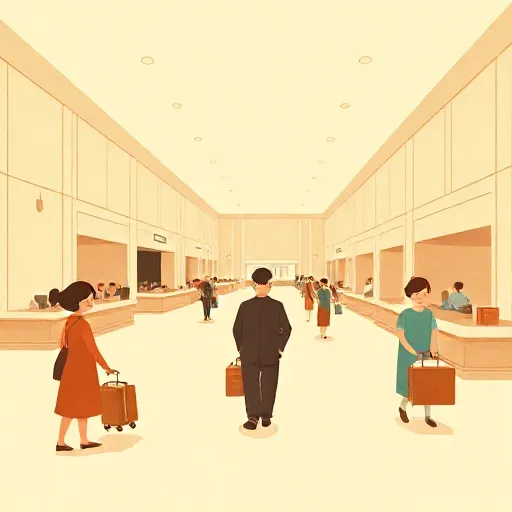
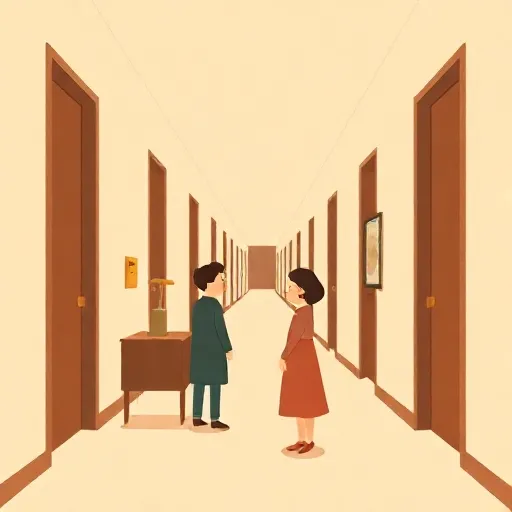
Imagine a hotel with a room for every counting number: room 1, room 2, room 3, and so on, without end. One night every room is occupied — the “No Vacancy” sign is lit. Then a new guest walks in. Can the manager find a room? Surprisingly, yes. She asks the guest in room 1 to move to room 2, the guest in room 2 to room 3, and so on. Room 1 is now empty for the newcomer. Even more astonishing: the manager could make room for an infinite busload of guests by moving each current guest from room n to room 2n, freeing all the odd-numbered rooms.
This thought experiment, known as Hilbert’s Hotel (after the mathematician David Hilbert, 1862–1943), shows that our everyday ideas of “full” and “empty” break down when we deal with the infinite. An infinite set can be the same size as a proper part of itself — something impossible for any finite set. The hotel seems to do the impossible, and that makes infinity both fascinating and puzzling.
Aristotle’s Two Kinds of Infinity
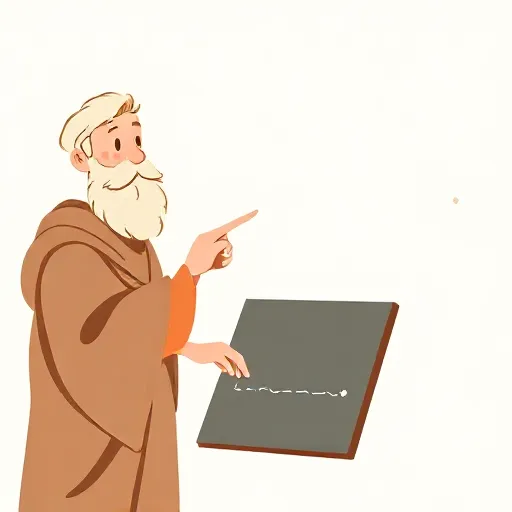
The Greek philosopher Aristotle (384–322 BCE) was one of the first thinkers to try to tame infinity. He noticed that you can keep dividing a line segment in half, and you can always take another half without reaching a smallest piece. Numbers can always get larger by adding one. In his view such processes are potentially infinite — they go on without limit, but at every step you still have a finite result. You never actually hold an “infinite number” in your hand; the infinite is always a possibility, not a finished thing.
Aristotle contrasted this with actual infinity, which would be a completed infinite collection — for example, the set of all natural numbers existing all at once as a single whole, or an infinitely long body. He rejected actual infinity for physical things. The cosmos, he thought, is finite in size; every line segment is finite; every number you can write down is finite. His distinction between potential and actual infinity influenced thinking about infinity for over two thousand years, a careful way to keep infinity from causing trouble without giving up useful infinite processes.
Galileo’s Puzzling Squares and Cantor’s Surprise
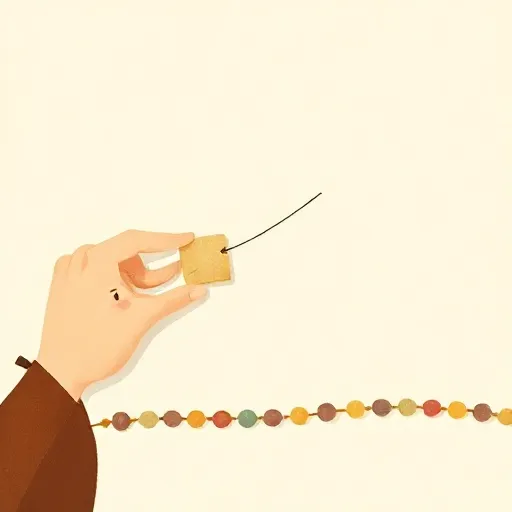
In 1638, Galileo Galilei (1564–1642) spotted a strange thing about infinity. Consider the natural numbers (1, 2, 3, …) and the square numbers (1, 4, 9, …). The squares are a proper part of the natural numbers — there are many natural numbers that are not squares. So it seems there should be fewer square numbers. Yet you can pair them up perfectly: match 1 with 1, 2 with 4, 3 with 9, and so on. Each natural number has a unique square partner, and each square has a unique “root” partner. So it seems there are just as many squares as natural numbers! Galileo concluded that for infinite collections the words “equal,” “greater,” and “less” simply do not apply in the ordinary way.
Two centuries later, the German mathematician Georg Cantor (1845–1918) sided with the pairing intuition. He defined two sets as having the same cardinality if their members can be put into a one-to-one correspondence. Using this definition, the natural numbers, the square numbers, and even the integers and fractions all have the same cardinality — they are countably infinite. But Cantor then proved something even more breathtaking: the real numbers (all the decimals on the number line) cannot be paired one-to-one with the natural numbers. There are strictly more real numbers — a larger infinity. So not all infinities are equal; there is a hierarchy of ever-larger infinite sizes, which Cantor called aleph numbers (ℵ₀, ℵ₁, ℵ₂, …). This discovery still amazes mathematicians today.
Can the World Be Truly Infinite?

If infinity works so strangely in mathematics, can real physical things ever be infinite? Some thinkers have argued that certain puzzles show actual infinities cannot exist in the world. One famous puzzle is Thomson’s Lamp: imagine a lamp that starts off. After one minute you switch it on. After half a minute more, you switch it off. After a quarter minute, you switch it on again, and so on, each switch happening in half the remaining time. After exactly two minutes you have performed infinitely many switches. Is the lamp on or off? The description does not force a single answer — you could set up the lamp’s mechanism to end in either state, or break down before the two minutes are up. Some philosophers take this as a reason to doubt that an infinite series of physical actions can be completed in a finite time.
Others point out that the universe itself might be infinite in space or time. Immanuel Kant (1724–1804) argued that both the claim “the world has a beginning” and “the world has no beginning” lead to contradictions, like an unsolvable stalemate. He thought our minds cannot grasp the true extent of space and time. Yet later mathematics, especially curved geometries developed by Bernhard Riemann (1826–1866), showed that a space can be finite without having a boundary — just as the surface of a sphere is finite yet you can walk forever without hitting an edge. So the question of whether our universe is finite or infinite is still open and depends on the actual shape of space, not just on reasoning alone.
Betting on Infinity: Pascal’s Wager
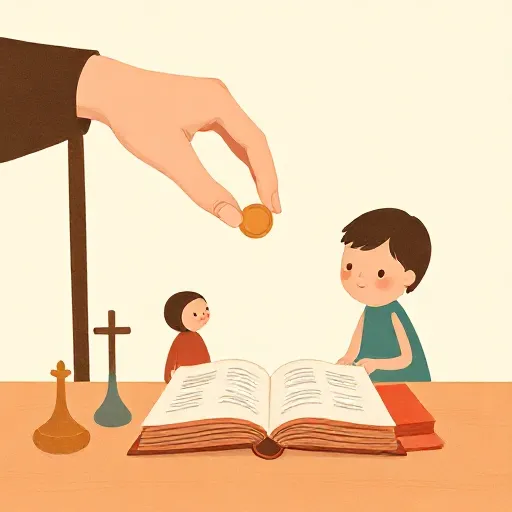
Infinity also enters the choices we make. The French philosopher and mathematician Blaise Pascal (1623–1662) presented a famous decision problem. Even if you cannot be sure whether God exists, you must still decide how to live — as if you are placing a bet. Pascal framed it this way: if you live as if God exists and it turns out God does exist, you gain an infinite reward (eternal happiness). If God does not exist, you lose only a finite earthly pleasure. The expected value of “wagering for God” is infinite, while the alternative has a finite expected value. Pascal concluded that reason requires you to wager for God.
Many later thinkers objected. If a utility can be infinite, then any action that gives even a tiny positive chance of that infinite reward would also have infinite expected value, making all such actions equally rational — which seems absurd. Others questioned whether we can make sense of infinite utility at all. And if infinitesimal probabilities are allowed, perhaps the product of an infinite utility and an infinitesimal chance could be a finite number, upending the argument. The debate continues, and it illustrates how infinity can dramatically warp our usual calculations of risk and reward.
The Shape of Space: Finite Yet Unbounded
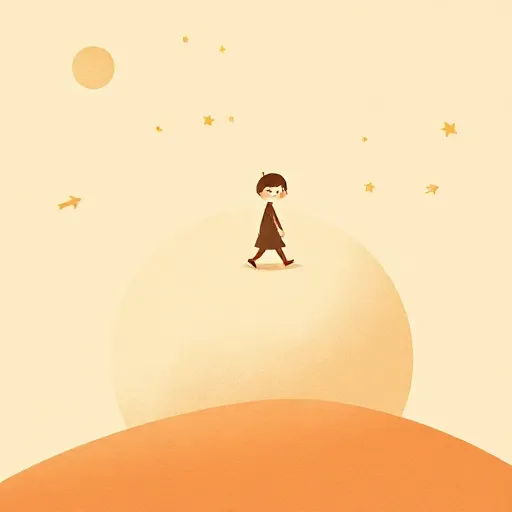
Until the nineteenth century, most people assumed that space stretches out infinitely in all directions, like an endless flat plain. When Kant wrestled with whether the world is finite or infinite, he did not yet have the mathematical imagination to conceive of a three-dimensional space that curves back on itself. Riemann’s geometry of constant positive curvature produced the 3-sphere, a finite universe that has no boundaries and no edges. In such a space, if you set off in a straight line, you would eventually loop back to your starting point, like an ant circling the surface of a balloon.
Albert Einstein’s general theory of relativity, introduced in 1915, describes space-time as a flexible fabric that can be curved by matter. Einstein’s equations allow both finite and infinite solutions. Today cosmologists search for clues — tiny patterns in the oldest light, the cosmic microwave background — that might reveal whether the universe is finite and the shape of its topology. The answer could change how we picture our home in the cosmos: a finite yet unbounded expanse, or an actual, never-ending infinity.
Why Infinity Matters in Your Life

You might never need to manage an infinite hotel or wager on an infinite reward. But infinity sneaks into your thinking more often than you realize. When you wonder, “Can the stars go on forever?” or “Is there a smallest thing?” you are chasing the same questions that puzzled Aristotle and Cantor. The idea that some infinities are larger than others helps mathematicians build the number systems behind computers and physics. The debate over whether space is finite or infinite fuels real scientific missions.
Even in everyday decisions, you sometimes face a kind of infinite regress: why choose one thing over another? If every reason needs a further reason, where does it stop? Infinity pushes us to ask whether some things must be accepted as starting points. So next time you stretch a rubber band, watch a timer count down, or gaze at the night sky, remember: infinity doesn’t have to make sense in the ordinary way — but thinking about it can make your own world a little larger.
Think about it
- If a mathematician proved that the universe contains an actual infinite number of stars, would you find that idea exciting or unsettling — and why?
- Can you think of a real situation in your life where having more possibilities is not always better? What does that tell you about the need for limits?
- If you could flip a coin infinitely many times, would every possible sequence of heads and tails happen somewhere? What would that mean for the idea of “impossible”?