Are Some Infinities Bigger Than Others?
The Question That Started It All
In the autumn of 1873, a young German mathematician named Georg Cantor (1845–1918) wrote a letter to his friend Richard Dedekind (1831–1916). He asked a question so simple it seemed almost silly. You have the natural numbers: 1, 2, 3, and so on forever. You also have the real numbers — all the decimals like 3.7, π, or the square root of 2. Could you pair each natural number with exactly one real number, so that no real number is left over? In other words, are these two endless collections the same size?
Pairing is easy when you count things. You know two boxes have the same number of socks if you can match every sock in one box with a sock in the other, none missing. That idea — a one-to-one correspondence — works for infinite sets too. Cantor showed that the natural numbers and the real numbers cannot be paired. There are more real numbers. Infinity has different sizes.
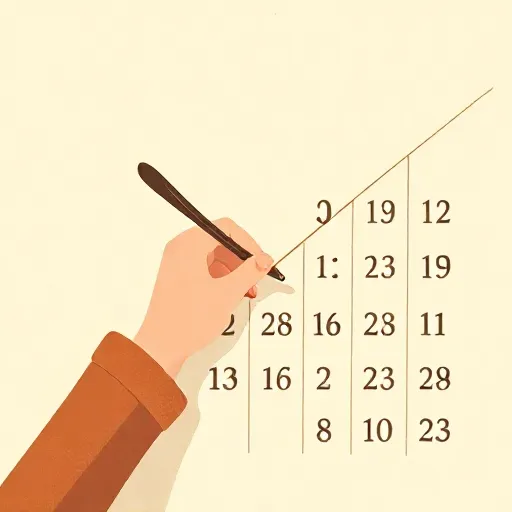
His proof is a famous trick. Imagine you could list every real number between 0 and 1 in a long column. Cantor showed how to build a new number that cannot be on your list. He went down the diagonal, changing each digit. That new number differs from the first at the first decimal place, from the second at the second place, and so on. So your list was incomplete. The real numbers are uncountable. Their cardinality — the size of the set — is larger than that of the natural numbers.
Before Cantor: Why Mathematicians Feared Infinity
For centuries, most mathematicians treated infinity as a way of speaking, not a real thing. Carl Friedrich Gauss (1777–1855) warned that you should never say a number is infinite; you can only say it grows beyond any bound. He feared that treating infinity as a completed object would cause logical nightmares.
Yet some thinkers pushed back. Bernard Bolzano (1781–1848) argued in 1851 that many paradoxes about infinity are harmless. He even described putting two infinite collections into one-to-one correspondence, like matching the interval [0,5] with [0,12] by a simple multiplication. But he resisted saying the two sets have the same size — old ideas about measurement still held him back.
The real shift came when mathematicians began thinking of collections as objects you could manipulate. Bernhard Riemann (1826–1866) used the word Mannigfaltigkeit (manifold) to describe a class of things together, and he dreamed of basing all geometry on such general collections. Richard Dedekind, in 1871, defined ideals in number theory as special subsets of numbers and operated on them like new objects. He treated a set as a single thing, not a scattered many. That leap — from a collection of many items to one mathematical object — was the secret ingredient for set theory.
Climbing Beyond Endless: Transfinite Numbers

Cantor’s own path started with studying limit points of sets of real numbers. He noticed you could take the derived set (all limit points) of a point set, then the derived set of that, and keep going. Some sets required infinite iterations. That led him to imagine numbers after all the finite ones.
He introduced two principles. First, given any number, you can make its successor. Second, after any sequence of numbers without a final one, there is a next number that comes immediately after all of them. So after 1, 2, 3, … comes the first transfinite number, ω (omega). Then ω+1, ω+2, … up to ω+ω, ω·ω, and far beyond. Cantor called these transfinite ordinals. They describe the order type of a well-ordered set — a set where every subset has a least element, like the natural numbers but arranged in much stranger ways.
Ordinals let Cantor build a ladder of ever-larger infinite cardinalities. The natural numbers have cardinality ℵ₀ (aleph-null). The set of all countable ordinals (the second number class) has a strictly larger cardinality, which he called ℵ₁. Could the real numbers have cardinality ℵ₁? Cantor believed yes. That guess is the Continuum Hypothesis — one of the most famous open problems in mathematics.
The Paradise of Sets Turns Troublesome
Around 1900, the new set theory ran into deep trouble. Cantor himself discovered that the collection of all ordinals would have to be an ordinal larger than itself — an impossibility. This is the Burali-Forti paradox. Worse still, using his own theorem that every set has a bigger cardinality, the “set of all cardinals” would be smaller than a cardinal it contains. These contradictions showed that not every well-defined collection can be a set.
The most famous shock came from Bertrand Russell (1872–1970) in 1901. He considered the set R of all sets that do not contain themselves. If R is a member of itself, then by definition it cannot be. But if it is not a member of itself, then it must belong to R. This is a direct contradiction, built from only the ideas of set membership and negation. When Russell wrote to Gottlob Frege (1848–1925), who was trying to ground arithmetic in logic, Frege saw his life’s work unravel. The principle that any property defines a set — the principle of comprehension — was fatally flawed.
Cantor thought he could solve the problem by calling some collections too big to be sets, but he had no clear rule for which ones were safe. The crisis demanded a new, careful foundation.
Axioms to the Rescue and the Unfinished Story
Ernst Zermelo (1871–1953) answered the crisis. In 1908 he published an axiomatic system — a list of precise rules about what sets exist and how you can build new ones. His rules blocked the known paradoxes. For example, you can’t just form the set of all sets; you can only collect elements from an already existing set using a definite property. That sidesteps Russell’s loop.
One axiom stirred fiery debate: the Axiom of Choice. It says that from any collection of non-empty sets, you can pick exactly one element from each, even if you have no rule for choosing. Many mathematicians found this suspect, because it declares the existence of a set without giving a recipe. It led to strange results, like the Banach-Tarski paradox (a ball can be split into a few pieces and reassembled into two balls of the same size). Yet the axiom became essential for countless theorems. The controversy settled only after Kurt Gödel (1906–1978) proved that if the usual axioms are consistent, adding Choice doesn’t create new contradictions.
Gödel also showed that the Continuum Hypothesis cannot be disproved from the standard axioms. Decades later, Paul Cohen proved it cannot be proved either. So the most famous question about infinity is independent of the usual rules — you can adopt it or not, and both ways are consistent. Which version is “true” remains a deep philosophical puzzle.
Why Counting Infinity Still Matters
Next time you use a number, a graph, or a computer program, you are living in a world built on set theory. The language of sets defines what functions, numbers, and spaces are. The paradoxes taught mathematicians to build arguments carefully, checking every assumption. The discovery that infinity comes in different sizes is as mind-bending today as it was in 1873.
The debate over the Continuum Hypothesis is not just a technical game. It asks how many points are on a line — a question at the heart of geometry and physics. And the very idea that some truths about infinite collections may be beyond proof challenges our confidence in what mathematics can know. So when you stare at the endless number line, you are staring at an open frontier. Are some infinities bigger than others? Yes — but how many sizes there are between them is still a mystery.
Think about it
- If you could list every real number, would the diagonal trick still work? Why or why not?
- Imagine a universe where every mathematical question has an answer. Is it okay if some answers can never be proved — only assumed?
- If a mathematical rule lets you build a paradox, does that mean the rule is wrong, or that our understanding of “set” needs to change?