
Who Made Up Money? And What About Race?
The Paper That Buys a Candy Bar

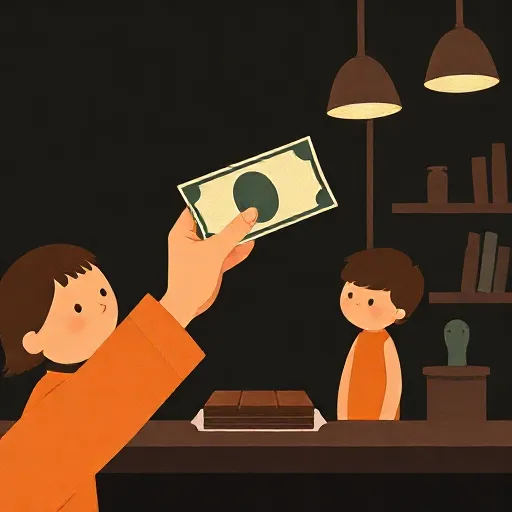
You reach into your pocket and pull out a crumpled dollar bill. It’s a small rectangle of cotton and linen. It can’t do anything on its own. Yet if you hand it to the person behind the snack counter, they’ll give you a candy bar. Why? Because everyone around you acts as if that piece of paper has value. The paper buys things not because of what it is, but because of how we all treat it.
Philosophers call this kind of thing a social construction. When something is socially constructed, it exists or has the features it does because people—through their words, thoughts, and shared practices—make it that way. The basic formula is simple: some group of people (or some cultural pressure) X socially constructs Y.
But not all construction works the same way. One big distinction is between causal construction and constitutive construction.
In causal construction, our actions bring something into existence or keep it going. If you build a watch from bits of metal, you causally construct it. Without you, the watch would not be there. The dollar bill’s physical existence is also causal—a government mint printed it.
Constitutive construction goes deeper. It means that what the thing is depends on our concepts and social agreements. A gathering of people in a room becomes a cocktail party only if the people there think of it as a cocktail party. The philosopher John Searle (born 1932) made this point. Remove that shared understanding, and you still have a bunch of people with drinks—but you no longer have a cocktail party. The party is constituted by our attitudes toward it. Money works the same way: the value of that dollar bill is not in the paper but in the agreement that it counts as money.
When a Diagnosis Creates an Epidemic

If money and parties are openly constructed, what about kinds of people? The philosopher Ian Hacking (1936–2023) argued that human categories can also be socially constructed—not just described by labels, but shaped by them.
Hacking studied a strange episode. In the late 1800s, European doctors described a condition called fugue, in which a person would suddenly wander off and forget who they were. Soon, cases surged. People seemed to perform the very symptoms the doctors had named. Hacking called this the looping effect: a new category is invented, people begin to see themselves in that category and change their behavior to fit it, and the changed behavior then seems to confirm that the category was real all along. The label doesn’t just point to a pre-existing thing—it helps bring the thing into being.
A similar pattern appeared with multiple personality disorder in the United States in the 1980s, Hacking noted. The idea that a single person could contain many separate selves spread through therapy and media. Diagnoses multiplied. The classification itself changed how some people experienced their own minds.
The looping effect is a form of causal construction. Our concepts cause behaviors that wouldn’t have occurred otherwise. Judith Butler (born 1956) pushed a related thought further. She argued that gender is a performance—that the acts, gestures, and styles we repeat create the appearance of an inner “gender core.” There is no hidden essence behind the show; the show is what makes the category feel natural.
Is Race Like a Cocktail Party?

Money and cocktail parties are clearly social. But what about things we usually think of as natural, like race or mental illness? Some philosophers say these are covert constructions—they look like facts about nature, but a closer look reveals they are produced by our social practices.
For instance, the historian Michel Foucault (1926–1984) famously argued that there were no homosexuals in earlier centuries. That sounds wild. But Foucault meant that the concept of a homosexual person—a distinct type of human defined by desire—emerged only in the 19th century. Before that, same-sex acts existed, but they weren’t seen as marking a deep identity. The concept didn’t just name the reality; it helped make that reality possible.
Charles Mills (born 1951) has argued something similar about race. The borders of racial categories, he suggests, were drawn to establish and protect the privileges of some groups over others. The “one-drop rule” in the United States was not a scientific discovery—it was a tool for maintaining racial hierarchy. On this view, race is not a biological fact but a social invention with powerful consequences.
This kind of claim runs into a sharp objection. The philosopher Paul Boghossian (born 1957) asked: isn’t it part of the very concept of things like electrons or mountains that they exist independently of us? If race is covertly constructed, doesn’t that clash with how we ordinarily think about it?
One answer borrows a tool from the philosophy of language. Sometimes we are wrong about what our own words really refer to. For centuries, people thought “water” meant whatever wet, drinkable stuff fell from the sky. We later discovered that water is H₂O—a fact that was true all along, even when nobody knew it. Philosophers call this a necessary a posteriori truth: it is necessarily true that water is H₂O, but we learned that truth through investigation, not just by thinking. Similarly, perhaps the word “race” has always referred to a social kind, even though most people mistakenly believed it referred to a biological kind. Investigation—historical, sociological, political—reveals the necessity. In this way, a constitutive constructionist can grant Boghossian’s point that our ordinary concept seems to point at nature, while still insisting that the real thing turns out to be social.
This strategy remains debated. But it shows that the question is far from settled. Are categories like race and gender more like electrons, or more like cocktail parties? The answer matters enormously for how we live together.
The Power to Change Reality

If something is socially constructed, then it can be reconstructed. That is the great promise—and the great danger—of constructionist thinking.
Once we see that a category is made by us, we become responsible for it. Hacking’s looping effect shows how medical labels can create new ways of being a person. Those labels can liberate or trap. For example, learning that your anxiety has a name can bring relief and community. But the same label can also narrow your sense of what is possible and mark you as “broken.”
Philosophers have noticed that constructionist explanations put human choices in the spotlight. If a group of people sustains an unjust social arrangement, they are morally answerable for it. Constructionism isn’t just a story about how the world is; it’s also an invitation to ask how the world ought to be.
There is a lively argument about whether causal or constitutive construction is more helpful for change. Some say constitutive construction is politically powerful: if a category is made by our concepts, then changing those concepts instantly changes the category. Others reply that causal construction matters more, because real harm lives in the causal effects, not in the definition. The debate reminds us that philosophy and action are tangled together.
So… What Do You Do With a Label?
Next time you hear someone say, “Boys are just like that” or “She’s born to be a leader,” ask yourself: is this a fact about nature, or is it something we’ve built together and can build differently?
Social construction is not about deciding that everything is fake. It’s about paying attention to the hidden work our minds and communities do in making the world what it is. That work is real, powerful, and always up for reexamination.
Think about it
- If everyone tomorrow forgot what money was, would the bills still be valuable? What would have to happen for them to become just paper again?
- Can you think of a label someone gave you (like “shy” or “class clown”) that ended up shaping how you acted? Did the label create the trait or just describe it?
- Scientists might one day find a clear biological basis for some mental illnesses. If that happens, does it mean those illnesses were never socially constructed? Why or why not?