Can a Sentence Break Itself? The Puzzle of Self-Reference
The Sentence That Breaks Itself

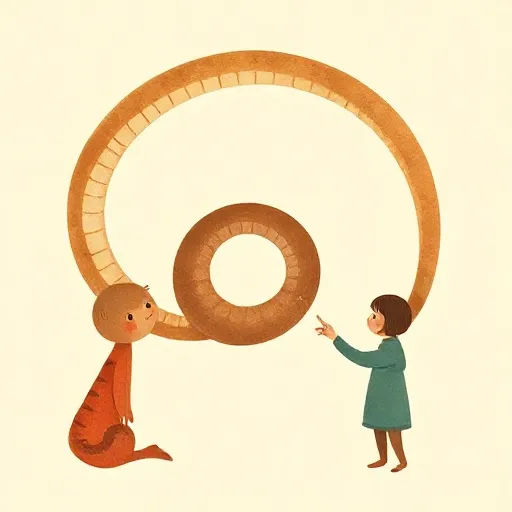
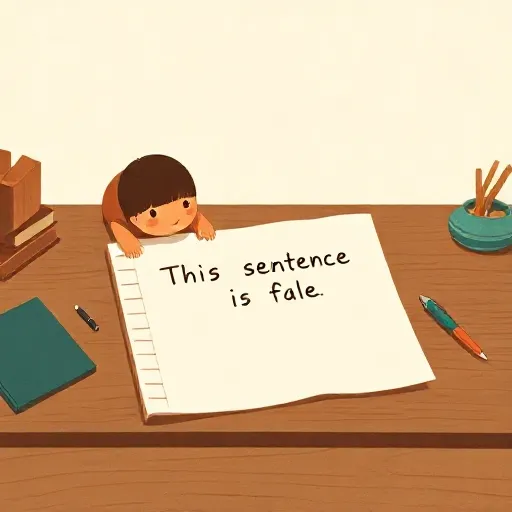
Imagine you pick up a note that says only one thing: “This sentence is false.” Try to figure it out. If the sentence is true, then what it says must be correct — so it really is false. But if it’s false, then what it says is wrong — so it can’t be false, it must be true. Around and around you go. You’re trapped.
This is the liar paradox, one of the oldest mind‑benders in philosophy. The ancient Greek thinker Eubulides of Miletus (4th century BC) is often credited with discovering it. A paradox is an argument that starts from reasonable assumptions but leads to a contradiction — an impossible result. The liar paradox belongs to a family called semantic paradoxes, because it plays with the meaning of truth itself. For over two thousand years, these puzzles were mostly seen as clever word games. But in the last century, they turned into something far more serious: cracks in the very foundations of mathematics and computing.
When Sets Eat Themselves

At the turn of the 20th century, mathematicians were trying to build a perfect logical house for all of mathematics. The bricks were sets — collections of things. The commonsense rule was this: for any description you can write down, there exists a set of all the things that match it. This is called unrestricted comprehension.
Then the philosopher and mathematician Bertrand Russell (1872–1970) asked a dangerous question. Take the description “sets that do not belong to themselves.” Most sets are like that — the set of all cats is not itself a cat. Now call the collection of all such sets R. Does R belong to itself? If R belongs to itself, then by definition it must not belong to itself. But if R does not belong to itself, then it fits the description and must belong to itself. We get a contradiction either way.
Russell wrote to the great logician Gottlob Frege in 1901, and Frege famously replied that his life’s work had collapsed. Russell’s paradox showed that the naive idea of a set was inconsistent. It has exactly the same underlying structure as the liar paradox — a loop of self‑negation — but now it was at the heart of mathematics.
A Paradox Without Self‑Reference?
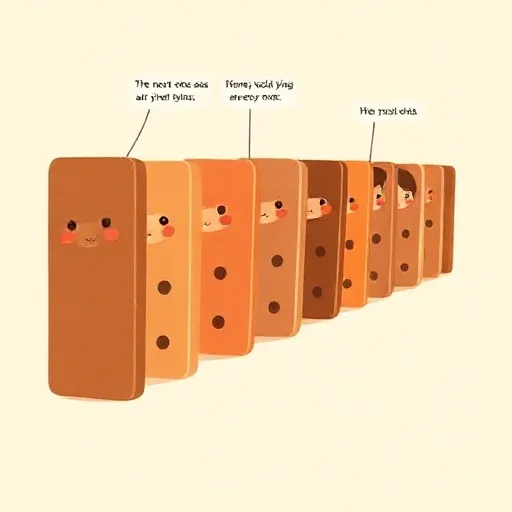
For a long time, everyone assumed that self‑reference was the troublemaker. A sentence that talks about itself can get tangled. But in 1985, philosopher Stephen Yablo built a paradox that seems to have no self‑reference at all.
Imagine an infinite line of people. The first person says, “Everyone behind me is lying.” The second person says, “Everyone behind me is lying.” And so on, forever. If the first person is telling the truth, then everyone behind them is indeed lying — including the second person. But if the second person is lying, then there must be someone behind them who is telling the truth, which contradicts the first person’s claim. If instead the first person is lying, then someone behind them must be telling the truth — say, the fifth person. But then the fifth person is claiming that everyone behind them is lying, and the same contradiction appears.
Yablo’s paradox (sometimes called the ω‑liar) shows that you don’t need a tight loop of self‑reference. A never‑ending, downward‑spiraling chain of reference can produce the same logical crack. It turns out that the real culprit is something more general: non‑wellfoundedness — a structure that has no solid bottom to rest on.
How These Puzzles Changed Math and Computers
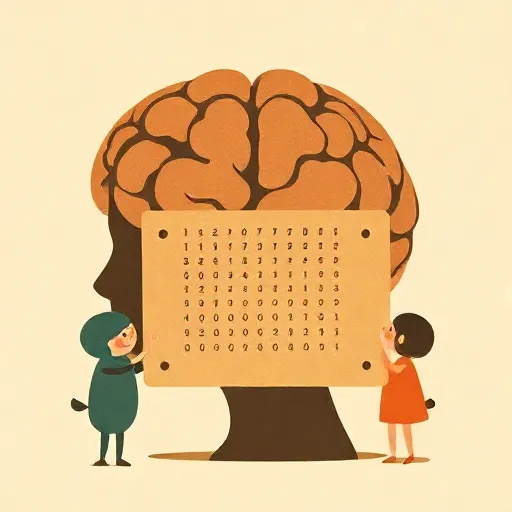
These aren’t just party tricks. The liar‑like structure popped up in three of the most important discoveries of modern logic.
First, Alfred Tarski (1901–1983) proved that no consistent formal language can contain its own truth predicate if it follows ordinary logic and arithmetic. If you could always say “this sentence is true” in the language itself, you could also construct the liar sentence and break everything. Truth, he concluded, must be split into levels — you can talk about truth in a lower language only from a higher, safer one.
Second, Kurt Gödel (1906–1978) used a similar self‑referential trick to prove his famous incompleteness theorems. He showed that in any system of arithmetic powerful enough to describe itself, there are true statements that can never be proved inside that system. In essence, he built a mathematical version of the liar sentence: a statement that says, “I am not provable.” If you try to prove it, you get into a tangle.
Third, Alan Turing (1912–1954) took the idea into the world of computing. He asked whether a computer program could ever decide if another program will eventually halt or run forever. By feeding a program a twisted description of itself — a computational version of Russell’s paradox — he proved the halting problem is undecidable. No universal error‑checker can exist. The liar paradox had migrated from philosophy into the hardware of the machines we use every day.
Can We Escape the Loop?

So how do we fix the cracks? Philosophers and mathematicians have tried several strategies.
One is to build hierarchies. Russell himself invented type theory, where sets come in strict levels — a set can only contain sets from a lower level, never itself. Tarski did the same for languages: each language layer can talk about truth only in the layers below it. The liar sentence can’t even be formed, because no sentence can speak of its own truth‑level. This works, but it feels heavy‑handed. Ordinary speech doesn’t come with level labels, and sometimes self‑reference is perfectly harmless — like when we say, “Everything I’m saying right now is in English.”
Another approach, developed by Saul Kripke (1940–2022) in 1975, allows a three‑valued logic: sentences can be true, false, or undefined. The liar sentence ends up undefined — neither true nor false. That avoids contradiction, but it creates a new problem: we can’t express in that same language that the liar sentence is undefined. Enter the strengthened liar: “This sentence is either false or undefined.” The revenge problem pops right back up.
A more radical view is dialetheism, defended by contemporary philosopher Graham Priest. It suggests that some contradictions really are true — that the liar sentence is both true and false at the same time. This requires a paraconsistent logic that doesn’t explode when a contradiction appears. Most mathematicians find this hard to swallow, but it’s a live debate.
Why It Still Matters

You might still wonder: why should a twelve‑year‑old care about some ancient word game? Here’s why. Every time your phone freezes because an app got stuck in a loop it can’t check, you’re brushing up against the same logical wall. The inability of a computer to fully understand itself — to decide in advance what every program will do — is a direct descendant of the liar paradox.
These puzzles also teach a deeper lesson. They show that some of the most obvious, innocent‑looking rules — “for every property there’s a set of things with that property,” or “a sentence can talk about truth” — secretly carry a bomb inside. Figuring out which rules are safe and which aren’t is still an open project. There is no single agreed‑upon solution to the paradoxes. That means the foundation of logic, mathematics, and language is still being built — and you could be one of the builders.
Think about it
- If your friend says, “I’m lying right now,” can you ever figure out whether they’re telling the truth? What follow‑up question would you ask that might help?
- Imagine a robot that is programmed to say only one thing: “The next sentence I speak will be a lie.” Then it shuts down without saying anything else. Is that first sentence true or false? What does your confusion tell you about the robot’s programming?
- If scientists ever build a computer that truly understands language, do you think it would be able to handle the sentence “This statement is false”? Why or why not?