
Can a Sentence Say It Is False Without Contradiction?
The Statement That Tangled Itself in Knots

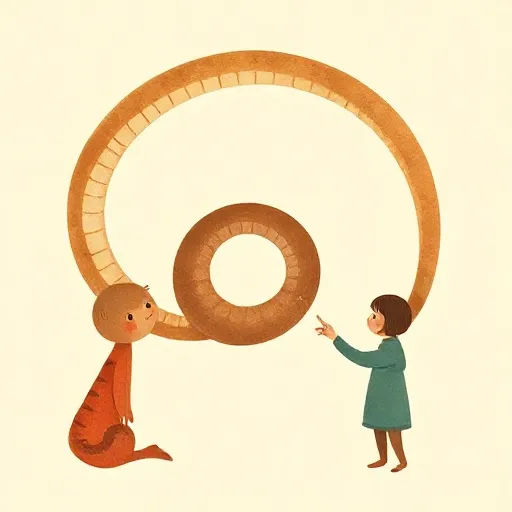
It is 1322 in Oxford. A student named Thomas Bradwardine listens to a debate that could make your brain feel like a snake eating its own tail. The puzzle goes like this. Suppose Socrates says, “What I am saying right now is false.” Is he telling the truth? If he is, then what he says is correct—so he really is saying something false. But if he is saying something false, then his claim is wrong, which means he is not saying something false after all—so he must be telling the truth. Round and round it goes.
This is the Liar paradox. Ancient Greeks knew it; legend says the poet Philetas of Cos worried about it so much that he could not sleep and died of exhaustion. Medieval thinkers called these puzzles insolubles—statements that seem impossible to decide. Unlike us, they had almost no direct access to the old Greek texts. What they did have was a short remark by Aristotle, who hinted that the Liar might be a mistake of mixing up things said conditionally with things said absolutely. That hint was enough to light a fire.
Early Fixes: Cancel the Sentence or Block Self‑Reference
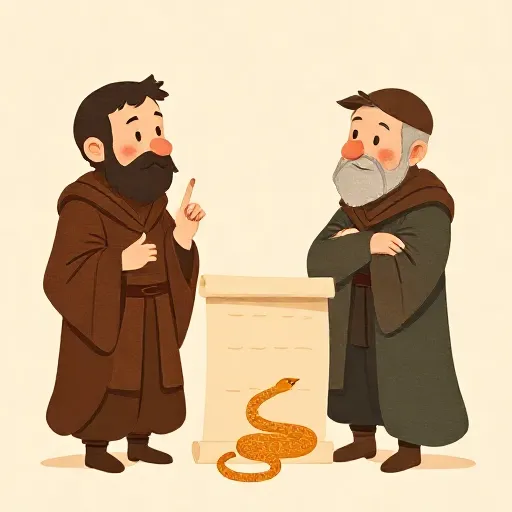
The earliest attempts to tame insolubles were wild and direct. One was called cassation—making the statement null and void. Around 1200, Stephen Langton (c. 1150–1228) argued that certain tangled sentences do not actually say anything. If you say, “Socrates, of whom nobody is speaking, is a man,” you have not asserted a real claim because the very act of speaking about Socrates contradicts the “nobody is speaking” part. The words cancel themselves. Some logicians applied the same idea to “I am lying”: the speaker fails to produce a genuine proposition, so there is no puzzle.
A more popular idea was restriction. Many logicians—called restricters—said that a word in a sentence cannot point back to the sentence it belongs to. If you forbid that kind of self‑reference, the Liar never gets started. The problem? Harmless sentences like “This sentence has five words” are self‑referential but not paradoxical. A weaker version allowed self‑reference only when it did not cause trouble, which sounded like saying “you can do anything except cause a paradox”—true but not very helpful.
Bradwardine’s Big Idea: Sentences Mean More Than You Think
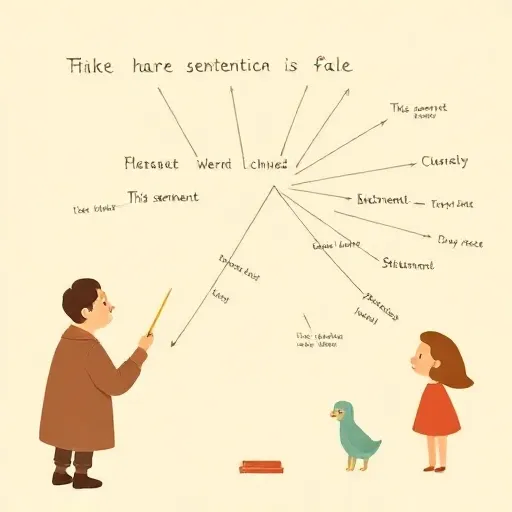
Thomas Bradwardine (c. 1300–1349) changed the game. For him, a sentence is not just a single claim; it carries a whole bundle of meaning. In his theory, a proposition is true only if everything it signifies—everything it really says about the world—is exactly the case. If even one part of that bundle is wrong, the whole proposition is false.
His key step was a principle: whatever must follow from what a sentence says is also part of what it says. Imagine a sign that reads “This sign is broken.” If it is broken, the sign is correct—so it works. If it works, it is not broken—so it lies. Bradwardine would say you are missing the bigger picture. The sign actually signifies both that it is broken and that it is true. Those two claims cannot both hold, so the sign is false. No self‑reference needs to be banned; the sentence just tries to say too much and contradicts itself. Later writers called Bradwardine “the first who discovered something worthwhile about insolubles.” His idea spread for generations.
Heytesbury’s Challenge: You Tell Me What It Means

While Bradwardine told you what the hidden meaning must be, another Oxford logician refused to guess. William Heytesbury, writing in 1335, treated insolubles as a debating game. He said a sentence like “Socrates is uttering a falsehood” becomes a paradox only in a carefully set‑up scenario: Socrates says that sentence and nothing else, and the words mean exactly what they normally do.
Heytesbury argued that in that precise situation, the words cannot mean only their ordinary meaning; if they did, a contradiction would follow. So if you want to claim a real paradox exists, you must tell him exactly what the sentence signifies besides its ordinary meaning. Otherwise, your scenario is impossible from the start. It was a clever “shift the burden” move. Later logicians often mixed his approach with Bradwardine’s: they said the extra meaning is that the sentence claims it is true. That combination became one of the most popular views for centuries.
Swyneshed’s Astonishing Claims: False Sentences That Get Reality Right
Roger Swyneshed, writing around 1330–1335, went further. He agreed that a true sentence needs something extra, but he drew startling conclusions. For him, a proposition is true only if it signifies as is the case and does not falsify itself. The sentence A that says “A is false” falsifies itself, so it is false. Yet it still signifies exactly what is the case—it correctly reports that it is false. Swyneshed accepted that some false sentences can perfectly describe reality.
This led to two mind‑bending claims. First, from a true premise you can sometimes validly reach a false conclusion, because the false conclusion simply falsifies itself. Second, A and its contradictory “A is not false” can both be false at the same time. That breaks the usual law that one of two contradictories must be true. Many medieval logicians thought this was ridiculous; others, like the great Paul of Venice a few generations later, adopted Swyneshed’s view as their own.
Why Medieval Logic Still Matters Today

The Liar paradox is not a dusty museum piece. You might see it on a T‑shirt that says “This T‑shirt lies” or in a puzzle game that breaks your brain. Modern philosophers and mathematicians still argue over how to tame self‑referential sentences without crippling ordinary language. The medieval solutions—hidden meanings, shifting the burden, revising the rules of truth—look surprisingly like today’s strategies.
Bradwardine’s idea that sentences carry more meaning than we notice reminds us that language is richer than it seems. Heytesbury’s challenge pushes us to say exactly what we mean. Swyneshed’s radical truth rule makes us wonder whether we really understand what it is for something to be true. None of these thinkers claimed to have the last word. Heytesbury himself admitted his opinion was not perfect, “because I do not see that this is possible.” That humility, combined with fierce curiosity, is what philosophy still runs on.
Think about it
- If you write a note that says “This note is a lie,” and you mean it exactly that way, do you think you have written something true, false, or neither? Why?
- Imagine a shop with only one sign that reads “All signs in this shop are false.” Is that sign telling the truth? Can you find a way out without throwing the sign away?
- Could a computer be programmed to handle the Liar paradox? What do you think would happen if you asked a chatbot, “If I say to you ‘You are lying,’ is that true?”