
Was Roger Bacon a Wizard, a Scientist, or Something In-Between?
A Secret Letter Changes Everything

One day in 1266, a letter arrived for a Franciscan friar living in Paris. It came from Pope Clement IV, and it said something surprising: that Bacon should ignore the rules of his order, write down his remedies for what was wrong with learning, and send them to the Pope in secret. The friar was Roger Bacon (c. 1214 or 1220–1292), and he had been waiting decades for someone to ask.
Bacon had already spent forty years studying everything he could get his hands on. He taught Aristotle at the University of Paris in the 1240s, then walked away from the usual academic grind to focus on languages, mathematics, and hands-on investigation. He learned about optics from Arabic scholars, pored over alchemical recipes, and grew convinced that the schools were making a giant mistake. They argued endlessly over words, he thought, but spent almost no time testing ideas against the actual world.
So when the Pope’s letter came, Bacon launched into the most intense writing project of his life. In about a year and a half, he produced the Opus maius — the “Greater Work” — plus several smaller follow-ups. The package he sent to Rome included a groundbreaking study of light and vision, a proposal for a new experimental science, and a map of the world. It was either the work of a visionary or a very strange monk. Probably both.
What Did Bacon Think Was Wrong With School?

To understand Bacon’s project, you have to understand what he was pushing against. The universities of his day ran on disputation. A teacher would pose a question, students would line up arguments for and against, and everyone would sharpen their logical knives. It was great training for lawyers and theologians. Bacon thought it was terrible training for knowing how nature actually works.
Bacon listed four causes of error that kept people stuck. First, they trusted unworthy authorities. Second, they followed long custom without checking whether it still made sense. Third, they believed uncritical popular opinion. Fourth, they hid their confusion behind fancy rhetorical words. Sound familiar? Those four habits can trap anyone — even today.
His remedy was twofold. First, he argued that scholars needed to read texts in their original languages — Hebrew, Greek, and Arabic — instead of relying on shaky Latin translations. (He even wrote Greek and Hebrew grammars himself.) Second, and much more famously, he insisted that reasoning alone was not enough. You had to go look. You had to measure, test, and verify. Logic could tell you whether an argument was consistent; only experience could tell you whether it was true.
Light, Force, and the Science of Seeing

Bacon’s favorite example of a real science was optics, the study of light and vision. For him, optics was not just about mirrors and lenses. It was a model for how any genuine science should work: you start with geometry, you apply it to physical things, and you check your ideas against careful observation.
To build his optics, Bacon drew on a concept he called species. A species was not a biological category. It was the force or power that radiates from every object in the universe. Light from the sun, heat from a fire, color from a rose — all of it spreads out along straight lines and multiplies itself through the air like invisible ripples. Bacon’s treatise De multiplicatione specierum (“On the Multiplication of Species”) laid out a complete theory of natural causation built on this idea. When something happens in nature, it happens because one thing’s species reaches another thing and produces an effect.
This let Bacon do something ambitious. He borrowed from the great Islamic scholar Ibn al-Haytham (Alhacen, c. 965–1040) and the ancient Greek astronomer Ptolemy (c. 100–170 CE), and he tried to build a single account of vision that combined the best of both. He described the eye as a kind of living geometry instrument, with the crystalline humor at its center. Vision happens when species enter the eye along the perpendicular ray; oblique rays produce less clear perception. Bacon drew careful diagrams and argued that many famous optical puzzles — the moon illusion, inverted images — could be explained if you actually measured things instead of simply repeating what Aristotle said.
He was not just reading. He experimented with pinhole images and lenses, and he once calculated the maximum elevation of a rainbow at 42 degrees, probably using an astrolabe. That number was a real measurement, not a guess recovered from an old book.
The Experimental Science That Wasn’t Quite Modern
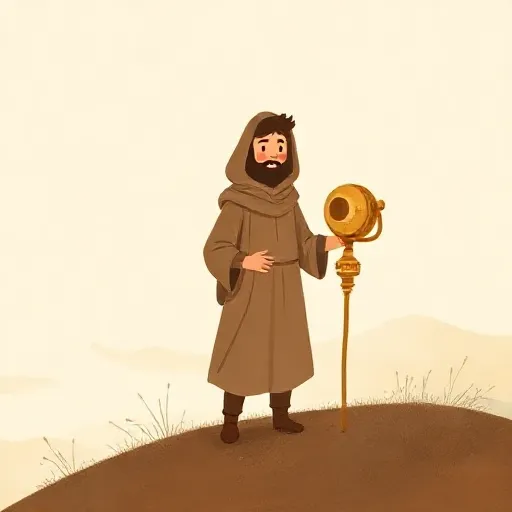
So was Bacon the first modern scientist? People have argued about this since the 1800s.
In 1859, William Whewell called Bacon an advocate of experimentation ahead of his time. For many historians of science who followed, Bacon looked like a lonely genius stuck in a superstitious age, someone who practically invented the experimental method four centuries before Galileo. He even wrote about gunpowder, flying machines, and submarines — or at least, he described technologies he had heard about. That fit the picture of a man who saw the future.
But other scholars pushed back hard. Lynn Thorndike and Pierre Duhem argued that real observation played a minimal role in Bacon’s work. Martin Heidegger, the 20th-century German philosopher, claimed that Bacon never achieved what makes modern science distinctive: projecting mathematics onto nature and then designing controlled experiments to test the projection. For Heidegger, the true forerunner of modern science was Johannes Kepler (1571–1630), not Roger Bacon. Alexandre Koyré reached a similar conclusion from a different angle. The debate got heated.
More recently, scholars have settled into a more careful view. David C. Lindberg, who edited Bacon’s scientific works, insisted that we must read him as a medieval scientist, not as an early modern one. His mathematics was the geometry available in his time. His experiments were real but unsystematic by later standards. He mixed science freely with astrology, alchemy, and religion in ways no modern lab would permit. And yet — he genuinely did mathematical work, he genuinely measured things, and he genuinely believed that experience could correct authority.
Mattia Mantovani has recently shown clear connections between Bacon’s theory of vision and the ideas René Descartes (1596–1650) would use four centuries later. So the story is not a simple one of a brilliant misfit ahead of his time. It is the story of a long, slow chain of thinkers, each building on the last, from Baghdad to Paris to Florence to the Scientific Revolution.
Signs, Words, and Why It All Still Matters
Bacon had another side that often gets overlooked. He was a sharp philosopher of language. In his De signis (“On Signs”), he proposed a definition that was radical for its time: a sign is something offered to the senses or the intellect that designates something to someone. Notice the word “someone.” For Bacon, a sign was not truly a sign unless there was an interpreter for whom it signified. A tavern sign with nobody to read it is just a piece of painted wood.
This matters because it flipped a basic assumption. Most medieval thinkers believed a word’s link to its meaning was permanent and objective, whether anyone understood it or not. Bacon said no. The relationship between a sign and the person who interprets it is what makes the sign a sign. Strip away the audience, and you strip away the meaning. That idea rippled through later centuries and prepared the ground for later thinkers like William of Ockham (c. 1287–1347).
Bacon’s obsession with language, mathematics, and experimental testing all pointed toward the same goal. He wanted knowledge that could be checked, shared, and used — for healing sick bodies, for understanding scripture, for advising princes, and for navigating a dangerous world. He was not a modern scientist. But he was one of the first people to argue systematically that if you want to know something, you should not just argue about it. You should build instruments, learn languages, measure angles, and go see.
Think about it
- If you had to prove that a rainbow forms at a specific angle in the sky, what tools would you use, and how would you convince someone who refused to believe anything they could not read in an old book?
- Bacon believed that words mean different things to different people. Can you think of a word that means one thing to you and something totally different to a friend or a parent? Who is right?
- Some scholars say Bacon was a scientist ahead of his time; others say he was just doing medieval science in his own way. What would you need to see someone actually do before you called them a “scientist”?