
Are You More Like a River or a Rock? The Ancient Fight Over Reality
You Can’t Step in the Same River Twice

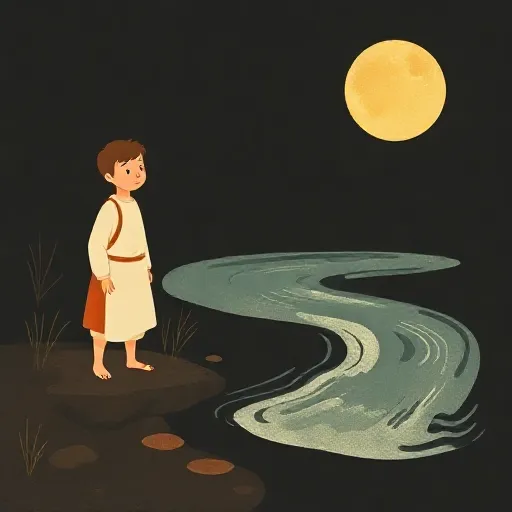
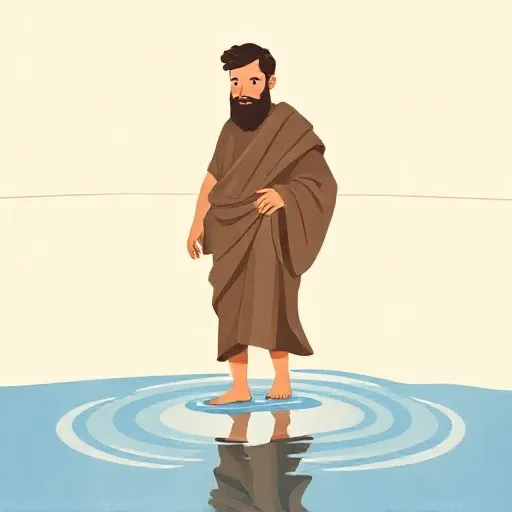
Around 500 BCE, in the bustling Greek city of Ephesus, a thinker named Heraclitus (c. 540–c. 480 BCE) made a puzzling claim. He told people they could never step into the same river twice. Why? Because the water is always flowing away and fresh water is rushing in. But there’s more: the person stepping in is also changing from one moment to the next — thoughts shift, cells replace themselves. So both the river and the person are constantly becoming something new.
Heraclitus wasn’t just being poetic. He was laying the foundation for what we now call process philosophy. This is the idea that change, motion, and activity are the deepest reality — not static objects. For Heraclitus, the world and everything in it is a dynamic unfolding. He even imagined a cosmic fire that never goes out, always shifting into the forms we see: solid earth, liquid sea, flaring flame. Nothing stays put; all things are continuously trading places in a measured, balanced way — like gold changing hands for goods.
Heraclitus left us three big insights that still guide process thinkers today:
- Change is not a side effect — it’s the main event. Usually we think of change as happening to something that stays the same. But Heraclitus turned that around: process itself is what’s real, and stable-looking things are just temporary patterns within it.
- Change follows a rhythm, not chaos. Even war and peace, day and night, hunger and fullness swing back and forth within natural limits. It’s not random; there’s a kind of “measure” to how things unfold.
- There are two flavors of dynamism. Some happenings are transitions from one state to another (like a river’s water moving past a point). Others are a tense, motionless balance of opposing forces — think of a drawn bow or a lyre string pulled tight, not moving but holding immense energy. Both are ways reality stays active.
So what was the rival view? The next section shows why many later thinkers pushed back hard.
Why Some Think the World Must Be Made of Solid Things
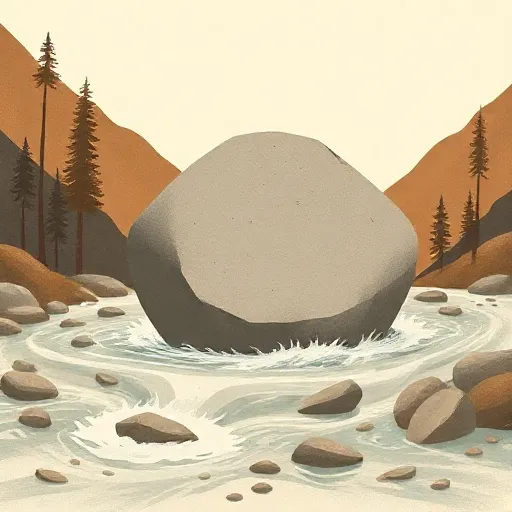
Not long after Heraclitus, Leucippus (5th century BCE) and his student Democritus (c. 460–c. 370 BCE) offered a rival picture. They said the world is made of atoms — tiny, unbreakable particles with shape and weight. The huge changes we see are just atoms rearranging, like a cosmic game of billiards. The atoms themselves never change or go out of existence. They are the permanent bricks of everything.
This became the heart of substance metaphysics. A substance is an independent thing that stays the same over time while its properties — color, position, shape — can change. A chair is a substance; so, according to this view, is a human being. The idea felt natural and became the dominant way of thinking in Western philosophy.
Even our language seems to back up the substance picture. When we speak, we typically need a noun as the subject — someone or something that does an action. “The dog runs.” “The stone falls.” This grammar nudges us to treat the world as a collection of objects. So many philosophers concluded that substances are the basic building blocks of reality.
In the mid‑20th century, philosopher Peter Strawson (1919–2006) tried to prove that substance thinking is unavoidable. He argued that for us to know and communicate about anything, we must be able to single out individual things and re‑identify them over time in a shared space‑time framework. Only material bodies, Strawson said, have the endurance and richness needed for this job. Therefore, things that are or have bodies must be the most fundamental kind of entity.
Process philosophers pushed back hard. They pointed out that we can also point to and re‑identify processes just fine. You can watch a waterfall, look away, and recognize the same waterfall when you turn back. Tornados, traffic jams, and even the flow of conversation can be singled out and tracked. What’s more, maybe what we call a “thing” could be understood as a bundle of processes. The fact that our common sense treats substances as basic doesn’t prove that substances are really fundamental — it might just reflect a language habit. So Strawson’s argument didn’t close the case.
With the substance view challenged, subsequent thinkers dug deeper into what kinds of processes exist and how they might explain the world. One of the first to make a crucial distinction was Aristotle.
Aristotle’s Surprise: Not All Happenings Are Alike
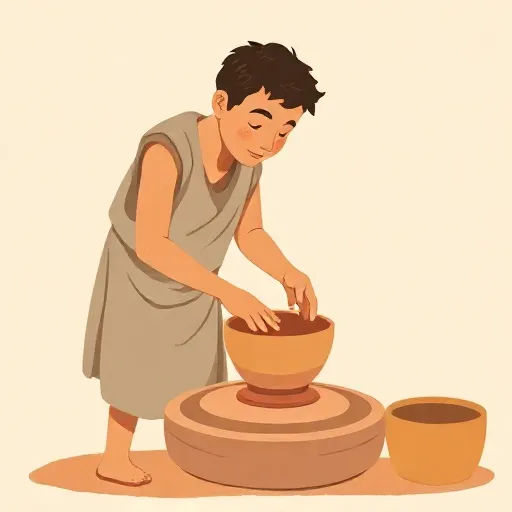
Aristotle (384–322 BCE) tried to have it both ways. He accepted substances as central to understanding nature, but he also paid close attention to different kinds of occurrences. He noticed a split that still matters for process philosophy today.
Some happenings are changes (kinesis) that aim at an end. When you’re building a house, baking a cake, or learning a new language, the action is incomplete until you reach the goal. You can’t say “I have built a house” while you’re still hammering the first nail. The process is all about the result.
Other happenings are activities (energeia) that are whole at every moment. Seeing, feeling the sun on your skin, or living a good life are not incomplete while they’re happening. The second you are seeing, you have already seen. Activity doesn’t wait for a finish line; it’s already complete while it lasts.
This distinction gave future process philosophers a powerful language. It suggested that not all dynamic things should be squeezed into the same box. Some are like a journey toward a destination; others are like a dance that exists fully in each step. Aristotle stopped short of saying everything is process, but his classification opened a door.
A Universe Made of Moments: Whitehead’s Radical Idea
Jump to the early 1900s. The mathematician Alfred North Whitehead (1861–1947) took the process idea to its limit. He claimed the most basic unit of reality is not a particle or a material object, but a momentary event he called an actual occasion. Each actual occasion is like a tiny droplet of experience. It “feels” or prehensions (takes in) the whole history of the universe up to that point, blends it into a new unified moment, and then passes itself on to be felt by the next actual occasions.
In Whitehead’s world, there are no solid lumps of stuff enduring through time. There is only a chain of these tiny, creative moments — each a fresh synthesis of everything that came before. A table is really a society of trillions of actual occasions repeating a stable pattern. A human being is an incredibly complex society of such occasions, organizing themselves into thoughts, feelings, and actions.
Whitehead’s vision was a full-blown process metaphysics. It answered the ancient question “What stays the same?” by saying: nothing is the same in a blocky substance sense, but recurring patterns can be stable enough to give us the experience of lasting things. A whirlpool in a river holds its shape because fresh water constantly flows through it in the same pattern. That’s how we exist, too.
When Science Discovered the Flow: From Quarks to Consciousness

You might think this is just a philosophical game. But over the last hundred years, science has started to sound surprisingly like process philosophy.
In quantum physics, particles stopped behaving like hard little marbles. An electron isn’t a thing in one place; it’s a cloud of possibilities that condenses into a definite outcome only when it interacts with something else. Physicists now speak of quantum “events” and “processes” rather than solid building blocks. Some interpretations even suggest that space and time themselves emerge out of deeper dynamic networks, not a fixed stage.
Biology tells a similar story. A living organism isn’t a static machine. It’s a humming network of metabolic flows, gene-regulation dances, and constant repair. Biologists increasingly see life as a process system that maintains itself through change — not a substance that passively sits there. Evolution, too, is a creative process that never stops generating new forms.
Even the study of the mind has taken a process turn. Instead of picturing thinking as a computer manipulating fixed symbols, many cognitive scientists now describe the mind as embodied cognition — a dynamic activity that involves the whole body and environment, constantly flowing and adjusting. Your thoughts aren’t static objects; they’re patterns of activity that come and go.
All of this gives process philosophy a powerful boost. It turns out that treating reality as a swarm of happenings, not a collection of things, might be the best way to make sense of our best science.
What Does This Mean for You? The Person as a Process

Now bring it home. If process philosophy is right, then you are not a changeless soul or a solid object. You are an ongoing happening — a delicate, ever-shifting weave of experiences, feelings, thoughts, and actions that hangs together like a melody. The “self” you were yesterday is already blended into the “self” you are right now, and you’re constantly becoming something new.
That doesn’t mean you don’t have a stable identity. The pattern of you — your memories, habits, values — can be remarkably reliable. But that stability comes from the way your life-process organizes itself, not from some hidden core that never changes. Understanding this can change how you think about forgiveness, growth, and even responsibility. If you’re never locked in place, you can always learn, adapt, and reshape the pattern.
The fight between substance and process isn’t finished. Many philosophers still hold that we need basic objects to make sense of the world. The argument that we can’t talk about anything without stable things — the one raised by Strawson — has been challenged, but the debate remains alive. The next time you watch a river, or notice your own moods shifting, remember: you might be glimpsing the real flow of things — a universe where process, not permanence, is the deepest truth.
Think about it
- If every cell in your body is replaced over time, are you still the same person you were when you were six? What makes you “you” if everything is changing?
- Imagine a tornado. It has a shape and can be pointed to, but it’s made only of swirling air. Does the tornado exist as a real thing, or is it just a name for a pattern? Could you be like that?
- If the universe is made entirely of processes with no permanent stuff, does that make you feel uncomfortable or free? Why?