
Can a River Teach You the Secret of the Universe?
A Grumpy Genius in Ancient Ephesus
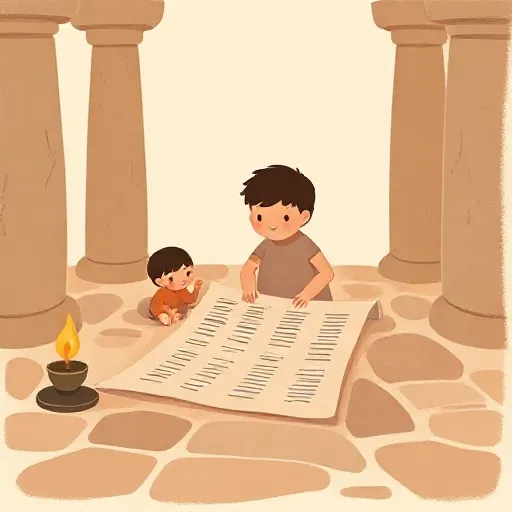
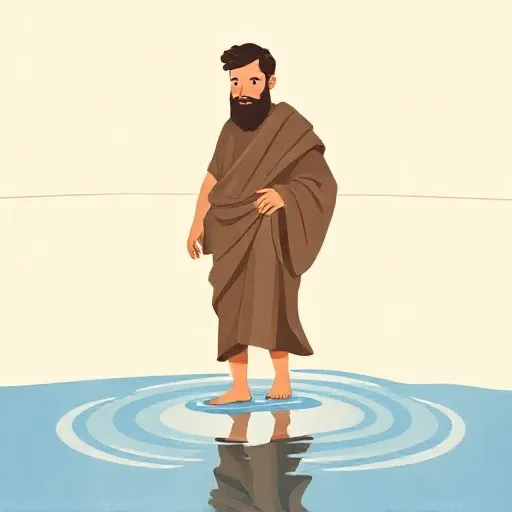
Imagine standing by a river and noticing something strange. The water that touches your ankle right now is already gone — new water rushes past every moment. Yet you still call it “the same river.” That simple puzzle, the kind a curious kid might notice, was the sort of thing that kept Heraclitus awake at night.
Heraclitus lived around 500 BCE in the wealthy Greek city of Ephesus, on the coast of what is now Turkey. Not much is certain about his life, except that he had a reputation for being difficult. He supposedly inherited an honorary kingship from his family and then handed it to his brother, preferring to spend his time thinking and writing. He looked at his fellow citizens, with their love of democracy and crowds, and saw mostly confusion. He was an aristocrat of the mind — convinced that only a few people would ever really get what he was saying.
He wrote just one book, a papyrus roll he placed in the great temple of Artemis, which was a safe place to store treasures. The book did not read like a normal argument. It was a collection of short, packed sayings — more like oracles or proverbs than a step-by-step lecture. And because Heraclitus thought most people were “asleep,” he designed his words to wake them up. He wasn’t going to hand the truth to you on a plate. You would have to work for it.
What the River Really Told Heraclitus

You have probably heard the saying “You can never step into the same river twice.” It’s been repeated for centuries, and it gets credited to Heraclitus. But there’s a problem: most scholars now think that’s not what he actually said.
The one fragment of his writing that really seems authentic puts the idea much more carefully. Heraclitus wrote, in effect, “On those who step into the same rivers, different and different waters flow.” Notice the difference. The river stays the same. The waters change. There is no claim that you cannot step in twice. The whole point is that the river persists by changing. If the waters stopped flowing, it would no longer be a river at all — it would be a lake or a dry bed. So the river is a magnificent kind of thing: it stays what it is because it never stops becoming something new.
This is the core of his idea about flux, or constant flow. But it’s not the wild, everything-falls-apart chaos that later thinkers accused him of. Heraclitus wasn’t saying that nothing is stable. He was pointing out that some things — like rivers, human bodies, and maybe the whole world — rely on steady change to keep existing. Think of your own body. Your cells replace themselves all the time, yet you are still you. Heraclitus would smile at that.
The Hidden Message: Logos and the Sounds of the World
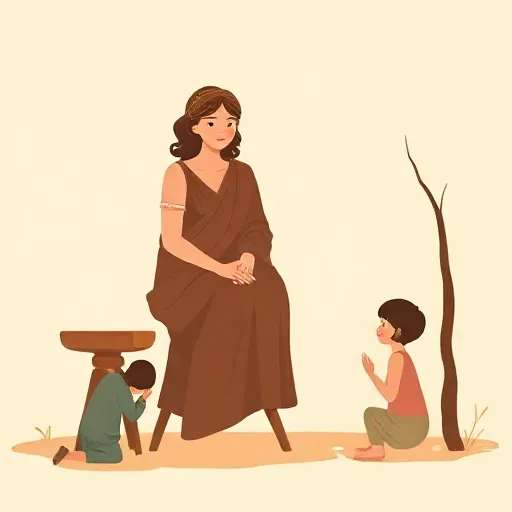
Heraclitus had a name for the deep order beneath all the surface chaos: he called it the Logos. The Greek word can mean “word,” “account,” “reason,” or “message.” In his book, he announced that listening not to him but to the Logos, it is wise to agree that all things are one. He was saying that the truth isn’t his private opinion. It’s a living pattern that the world itself broadcasts all the time. The problem is that most people have the volume turned down in their own minds.
He chides his readers. he warns that although this Logos is common, the many live as if they had a private understanding. They walk around like sleepwalkers, hearing sounds but not really listening. Heraclitus thought the leading thinkers of his day were just as bad. He mocked poets like Hesiod and Homer, respected scientists like Pythagoras, and pretty much everyone else for piling up facts without ever understanding what they meant. “Learning many things,” he said, “does not teach understanding.”
That’s why he deliberately wrote in riddles. He packed his sentences with double meanings and odd patterns, forcing a reader to slow down and puzzle things out. A simple fragment of three Greek words, often translated as “The character of man is his guardian spirit.” links the idea of inner character and outside fate with a grammatical trick: the word for “person” glues the two ideas together so you can’t tell where one ends and the other begins. He compared his method to the oracle at Delphi, which “neither reveals nor conceals, but gives a sign.” To get Heraclitus, you have to interpret him the way you interpret the world itself — actively, attentively, never on autopilot.
When Opposites Hold Hands
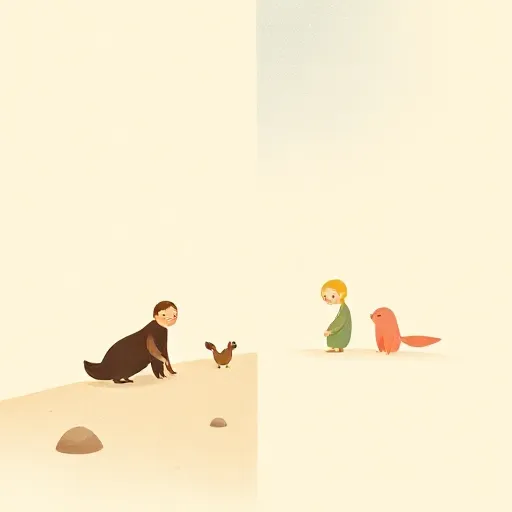
If you look at the world through Heraclitus’s eyes, you start seeing that opposites aren’t enemies. They’re dance partners. This is what scholars call the unity of opposites.
Take the sea. Heraclitus said it is the purest and most polluted water: for fish drinkable and healthy, for human beings undrinkable and harmful. The same water has opposite qualities at the same time — depending on who is looking. There’s no contradiction, just a shift in perspective. He saw life and death, waking and sleeping, youth and old age as a single chain. They are not identical, but they transform into each other. “As the same thing in us,” he wrote, “are living and dead, waking and sleeping, young and old. For these things having changed around are those, and those in turn having changed around are these.”
Even conflict itself is not a bug in the universe; it’s the engine. “War is father of all and king of all,” he declared, and “all things happen according to strife and necessity.” Without tension between opposing forces — hot and cold, wet and dry, justice and injustice — everything would freeze into a lifeless sameness. A musical harmony depends on high notes and low notes pulling against each other. A bow needs the string to be stretched in opposite directions to work. Heraclitus thought the cosmos works the same way.
Fire: The Living World
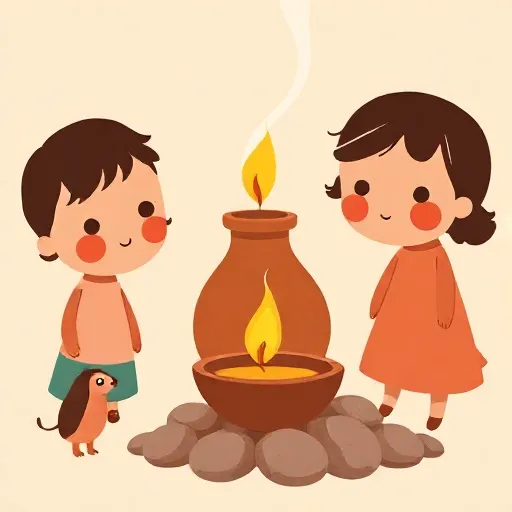
Heraclitus gave the world a surprising name. He said the ordered universe — the kosmos — is “everliving fire, kindling in measures and being quenched in measures.” Unlike earlier thinkers who thought everything came from water, air, or some boundless stuff, Heraclitus chose fire. But he didn’t think the world was literally just a big flame. He saw fire as the perfect symbol of a process that can’t sit still. Fire lives only by feeding on something and constantly changing. It’s not a solid object you can put in a box.
He mapped out a cosmic cycle: fire turns into sea (water), and sea in turn becomes earth. Half of that earth eventually turns back into sea, and the other half into a fiery storm-wind. The amounts stay balanced, like a giant chemical equation. The world, then, has no beginning and no end. he wrote that no god or human made this world-order, but it ever was and is and will be. What makes it eternal is not some unchanging core, but the endless, rhythmic swap of elements. Lightning — the thunderbolt — he said, “steers all things,” pointing to a guiding intelligence that plays by the rules of change, not against them.
Can Riddles Make You Wise?
All this flux might make knowledge seem impossible. If everything is in motion, how can you ever pin anything down? But Heraclitus never gave up on wisdom. He just thought most people went after it the wrong way.
He valued sense experience. he said that he prefers the things of which there is sight, hearing, experience. Still, senses alone are like having a high-resolution camera without knowing how to frame a photograph. poor witnesses for human beings are the eyes and ears of those who have barbarian souls. A barbarian, to a Greek, was someone who could hear your words but couldn’t understand their meaning. So most people, Heraclitus thought, take in sights and sounds without ever grasping the pattern.
Real understanding, he believed, requires a different kind of mind: one that can hold together opposites, that can read signs rather than demand plain statements. That’s why his book works like a gym for the brain. It presents you with concrete pictures — a river, a bow, a road — and leaves you to find the general principle hiding inside. If you just memorize facts, you stay asleep. If you struggle with the riddle until the light goes on, you wake up. And waking up, for Heraclitus, is what a human life is for.
Why Heraclitus Still Speaks to You

Heraclitus didn’t have students in a school, but his ideas traveled like seeds on the wind. They helped provoke Parmenides to argue the exact opposite — that reality is one unchangeable block. They influenced Plato, who used Heraclitus’s flux to describe the shifting world we see with our eyes, while reserving stability for an invisible realm of ideas. The Stoics built their whole physics around a world that cycles through fire. And modern process thinkers, who see reality as made of events rather than solid objects, often point to Heraclitus as their ancient ancestor.
Back in Ephesus, Heraclitus didn’t offer much comfort. He thought one excellent person was worth more than a thousand ordinary ones, and he scoffed at his fellow citizens for valuing popularity over insight. But he also believed that every human being has a share in sound thinking. The door is open. The world is speaking its message right now — in the way a river stays a river, in the way day turns into night without ever making a clean break, in the way every ending is also a beginning.
When you wonder whether you’re still the same person you were three years ago, you’re standing where Heraclitus stood. If your memories, your friends, even your taste in music have shifted, are you a new person? Or do you stay you by changing, like the river? Heraclitus won’t give you a flat answer. He’ll just hand you the riddle and expect you to do the listening.
Think about it
- If every single part of your favorite bicycle is replaced over the years — wheels, frame, pedals — do you still own the same bicycle? What would Heraclitus and his river say?
- Can two things that are completely opposite — like silence and sound, or safety and danger — ever need each other to exist? Try to think of an example from your own day.
- Most people scroll through dozens of facts every day on their phones. Heraclitus said “learning many things” isn’t the same as understanding. In your experience, when has a single small observation taught you more than a mountain of information?