
Can You Step into the Same River Twice? What Physics Says About Time
The River and the Rock

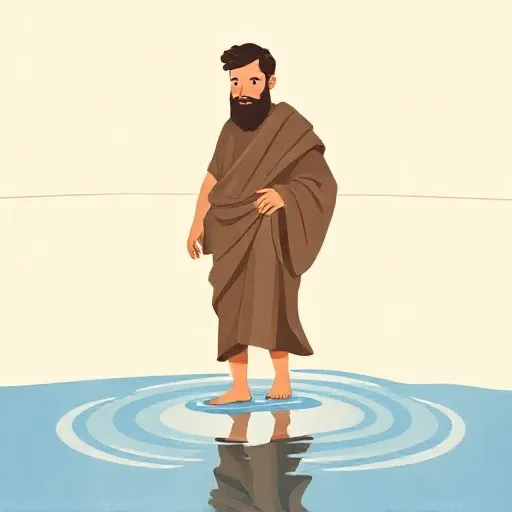
Over 2,500 years ago, the Greek thinker Heraclitus (c. 500 BCE) looked at the world and saw constant change. He used the image of a river: you cannot step twice into the same river, because the waters are always flowing past. Everything, he thought, is in motion—nothing stays the same.
Not long after, another Greek, Parmenides (c. 500 BCE), took the opposite view. He argued that true reality must be whole, still, and eternal. Change, he said, is an illusion—what is real never comes into being or passes away.
This ancient clash still haunts us. Fast forward to the 20th century: the great physicist Albert Einstein (1879–1955) told his friend, the philosopher Rudolf Carnap (1891–1970), that the experience of “now” bothered him deeply. The flowing present feels special, unlike past or future, yet physics cannot capture it. Carnap replied that science can describe everything that happens, including our feelings of time. But Einstein wasn’t satisfied. The mystery of the flowing now—the Heraclitean river inside a Parmenidean universe—remained. This article explores that mystery, using the lens of modern spacetime.
Three Pictures of Time

Before Einstein, the universe was thought to have a single, absolute time. In that classical picture, everyone could agree on what was happening “right now” across the entire universe. This idea lets us draw three rival pictures of time.
The first is presentism. It says that only the present exists. The past is gone; the future hasn’t happened yet. The present moment is always moving forward, like the edge of a spotlight sweeping across a stage. This feels natural: yesterday’s lunch is no longer real, tomorrow’s dinner is not yet real.
The second is eternalism. It treats all times—past, present, and future—as equally real, like frozen frames in a film reel. There’s no special “now”; the present is just wherever you happen to be standing, just as “here” is a matter of your location. This view is sometimes called the block universe.
The third, possibilism (or the growing block), is a mix. The past and present are fully real, but the future doesn’t exist yet. Each moment, a new “now” layer gets added, like a tree trunk gaining a ring. The future is open—merely possible—until it becomes actual in the present.
All three views assume that there is a cosmic-wide present, a single slice of time that is happening simultaneously everywhere. But Einstein’s work would shatter that assumption.
McTaggart’s Tricky Argument

Before relativity, a British philosopher named J. M. E. McTaggart (1866–1925) argued that time itself is an illusion because the idea of a flowing present is self-contradictory.
McTaggart distinguished two ways to order events. The B-series uses the permanent relations “earlier than” and “later than.” If your birth is earlier than your graduation, that relation never changes. The A-series uses the shifting labels “past,” “present,” and “future.” A future event becomes present and then recedes into the past.
McTaggart thought that real time demands the A-series, because only it captures temporal becoming—the sense that time passes. But he claimed the A-series leads to a contradiction. Every event must have all three A-properties (it was future, is present, will be past), yet having them all at once seems impossible, since “past” excludes “present” and “future.” Therefore, time is unreal.
Philosophers have spent over a century responding. One common reply is that McTaggart’s puzzle rests on a confusion about the word “is.” When we say “the exam is future” today, we mean it has that property relative to now. Tomorrow we can say “the exam is present,” but that doesn’t mean it’s both future and present in the same sense. We can sort out the timing of our statements by using a tenseless “be” (as in “the exam be future on Monday”) to avoid contradiction.
Another philosopher, C. D. Broad (1887–1971), suggested that becoming isn’t like a spotlight moving over events. Instead, absolute becoming is simply the happening of events—they “come to pass.” That doesn’t require mysterious motion; it’s that events occur one after another. This lets presentism and possibilism escape McTaggart’s trap, but it doesn’t settle whether physics forces us toward eternalism.
Einstein’s Surprise: No Universal “Now”
In 1905, Einstein’s special theory of relativity overturned the idea of absolute time. The theory starts from two principles: (1) the speed of light is the same for all observers, no matter how fast they move, and (2) the laws of physics look the same in every constantly moving (unaccelerated) frame.
A startling consequence is the relativity of simultaneity. Two events that one person sees as happening at the same time will not be simultaneous for another person moving differently.
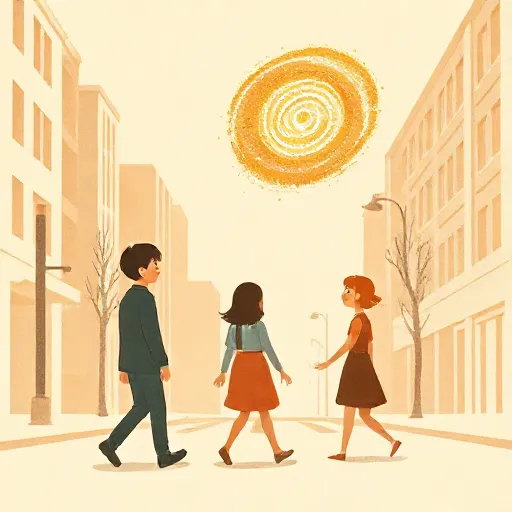
Imagine you and a friend stand together on a street. At the exact moment you meet, you both look toward the Andromeda galaxy, two million light-years away. You start walking toward Andromeda at 4 km/hour; your friend walks away at the same speed. According to relativity, your “now” slice through Andromeda will be about 5¾ days later than your friend’s. If an Andromedean fleet launches between those two times, you would say the launch has already happened; your friend would say it hasn’t happened yet.
This leads to a puzzling argument for chronogeometrical fatalism—the idea that the whole block universe is inevitable. If an event is in your past, it seems fixed and real. By picking suitable walkers, you can show that any future event is already in someone’s past—so everything must be fixed. The block universe wins, and passage is an illusion.
But there’s a catch. The fleet launch is spacelike separated from your meeting: no signal, not even light, can travel between those two events. According to relativity, they cannot causally influence each other. Labels like “past” and “future” for such distant events are frame-dependent, like arguing whether left or right is “really” ahead. Many philosophers think this drains the fatalism of its force. The cosmic block might be there, but that doesn’t mean your future is forced—just that the geometry of spacetime treats all events as equally real.
Can Becoming Survive in Spacetime?
So must we abandon the flowing present? Not necessarily. In the 20th century, the philosopher Howard Stein (1929–2024) proposed a new way to define “having become.” Instead of using a global “now,” he used the light cone. For any event, only those events in or on its past light cone have already become relative to it. The future light cone contains events that can be influenced but haven’t happened yet. The rest—the spacelike separated events—are neither past nor future in an objective sense.
Stein’s definition avoids the fatalism trap, but it has a striking result: the present for a single pointlike event is just itself. There is no shared “now” across space; each event’s present is uniquely its own. Some find that lonely, but others think it fits what physics tells us.
Another approach points to proper time—the time measured by a clock following a path through spacetime, not by some cosmic coordinate. Every object has its own proper time, and along that worldline, events happen in a definite order. Temporal becoming can be thought of as the advance of proper time, perfectly compatible with relativity.
What about the present we feel? Psychologists speak of the “specious present,” a short window of a few seconds during which we perceive events as happening now. That window can be represented by a causal diamond: the intersection of the past light cone of the end of the interval and the future light cone of the beginning. This diamond includes nearby events (even the moon) and naturally varies in size. So a shared present isn’t entirely lost—it’s just local and fuzzy.
These ideas show that the debate between the Heraclitean river and the Parmenidean block isn’t settled. Physics constrains our options but doesn’t eliminate the flow of time.
Why This Ancient Puzzle Still Matters

You might wonder: does any of this affect me? If the whole block universe exists eternally, does that mean your future decisions are already laid out, like pages already printed in a book? Not quite. Even in eternalism, your choices are still yours—they are part of what makes the block the way it is. The feeling that you are genuinely deciding isn’t necessarily an illusion; it’s just that from a “view from outside time,” all decisions are already in the block. The hard question is whether that outside view tells the whole story.
If only the present is real, then the past is truly gone and the future truly open. That might make your actions feel more urgent. But if the growing block view is correct, the past remains in existence forever—every moment, good or bad, persists as part of reality.
The puzzle Einstein handed to Carnap—why the “now” feels so special—has no easy answer. But it pushes you to reflect on how you live. Does believing in a frozen future change how you see tomorrow’s test, or the choices you make this afternoon? Philosophers don’t agree, but they do agree that time isn’t just a number on a clock. It’s one of the deepest mysteries there is.
Think about it
- If a time traveler visited your future and saw exactly what you will do, would that mean you never really had a choice?
- Imagine you and a friend argue whether tomorrow’s soccer game is already decided. Could running in opposite directions settle the argument? How would you decide who is right?
- Would you treat people differently if you believed the past still existed just as vividly as the present—like every embarrassing moment you ever had still being out there?