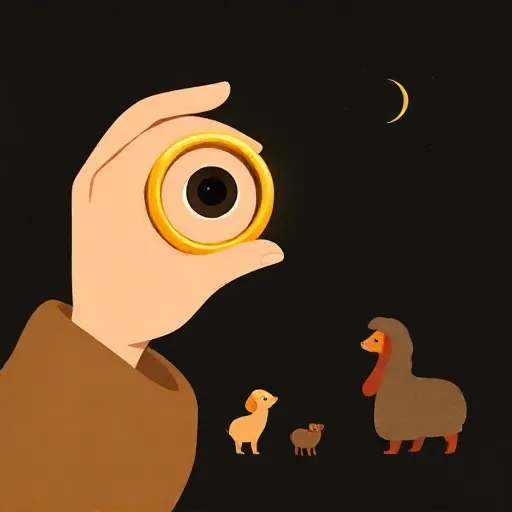
How Can We Know a Perfect Circle? Plato's Answer
A Last Conversation About Sticks and Stones
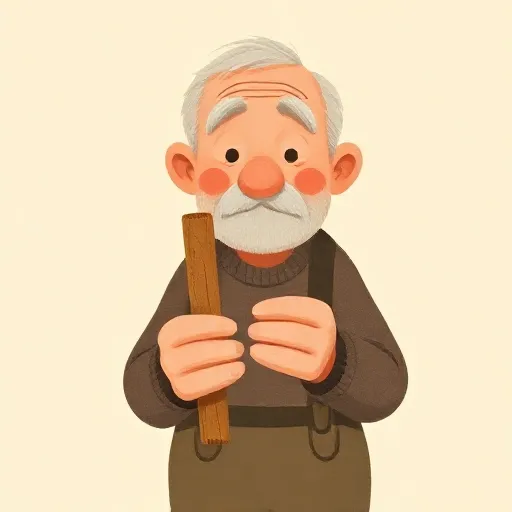
It is summer, 399 BC. The philosopher Socrates (470–399 BCE) sits in an Athenian prison cell, waiting to die. His friends have gathered, but Socrates is not worrying about death. He is thinking about two wooden sticks.
“Look at these sticks,” he says. “Are they equal in length?” At first, the friends agree they seem equal. But then Socrates points out that the same pair can look unequal if you tilt your head, or one stick might be a fraction shorter if you measure closely. Even if two sticks are extremely close, no physical sticks are perfectly, exactly equal in every way. And here is the surprise: to say “these sticks are not really equal,” you must already have an idea of what true Equality is.
Socrates never saw perfect equality with his eyes. Neither have you. But somehow, you know it. His pupil Plato (428–348 BCE), who wrote down this scene in a dialogue called the Phaedo, would spend his whole life developing that puzzle into a bold theory: the Theory of Forms.
Two Rivers and an Unmoving World
To understand why Plato was so convinced, you need to meet two thinkers who came before him.
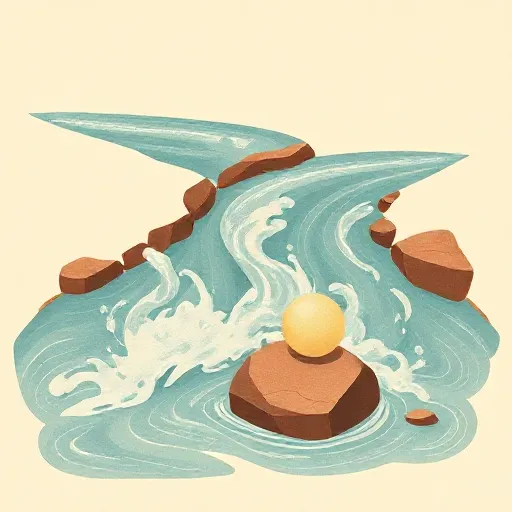
Heraclitus (about 540–480 BCE) looked at the physical world and saw nothing but change. A river flows, a fire flickers, leaves grow and decay. He said that you cannot step into the same river twice, because both you and the river are always changing. If everything is always in flux, can anything be known for sure?
On the other side stood Parmenides (about 515–450 BCE). He argued that change is an illusion. Reality, he said, is one single, unchanging Being. Think about it: if something changes, it becomes what it was not before — and how can what-is-not possibly produce anything? Real Being, for Parmenides, never moves, never becomes, and only it can be thought or known.
Plato inherited both pictures. He agreed with Heraclitus that the physical world — sticks, people, mountains — is always changing. But he also agreed with Parmenides that knowledge needs something stable. So Plato proposed that there must be a second kind of reality: a world of perfect, unchanging patterns he called Forms (from the Greek eidos, meaning “shape” or “kind”).
A stick is only approximately straight; the Form of Straightness is perfectly straight, with no curves. Helen of Troy was beautiful, but also unfaithful, and compared to a goddess she might seem plain. The Form of Beauty, on the other hand, is simply and completely beautiful — never partly ugly. This solves a problem called the compresence of opposites: physical things can be both F and not-F (tall compared to a child, short compared to a tree), but a Form is purely what it is. The Form of Largeness never looks small; the Form of Equality never looks unequal.
What Are the Forms Really Like?

If Forms are not physical, what are they?
First, they are separate. They do not exist in space or time. The Form of Justice is not inside a courtroom, and the Form of Circle is not any specific circle drawn on paper. A Form is what it is “itself by itself” — independent of any particular thing that copies it. Even if every triangle in the universe were destroyed, the Form of Triangle would still be exactly what it is: a three-sided closed figure with angles summing to 180 degrees.
Second, Forms are simple or monoeidetic — “of one form.” The Form of Heat is just heat. It is not also cold, or colored, or heavy. In many ways, a Form has only one essence. When Plato says “Justice is just” or “Beauty is beautiful,” this is called self-predication. But what does that mean? Philosophers argue: some think it means Beauty Itself is a perfect beautiful thing, the most beautiful object you could imagine. Others think that “Beauty is beautiful” just means the Form is the very definition of beauty — not a beautiful object at all, but the standard by which anything else gets called beautiful.
In either interpretation, Forms are knowable only by reason, not by the senses. You cannot see Justice with your eyes, but you can grasp it with your mind. That is why Plato draws a sharp line: physical things are objects of belief (which can be mistaken), while Forms are the objects of knowledge (which is always true).
How Do You Know What You’ve Never Seen? Recollection
Here is the question that kept Plato awake: if we have never seen perfect Equality or perfect Circle, where does our knowledge of them come from?
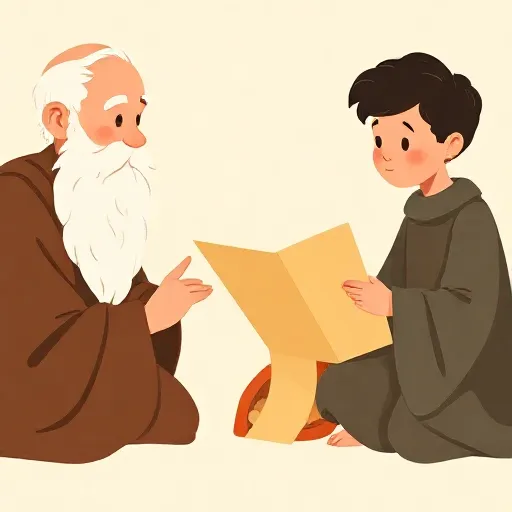
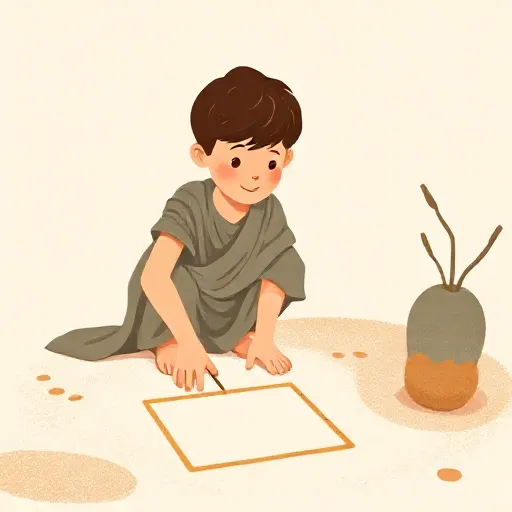
To answer, Plato tells another story. In the dialogue Meno, Socrates calls over a young slave boy who has never studied geometry. Socrates draws a square and asks the boy to find the length of the diagonal of a square double the area. By simply asking questions — never feeding an answer — Socrates leads the boy to figure it out. The boy’s correct belief, Plato says, was “inside him all along.” Learning, in this picture, is really recollection (anamnesis).
The Phaedo pushes the same idea further. When you see two roughly equal sticks, your mind notices they fall short of perfect Equality. But you could only notice that shortfall if you already possessed the standard in your mind. You must have encountered the Form of Equality before — not with your physical eyes, but with your soul. Plato’s radical claim: before birth, your immortal soul lived among the Forms and knew them directly. Coming into a body made you forget. Seeing imperfect copies in the world “triggers” a dim memory, and with careful questioning you can recover the full knowledge.
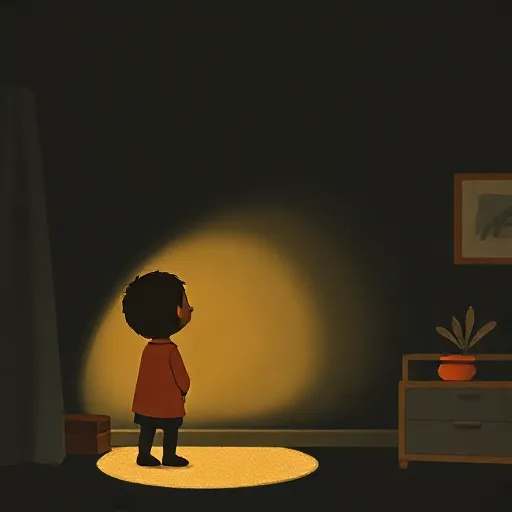
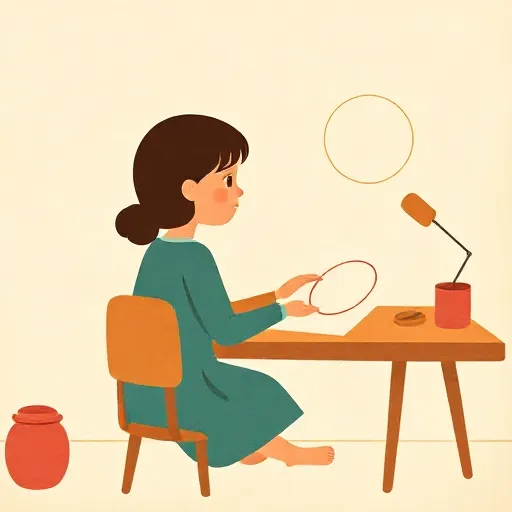
You have never seen a perfect circle. Yet if someone hands you a wobbly drawing of one, you immediately say “That’s not a real circle.” Where did that idea of “real circle” come from? Plato says you were born with it, and learning is just waking it up.
The Prisoners Watching Shadows
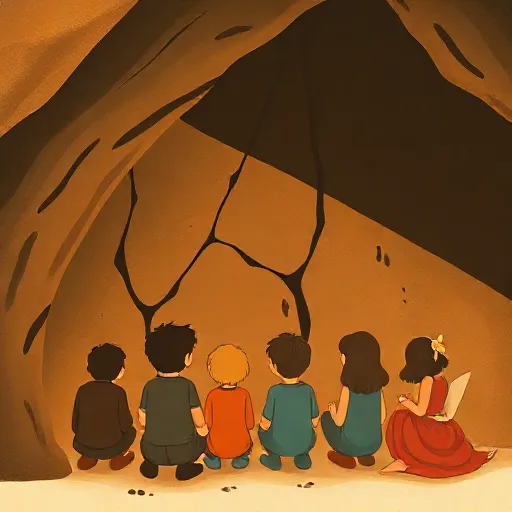
Plato’s most famous picture of the human condition appears in the Republic. He asks us to imagine a cave.
Prisoners have been chained since childhood, facing a blank wall. Behind them blazes a fire, and between the fire and the prisoners, puppeteers carry carved statues and figures. The prisoners can see only the shadows of those figures on the wall. They hear echoes and believe those shadows are the real world — they even give names to the shapes and argue about whose shadow will appear next.
One day, a prisoner is freed. He turns around. At first, the fire blinds him and the puppets look less real than the shadows he knows. Then he is dragged up a steep, rough path into the sunlight. Again, he is blinded — he can only look at reflections in water. But slowly his eyes adjust. He sees real trees, real animals, and finally the sun itself, which makes everything visible and alive.
For Plato, the cave is the visible world we experience with our senses. The shadows are the everyday objects we treat as fully real. The puppets are the actual physical things, which are more real than shadows but still copies. The world outside the cave is the realm of Forms, and the sun stands for the Form of the Good — the source of all being and truth, which makes knowledge possible.
The freed prisoner is the philosopher. And when she returns to the cave to help others, they think she is crazy. Her eyes are now ruined for shadow-gazing. This, Plato says, is what happens when someone turns away from appearances and begins to seek what is genuinely real.
Why a Perfect Circle Still Matters
You will never hold a perfectly just law in your hands, and you will never see a beauty that is beautiful in every possible way. Yet you use the ideas of perfect fairness and perfect beauty every time you feel outrage at a wrong decision or admire a sunset.
Plato’s theory of Forms turns ordinary life into a philosophical adventure. It asks: where do our abstract concepts come from? When you say “that’s not fair,” you are comparing real events to an invisible standard. When you recognize a shaky triangle as a triangle, you are using a definition that no physical triangle perfectly satisfies.
And here is why this still matters. If the most real and important things are invisible — things like justice, truth, and the mathematical relations that hold the universe together — then a life spent chasing only what can be seen and touched might leave us, like the cave prisoners, staring at shadows. Plato does not give us a final, easy answer about whether you can ever fully grasp these Forms. He leaves you with the challenge: to keep asking what is it? and to realize that the answer is never just the next thing your eyes catch.
Think about it
- If you’ve never seen a perfectly straight line, how do you know a ruler isn’t perfectly straight? Is perfect straightness something you learned, or something your mind already had?
- Imagine you are a prisoner in the cave who has only ever seen shadows. Someone whispers that the shadows aren’t real. Would you believe them? Why might you prefer to stay in the cave?
- Name something you are certain is real even though you cannot see or touch it. What makes you so sure it exists — and could you be wrong?