Can Perfect Ideas Survive a Grilling by a Master Logician?
Three Philosophers Walk into a House in Athens
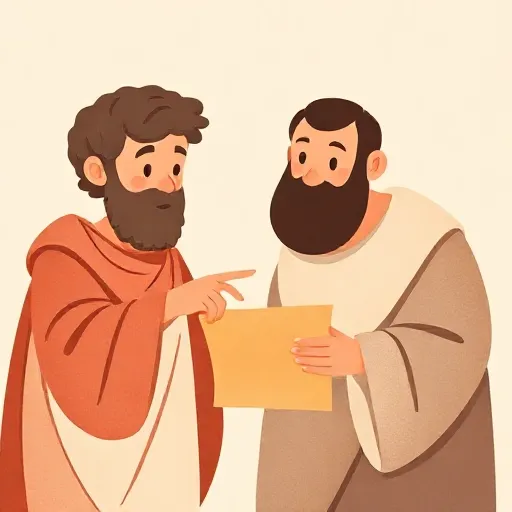
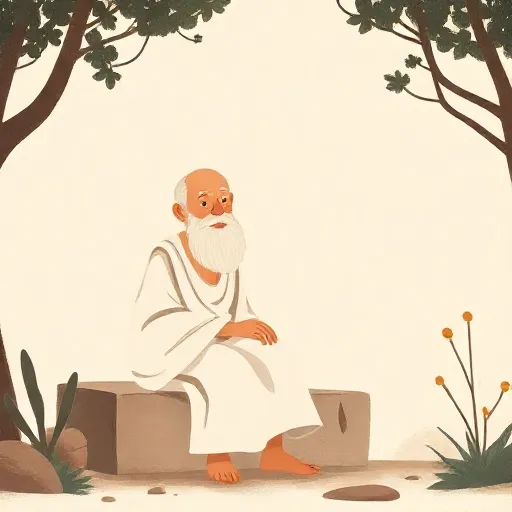
Imagine Athens around 450 BCE. The city is buzzing with the Great Panathenaic festival, and a crowd of curious young men has gathered at a private house. They’ve come to hear Zeno (c. 490–430 BCE), a visiting philosopher, read from his book. Zeno wants to defend his teacher Parmenides (born c. 515 BCE), who says that reality is a single, unchanging thing. Zeno’s argument is simple: if many things exist, they must be both alike and unalike — which seems impossible — so only one thing can exist.
When Zeno finishes, a confident young man named Socrates (c. 470–399 BCE) speaks up. Socrates thinks Zeno has missed something important. There could be many things after all, if we understand that they share in invisible, perfect blueprints that are not things we can touch. He calls these blueprints Forms. And that’s where the real trouble begins.
The Theory of Forms: Perfect Blueprints for Everything
Socrates believes that for every property — largeness, beauty, justice — there is a single, eternal Form. The Form of Largeness is what makes big things big. The Form of Beauty is what makes beautiful things beautiful. Things down here in the world partake of these Forms. When you look at a large tree, it is large because it somehow gets a share of the Form of Largeness. This is the principle of Causality: all F-things are F because they partake of the F itself.
But there are strict rules. The Forms are separate — they aren’t identical to any physical thing. And they are pure: a Form cannot have contrary properties. The Form of Largeness cannot be both large and small; the Form of One cannot be both one and many. Physical things are messy; a tree can be large compared to a bush but small compared to a mountain. Forms stay clean.
Socrates adds another rule: Self-Predication. The Form of Largeness is itself large. The Form of Beauty is beautiful. This sounds natural, but, as Parmenides will soon show, it causes serious trouble.
The Pie Problem: When Sharing Gets Messy
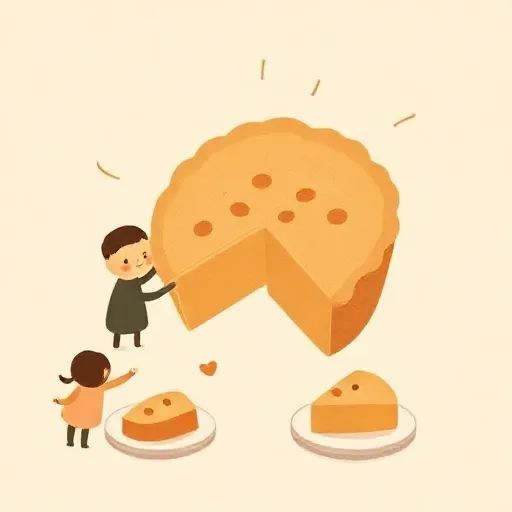
Parmenides, who has been listening quietly, now leans in. He wants to know exactly how physical things “partake” of a Form. Suppose partaking works like sharing a pie. There are two options: either the whole Form is in each thing that partakes of it, or only a part of the Form is in each thing. Parmenides calls this the Whole-Part Dilemma.
Take three separate large things. If each gets the whole Form of Largeness, then the one Form must be entirely in three different places at the same time. That would mean the Form is separate from itself — which is absurd. Socrates tries to dodge by saying “a form is like a day”, which can be in many separate places at the same time. Parmenides shoots back that a day works that way only because different parts of it are over different places; that’s just the “part” model again.
So what if each large thing gets only a part of the Form? Then the Form has parts, so it’s divided — and therefore many, not one. Even worse, a part of the Large is smaller than the whole Form. So something large would be made large by getting something small. That violates a rule Parmenides calls No Causation by Contraries: a property can’t be produced by its opposite. The pie model collapses.
The Infinite Largeness Ladder: The Third Man
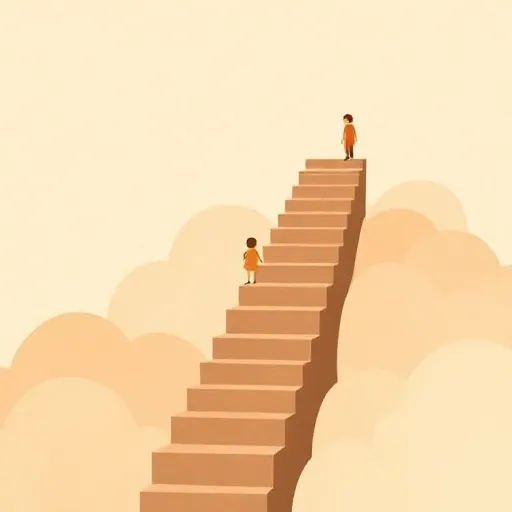
Parmenides isn’t done. He now targets Self-Predication with an argument later named the Third Man. Imagine we gather all the large things we see: a horse, a temple, a mountain. Because there are many large things, there must be a single Form of Largeness — call it L1 — that they all partake of. And, by Self-Predication, L1 itself is large.
But now we have a new group of large things: the horse, the temple, the mountain, and L1. If there’s a Form for that group, we get a second Form, L2. L1 partakes of L2. And L2 must be large too, so we add it to the group and get L3. The process never stops. Instead of one Form of Largeness, we get an infinite ladder of Forms, each partaking of the one above. That contradicts Uniqueness — the idea, which Socrates accepts, that there is exactly one Form for each property.
The regress also destroys Oneness, the claim that each Form is one. If every Form partakes of infinitely many other Forms, then each Form itself becomes infinitely many — the opposite of one. Something in the theory has to break.
Can Humans Know the Forms? The Greatest Difficulty
Parmenides saves his most devastating objection for last. He points out that if Forms are entirely separate from our world — not “in” human affairs — then our knowledge can’t touch them. Human knowledge is about things that are in the human sphere. Knowledge itself, as a Form, is defined in relation to what it knows: the Form of Knowledge is knowledge of the Form that is its object. But by the logic of separation, that object must also be a separate Form, not something in our world. So the Forms cannot be known by us.
Worse, the argument extends to the gods. If the gods possess the most precise knowledge, and that knowledge is a Form defined in relation to its object, then the object must be a Form, not anything human. So the gods cannot know human affairs — a result even Socrates finds shocking. The whole point of Forms was to explain reality and make knowledge possible. Now it seems they make knowledge impossible.
Saving the Forms by Letting Go of Purity
Instead of declaring the theory dead, Parmenides proposes a training method. Suppose we take “the one” — a Form — and work through all the consequences of it existing and not existing. The exercise that follows is long and full of twists, but many philosophers think it delivers a clear message: the contradictions that plagued Socrates arose because he insisted that Forms are completely pure and that there is exactly one Form per property.
The deductions show that if the one exists, it can be both one and many, like and unlike, at rest and in motion — all the contrary properties that Socrates had banned for Forms. The exercise also shows that infinite many Forms of oneness spring up. The lesson appears to be that the theory of Forms can be saved, but only if we abandon Purity-F (the rule that Forms can’t have contrary properties), Uniqueness, and No Causation by Contraries. The core of the theory — that separate Forms explain why things are as they are — stays intact.
What remains is the Greatest Difficulty about knowledge. That challenge is left hanging, maybe as a puzzle for future thinkers.
Why a 2,400-Year-Old Grilling Matters Today
You don’t need to be an ancient Greek to feel the pull of this debate. When you think about “fairness” or “courage,” you probably imagine them as flawless, shining standards. But real life is full of situations that are fair in one way and unfair in another, or acts that are brave and reckless at the same time. The Parmenides asks whether our pure ideals can survive contact with a complicated world — and whether it’s even a good idea to insist they stay pure.
It also shows that the best ideas need to be tested. Plato, one of the greatest thinkers ever, wrote a dialogue in which his own theory gets systematically dismantled. He didn’t hide from the hard questions; he turned them into a training ground. That’s a model for how we should treat our own convictions: ask the toughest objections you can, and see what remains standing.
Think about it
- If a perfect Form of “deliciousness” existed, could any real food fully match it? Or would every food be delicious and not delicious at once?
- Is it a problem for a chair to be both sturdy and wobbly at the same time, depending on how you look at it? Why might some philosophers have thought that a thing can’t have opposite properties?
- If no one could ever fully know a Form like “justice,” would it still be useful to talk about it as a perfect standard? Why or why not?