What If Asking “Why?” Never Stopped?
The Borrowed Sugar That Came From Nowhere

Imagine you need sugar for a cake. Anne is in just this pinch, so she borrows a bag from her friend Breanna. But Breanna borrowed it from Craig, who borrowed it from Devi — and so on, forever. When Anne finally bakes, an extra bag of sugar seems to have appeared from nowhere. Nobody ended up with less sugar; Anne just has more. How did that happen?
This puzzle is not really about baking. It gets at a philosophical problem called an infinite regress. An infinite regress happens when explaining one thing forces you to bring in another thing of the same kind, and that pattern never ends. The question is: does the never‑ending chain mess something up, or can everything still be perfectly explained?
Philosophers have spotted infinite regresses in many corners of thought: how we know things, why anything exists at all, even what makes an action good. Sometimes the regress reveals a hidden contradiction. Other times it seems harmless. And sometimes it forces us to choose between three big strategies: stopping somewhere, going in a circle, or simply accepting that the chain never ends.
Plato’s Growing Pile of Forms

One of the oldest regress arguments comes from Plato (c. 428–348 BCE). According to his theory of Forms, when several things are alike — say several red apples — they all share in a single Form, Redness, that makes them red. Plato also thought that Forms are self‑predicated: the Form of Redness itself is red. Finally, he held that the Form must be distinct from the things that share in it.
Now trouble begins. If Redness is red, then Redness and all the red apples are alike in being red. So, by the same rule, there must be a new Form — call it Redness₁ — in which both the apples and Redness share. But Redness₁ is also red (self‑predication), so we need a third Form Redness₂, and so on without end.
Worse, the three starting claims contradict each other. Combining them forces Redness to share in itself, but the rule says a Form must be distinct from whatever shares in it. So the theory quietly says that Redness is both identical to itself and distinct from itself — a flat‑out contradiction. The regress didn’t just produce extra things; it exposed a logic‑breaking flaw. In this case, the endless chain is a red flag that the original ideas cannot all be true.
When Infinity Is Fine — and When It’s Not

An infinite regress on its own, though, isn’t always a dealbreaker. Consider the natural numbers. The rules are simple: zero is a number; every number has a successor that is also a number; zero is not anybody’s successor; and no two different numbers share the same successor. These rules churn out an unending chain: 0, 1, 2, 3… And with it comes infinitely many things — the natural numbers. Hardly anyone loses sleep over that. We do not have any good reason to think the number line must be finite.
Now compare another chain. Suppose every event has a cause, and the causing event always comes before the caused one. If you trace back before any event, you never hit a first cause; you get an infinite regress of past events, each one preceded by another. This looks similar to the numbers case, yet it bothers many thinkers. Why? Because we have independent evidence about time. Cosmology suggests the past is finite — time started with the Big Bang. And if all those past events had to squeeze into a finite stretch of time, they would need to get arbitrarily close together. But physics might forbid that: there may be a smallest unit of time, so you cannot pack events ever tighter. Thus the regress of past events clashes with what we already know about the kind of thing “event” is. The very same regress structure can be harmless or alarming depending on whether we have good reason to think the domain is finite.
Turtles All the Way Down: The Foundationalist Challenge
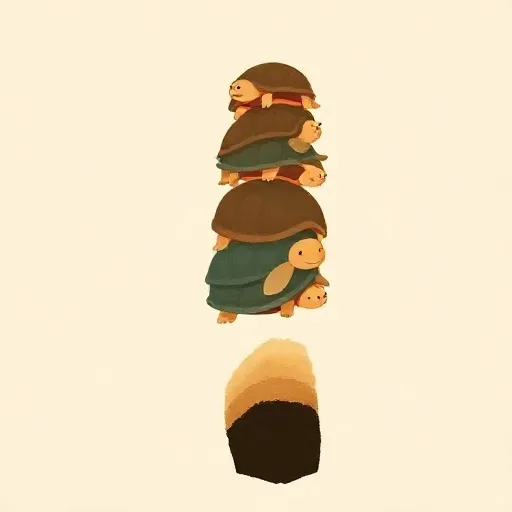
The sugar‑borrowing story is a close cousin of a famous myth: the world rests on the back of a giant turtle. And that turtle? It stands on another turtle, and so on — “turtles all the way down.” The philosopher Gottfried Wilhelm Leibniz (1646–1716) had a similar worry about what reality is made of. He imagined that every material thing is made of smaller parts, which are themselves made of smaller parts, with no smallest building blocks — a world where “gunk” goes down forever. Leibniz argued that such a world could not exist.
His reasoning is like the sugar case. If a table exists only because its parts exist, and those parts exist only because their parts exist, and this chain never hits something that simply exists on its own, then existence seems to be borrowed forever without ever being paid for. Schaffer wrote that “Being would be infinitely deferred, never achieved”. The contemporary philosopher Jonathan Schaffer draws the same conclusion: if everything depends on something else all the way down, then the whole pyramid floats with no foundation. So these thinkers become Metaphysical Foundationalists — they insist there must be basic, fundamental things that depend on nothing else, to stop the regress.
But not everyone agrees that the chain is broken. Ricki Bliss points out that each individual thing’s existence can still be fully explained. The table exists because its parts exist; the parts exist because their parts exist; and so on. Each “why does this exist?” gets a solid answer. What the regress does not explain is the global fact: why there are things at all. Yet the regress was never meant to explain that. If you only wanted to explain each piece, the endless chain works perfectly. Whether the regress is a problem depends on how big a question you set out to answer.
Passing the Buck Without Losing Anything

Even if you aim to explain the whole collection, not every infinite regress leaves you empty‑handed. The secret lies in what gets passed down the chain. Imagine you are trying to prove that a locked door cannot open. You say: “It’s locked because the key is turned, engaging the deadbolt.” You do not also need to give a full explanation of how deadbolts work; it is enough that the deadbolt is, in fact, engaged. The justification of your first claim does not depend on having a complete explanation of the deadbolt’s inner workings. In other words, the chain can continue without each step borrowing its strength from the next.
The logician Bob Hale calls this a non‑transmissive explanation — the crucial feature (being justified, being necessary) does not have to be passed along. An infinite chain of non‑transmissive explanations can supply a complete account, because at no point does your original explanation hang on the later ones. The philosopher Peter Klein uses this move to defend Epistemic Infinitism: the view that to be justified in believing something, you need an infinite chain of reasons. Klein says each reason raises the probability of the one before it, but the justification of belief does not flow from the end of the chain. It simply is the chain itself, with each link doing its own work.
This is very different from the turtles or the sugar, where each thing’s very existence is supposed to be handed along. In those cases, the explanation is transmissive: the existence of the table genuinely depends on the existence of the legs, and so on. So whether an infinite regress spoils the explanation depends not only on how far you want to explain, but on whether the thing‑being‑explained must be transmitted through every link.
Why the Endless Chain Matters to You

You have almost certainly built tiny regresses yourself. When a parent says “Because I said so,” and you shoot back “But why?” again, you are testing whether the reason stops somewhere solid. If the answer is just another “Because!”, you might sense the whole conversation is floating on nothing. That feeling is exactly what philosophers study: we want our explanations to land on something — a basic rule, an unquestionable fact, or at least a stable circle of ideas.
The centuries‑old quarrel about infinite regresses is really a quarrel about what it means to understand something. Foundationalists want a bottom turtle. Coherentists are happy to loop reasons around like a roundabout. Infinitists think the chain can just keep going, as long as each link is strong. None of these answers is obviously wrong, and what makes sense in a debate about the universe might change when you are arguing about a bedtime or a math proof. The next time you chase a chain of “Why?”s, you are doing philosophy — and you get to decide when you have heard enough.
Think about it
- If a friend kept asking “Why?” about every answer you gave, would you ever reach a final reason that doesn’t need another reason? How would you know you had found it?
- Imagine a video game where every level is contained inside a smaller level, forever. Could such a game actually exist, or does the idea secretly break? What would it mean to “finish” a level?
- Scientists often explain one fact by pointing to another. Do they ever accept an infinite chain of explanations for something, or do they always search for a fundamental law that stops the chain? Can you think of a case where they might be happy with a never‑ending regress?