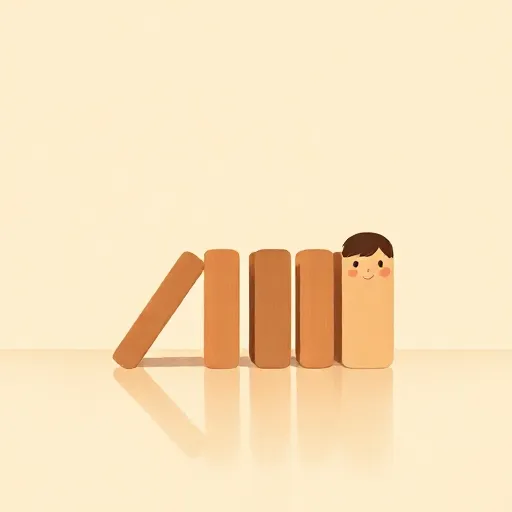

Are There Beliefs That Prove Themselves?
Why, Why, Why?

Imagine your little sister asks you why the toy car rolled across the floor. You say, “Because I pushed it.” She asks, “Why did your hand move?” You say, “Because my brain sent a signal.” She asks, “Why?” You keep answering, but after ten or twenty “whys” you run out of things to say. Eventually you mumble, “It just is.”
This isn’t just a child’s game. Grown‑up philosophers call it the epistemic regress problem. Whenever you claim you have a good reason to believe something, I can ask, “What’s your reason for believing that?” And then for that new reason, I can ask again. If every belief needs another belief to back it up, you seem to need an endless chain of reasons. But you are not an endless being — you can’t complete an infinite chain. So how can anyone be truly justified in believing anything at all?
This question has rattled thinkers for over two thousand years. Some answer that there must be a special kind of belief that needs no other belief as a reason — a foundational belief. Others say the chain doesn’t have to be a straight line, or that infinity isn’t as scary as it sounds. Let’s walk through the arguments, starting with a man who thought he could find a belief so solid that even the wildest doubts couldn’t knock it over.
Descartes’ Quest for a Solid Foundation

René Descartes (1596–1650) wanted to build knowledge the way you’d build a brick tower — from the ground up, with stones that cannot be shaken. He worried that many of his beliefs might be false, planted by a powerful demon who could trick his senses. So he decided to doubt everything until he found a belief that was absolutely indubitable — impossible to doubt.
He landed on the famous Cogito: that he thinks, therefore he exists. Even if a demon made him think he saw a tree, the very act of thinking proved he existed as a thinking thing. Descartes then argued that if he could clearly and distinctly see other truths — like mathematical axioms or the fact that a cause must have at least as much reality as its effect — he could build outwards, piece by piece. His ideal foundational belief was infallible: the mere fact that he believed it guaranteed it was true.
This version of foundationalism — the view that all justified beliefs rest on a base of beliefs that don’t need other beliefs for their own justification — became hugely influential. Aristotle (384–322 BCE) had hinted at similar ideas long before: in his Posterior Analytics, he said not all knowledge can come from demonstration, or we’d never get started. Many medieval and early modern thinkers, from John Locke to David Hume, accepted some form of it. But once you look closely, Descartes’ perfect bedrock crumbles. What can you really know infallibly? That you exist? That you feel a pain? That’s not much to build an entire world on.
The Regress Argument: Why Philosophers Thought We Need Foundations

Most philosophers aren’t satisfied with “it just is.” They want to see the structure that makes a belief rational. That leads to a simple principle, which the SEP article calls the Principle of Inferential Justification (PIJ). Stripped down, it says two things:
- If you want to justify a belief P by pointing to evidence E, you must already be justified in believing E.
- You must also be justified in believing that E makes P likely — that there’s a real connection between the evidence and the claim.
The first clause alone creates the regress. Suppose you believe it will rain because you saw dark clouds. You’re justified only if you’re justified in believing the clouds were really there and that your eyesight is reliable — and those beliefs need their own support, and so on. A circle is no help: you can’t use P to justify P. So either the chain goes back forever, or it stops somewhere.
And if it never stops, a finite human mind can’t travel the whole length. As Aristotle saw, that would mean we cannot be justified in believing anything at all — a kind of radical skepticism where even the claim “I’m unjustified” would itself be unjustified, which seems absurd. So, the argument goes, foundationalism must be right: there are beliefs that have justification without depending on other beliefs. Notice the argument doesn’t prove which beliefs are foundational; it just says if justification is possible at all, then something must sit at the bottom.
The second clause of PIJ makes the problem even thornier. Not only would you need an infinite chain for E, you’d need infinite chains for the connection between E and P, then for the connection between that connection and its evidence, and so on — an infinite number of infinite chains. Philosophers still argue about whether the second clause is too strict, but even the first clause is enough to push many thinkers toward foundationalism.
Other Ways to Stop the Chain: Webs and Infinity

Not everyone buys the regress argument. Some think the whole metaphor of a chain is misleading. Coherentism says beliefs are justified not by leaning on a foundation but by fitting together in a consistent, mutually supporting system — a bit like a spider web where each strand helps hold the others. The coherentist doesn’t have to first be justified in believing each strand; the whole web’s coherence is what does the work. So there’s no infinite chain, no circle that begs the question, just a holistic network of beliefs that hang together.
Another alternative, infinitism, bites the bullet and accepts the infinite chain. Infinitists argue that the human mind can have infinitely many justified beliefs — think of simple arithmetic: you believe 2 is greater than 1, 3 is greater than 1, and so on forever. If each belief is justified by a distinct reason, there’s no logical problem, and the chain is not “vicious.” Infinitism has far fewer fans than foundationalism or coherentism, but some contemporary philosophers, like Peter Klein, have defended it vigorously.
Foundationalists reply that coherentism can’t explain why a tightly coherent fairy tale isn’t true, and that infinitism glosses over how a finite mind could actually complete an infinite chain of reasons. The debate remains alive.
Modern Foundations: When Belief ‘Just Seems True’

Few philosophers today think we need infallible foundations like Descartes wanted. Many try to find a middle ground where basic beliefs are fallible — they can be wrong — yet still give us a starting point. Phenomenal conservatism, defended by Michael Huemer (20th–21st century), says that if it seems or appears to you that P, then, in the absence of a reason to doubt it, you are justified in believing P. A visual seeming, a memory, an intuitive grasp — all count. Similarly, dogmatism, championed by Jim Pryor (20th–21st century), holds that having a perceptual experience as of a hand in front of you can give you immediate justification for believing there’s a hand, even if you can’t first prove your senses are reliable.
These views are far more permissive than classical foundationalism. They allow that you’re justified in believing that there’s a table, that you had fish for dinner, that 2+3=5 — all just because it seems that way to you, unless something defeats that seeming. The attraction is obvious: it matches how we actually think and avoids a terrifying slide into skepticism.
But critics pounce. If a seeming alone can justify a belief, then you could reason like this: “The table looks red. So it’s not a white table under red lights.” Or: “I seem to have hands, so I’m not a handless brain in a vat being fed illusions.” That feels too easy. The problem of easy knowledge suggests that if basic justification is that cheap, you can bootstrap yourself into knowing you’re not being fooled without ever checking whether your machinery is trustworthy. Foundationalists push back: sometimes what looks cheap is actually just the way justification works, and skeptical scenarios are precisely the sort of doubt you’re allowed to ignore unless you have a real reason to worry.
Why This Still Matters When You Trust Your Eyes

Every day you lean on beliefs you don’t stop to prove. When you step off a curb, you assume the ground won’t vanish. When you read a sentence, you trust that your memory about word meanings is solid. When you tell a friend, “I’m feeling anxious,” you take yourself to be a direct authority on your own mind. Philosophy’s hunt for foundations is really an attempt to understand what makes these everyday leaps reasonable — or whether they are leaps at all.
The debate over foundationalism isn’t just a dusty puzzle. It shapes how we think about science, artificial intelligence, and the law. If our most basic beliefs require no further evidence, then building reliable knowledge might be possible after all. If they always rest on something else — or on nothing — then our whole tower of beliefs might be shakier than it feels.
The next time you catch yourself asking “why” over and over, remember you’re not alone. Philosophers have been playing that game for millennia, trying to find a place to stand. Whether that place is a solid rock, a spider’s web, or an infinite staircase is still anyone’s call.
Think about it
- If you could trace every reason for a belief back to a single starting point that you just had to accept without proof, would you be satisfied — or would you still wonder if you’d hit real bedrock?
- Imagine you trust your eyes to tell you there’s a table in front of you. How could you prove your eyes are reliable without using your eyes? Is that a genuine problem, or is it okay to trust them until you have a specific reason to doubt?
- Some people say that knowing something means you can explain all the reasons behind it. Others say that if you had to explain every reason, you’d never finish. Which view gets closer to how you actually live your life?