Why Does Gluing Qualities Together Never End?
A Lump of Sugar and a Philosophical Puzzle

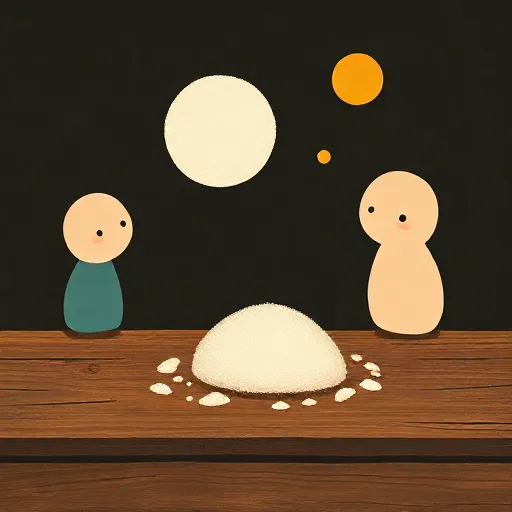
Suppose you pick up a lump of sugar. It seems like one thing. You can describe it: it is white, it is sweet, it is hard. But what is this “lump” that is white, sweet, and hard? Is it something extra, beyond those three qualities? Or is the lump just the three qualities bundled together? And if they are bundled together, what does the bundling?
In 1893, the British philosopher F.H. Bradley (1846–1924) asked these very questions. He wanted to know how qualities — like whiteness, sweetness, and hardness — could stick together to form a single object. The answer seemed to be a relation: some kind of connection or glue that holds the qualities in a unity. But Bradley argued that this glue leads to an endless series of glues. He believed he had found a fatal flaw in the very idea of a relation. The puzzle he raised is now called Bradley’s regress.
Long before Bradley, an ancient Greek philosopher, Plato (5th–4th century BCE), had a similar worry. In his dialogue Parmenides, Plato described a puzzle called the Third Man Argument. If many large things are large because they share in a single Form of Largeness, then that Form and the large things are all large together — which would require a second Form of Largeness, and then a third, and so on forever. The pattern was already clear: explaining a connection by introducing another thing that connects often sets off an infinite chain.
Bradley would push that pattern to its limits.
The First Regress: Independent Relations Cannot Relate

Bradley’s first argument in his book Appearance and Reality focused on what he called independent relations. Imagine you have two qualities, call them A (whiteness) and B (hardness). You want them to belong to the same lump of sugar. So you introduce a relation C that stands between A and B and ties them together. But now C itself is something separate from A and B — it is an extra entity. How does C get linked to A and to B? You need another relation D that connects C to A and B. But D is also separate, so you need a relation E to connect D, C, A, and B… and the regress never ends.
Bradley’s complaint was not that we can imagine this chain, but that at no point do we actually succeed in relating the original qualities. If a relation is truly independent of the things it is supposed to relate, it is just another thing that itself needs relating. Bradley thought that a real relation must somehow be “founded” in the terms it connects — it cannot sit outside them like a separate piece of string. But independent relations, by definition, do sit outside. So they can never do the job.
When Qualities Need Roles: The Second Regress

Bradley’s second argument went even deeper. He considered internal relations: relations that are not separate add‑ons but are somehow grounded inside the qualities themselves. For Bradley, the most promising internal relations were ones that grew out of the very nature of the qualities they relate. But he spotted a new problem. Qualities, he thought, need relations to perform two different jobs at once. First, a relation must unite qualities into a single whole — making them belong together. Second, a relation must differentiate qualities — making whiteness different from sweetness, so they are not just a formless blob. So a single quality, like the whiteness of the sugar, must supply a part of itself that grounds the difference‑making relation, and another part that grounds the unifying relation. Those two parts are different, so each part must itself contain further parts for its own difference‑making and unifying relations. The quality would have to split endlessly into smaller and smaller fragments. Bradley called this a “process of fission,” and he thought it proved that qualities standing in relations are unintelligible.
Many later philosophers have objected. Why think a quality needs separate parts to play both roles? Perhaps the same whole quality can ground both distinctness and unity without splitting. Or perhaps differences among qualities are just basic — whiteness and sweetness are different in their whole nature, and no extra difference‑making relation is needed. But Bradley was already imagining a world where everything is ultimately one undivided whole. From that starting point, any distinction seems to demand an explanation, and the regress of fission felt inescapable to him.
Russell Strikes Back: Relations Just Relate

When Bradley published his arguments, one of the sharpest replies came from Bertrand Russell (1872–1970). In a famous exchange of articles in 1910–1911, Russell defended the reality of external relations. An external relation, like “is next to,” does not depend on the inner natures of the things it relates. It is something that simply holds between them. For Russell, if you have a thing x and a thing y and an external relation R, you obtain a new unified whole: the fact that x‑R‑y. What turns a mere list of items into a unified fact is that the relation actually relates. No further relation is needed to attach R to x and y, because relating is just what relations do.
Bradley was not satisfied. He asked what the difference is between a relation that relates and one that does not. If you have the same three items — x, y, and R — sometimes they form a unity and sometimes they are just a pile. What makes the difference? For Russell, the difference was a fundamental fact of the world; it could not be broken down into further components. For Bradley, that was an admission of failure: you still had not explained how relations relate.
This stand‑off has never been fully resolved. Some later thinkers tried to escape the regress by positing a special non‑relational “tie” (a kind of super‑glue that is not itself a relation). Others argued that the items that make up a fact — a particular and its property — depend on each other so tightly that no extra connection is needed. And some, like the Australian philosopher D.M. Armstrong (1926–2014), accepted that the regress is real but harmless: it is an infinite chain of explanation, not an infinite chain of extra things.
From Sugar to the Universe: Why We Still Care
At first glance, Bradley’s regress can look like a puzzle about words, or a technical issue that only professors need to worry about. But the same riddle shows up everywhere. When you say “The cat is on the mat,” what makes that sentence about the world true? Is there a fact out there, composed of the cat, the mat, and the relation “on”? And if so, what holds that fact together? If you cannot answer, you might doubt that facts are real at all — or you might suspect, as Bradley did, that the very idea of separate things being connected is a kind of illusion.
The debate also matters when we ask deeper questions about explanation. If every explanation relies on another explanation, can any explanation ever really finish? Some philosophers think that unless our chain of reasons can “ground out” in something fundamental, we are left with an infinite regress that explains nothing. Others reply that an infinite chain of dependencies is not automatically vicious; it may just be a sign that reality has no bottom level.
Bradley’s sugar cube opened a crack in our everyday confidence that the world comes divided into neat separate things that then get connected. That crack is still wide open. Whenever you think about what holds your own thoughts together, what makes a team a team rather than a collection of players, or what makes a computer program a unified process and not just a list of instructions, you are walking on the ground that Bradley first dug up.
Think about it
- If you take apart a LEGO house, you have a pile of bricks. Is the house something more than the bricks, or is it just the bricks arranged in a certain way? What does the arranging?
- Imagine you had to explain every connection by pointing to another connection. Could you ever finish explaining anything? What would that mean for science or for everyday knowledge?
- Do you think a relation, like “being next to,” is a real thing that exists in the world, or just a convenient way of talking about how things are placed? Why?