Who Are You, Really? Ancient India's Search for the Self
The Seer and the Doer: An Ancient Puzzle
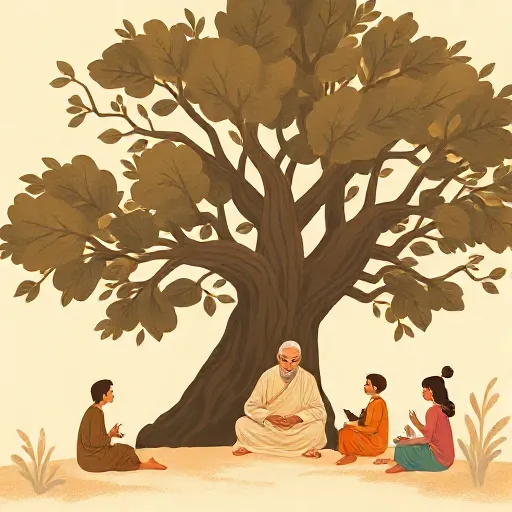
Imagine waking up after a strange dream and wondering: Am I still the same person who fell asleep? That question—what makes you the same you over time—was at the heart of philosophy in ancient India more than two thousand years ago. The earliest answer appears in a set of sacred texts called the Upaniṣads, composed from around 700 BCE.
These texts introduce the ātman, the self or soul. In a famous dialogue, the sage Yājñavalkya describes the ātman as a pure subject, a witness that never changes. It is not big or small, not hot or cold, not visible, not touchable. It has no body, no senses, no mind—it simply sees, hears, and knows while standing completely apart from the world. Yājñavalkya calls it the unseen seer and the unheard hearer. That picture is of a detached, changeless observer hidden inside you.
But the Upaniṣads also paint a very different picture: the person as an active agent, a doer and an enjoyer. What you become, the texts say, depends on how you act and how you conduct yourself. Good actions turn you into something good; bad actions turn you into something bad. This is the law of karma—a kind of cosmic cause and effect. Every action creates a karmic residue that will eventually ripen into a result, maybe in this life, maybe in a future life. So the person is not a detached witness but an embodied soul, swept up in a cycle of birth and rebirth (saṃsāra), driven by desire and the consequences of past deeds. The only way to break the cycle is mokṣa, liberation, which comes from truly knowing your own real nature.
Straightaway there is a tension: are you the still, untouchable witness, or the restless doer tangled in karma? For centuries afterwards, Indian thinkers fought over how to put these two ideas together.
The Soul as Pure Consciousness: Spiritual Views
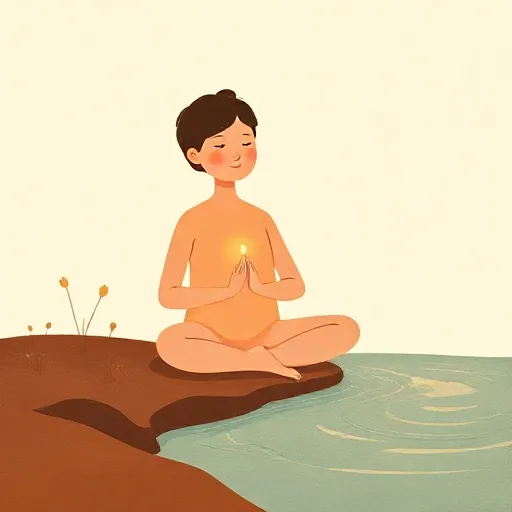
Two major Hindu schools took the witness-self idea and ran with it.
Advaita Vedānta philosophers, flourishing from around the eighth century CE, pushed the idea to its extreme. They claimed there is only one reality, Brahman—an infinite, undivided consciousness. Your individual self, the ātman, is simply identical with Brahman. The whole world of separate things—trees, mountains, bodies, even your sense of being a particular person with a name and family—is a cosmic illusion, māyā, projected by our ignorance. The self, they said, is not a substance that has consciousness; it is consciousness itself, like a light that reveals everything without itself being any particular thing. Once you realize, through study and meditation, that you are that one consciousness, the illusion of being a separate person falls away, and you are free.
The Sāṃkhya and Yoga schools also saw the true self as pure spirit, or puruṣa, but they disagreed that the existence of many individual persons is just an illusion. They argued that each person has a separate puruṣa. Every individual is a combination of that non‑material puruṣa and matter, called prakṛti. Matter is always in motion because of three inner forces or guṇas: sattva (light, pleasure), rajas (energy, passion), and tamas (heaviness, slowness). Your unique blend of guṇas shapes your body, your temperament, and your fate.
Sāṃkhya philosophers explained the union of puruṣa and prakṛti with an analogy: a blind man (matter) and a lame man (soul) meet and decide to cooperate. The lame man climbs onto the blind man’s shoulders, and together they reach their destination. In the same way, the soul becomes entangled with matter for the sake of experiencing the world—but it forgets its true nature and starts to identify with the body and the ego. That confusion brings suffering. Liberation happens when the soul finally sees through the show, becomes indifferent to material pleasures, and returns to its own blissful, uninvolved state. Yoga adds that this insight is reached not only by reasoning but through disciplined meditation.
Both schools held that your deepest self has almost nothing to do with your daily life. The search for the real you is a journey away from the person you seem to be.
The Soul in Action: Worldly Views
Not every thinker was ready to abandon the everyday person. The Nyāya‑Vaiśeṣika and Mīmāṃsā schools insisted that the self is not just a witness—it is an agent, a knower, and the bearer of karmic consequences.
The Nyāya school pointed to the ordinary facts of experience: desire, aversion, pleasure, pain, and decision‑making are marks of a self. They argued that we never see such qualities floating around on their own; they must belong to a permanent substance, the self. But here a knotty problem arose. According to the Nyāya philosophers, the self by itself is totally dependent on the body and the mind‑senses to function. Without them, it cannot think, remember, or act. So the isolated soul seems causally powerless—a mere passive owner of qualities that are actually produced by the body‑mind complex. For all practical purposes, it is the embodied person, not the bare soul, that is the true doer and enjoyer.
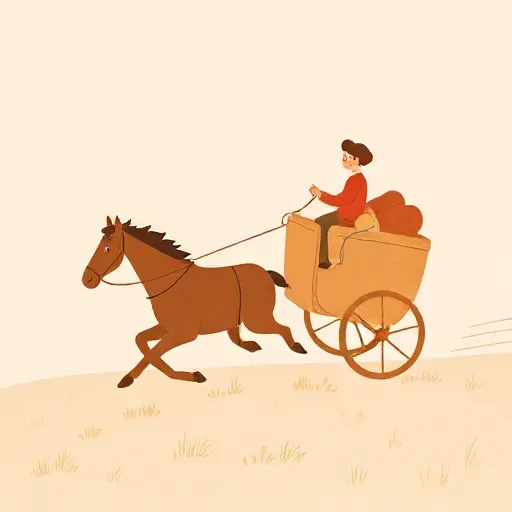
To explain how we know a self exists, they offered the chariot analogy: when you see a chariot moving skillfully down the road, swerving to avoid obstacles, you automatically infer that a driver is at the reins. In the same way, they said, we infer a self behind the body’s actions. But critics noticed a flaw: the connection between a charioteer and a chariot is fairly distanced, yet when your body is hurt you feel pain directly—the connection seems much tighter than that between a sailor and a ship.
The Mīmāṃsā school, focused on ritual and duty, added another layer. Here a person is defined by eligibility to perform religious actions and receive their karmic results. You are someone belonging to a social class, with a body, resources, and a place in a community—a downright worldly being. The Bhaṭṭa Mīmāṃsā philosopher Kumārila tried to soften the picture by saying the soul can undergo change while staying the same substance, like a piece of gold being recast into different ornaments. Still, the tension remained: a soul that is utterly separate from matter struggles to be the real agent of a life.
No Soul, Just a Person? The Buddhist Revolution

Buddhist philosophers took a dramatic turn. They flatly rejected the idea of an unchanging self, but they still needed to explain who carries karma from one life to the next. Their solution was to separate the concept of a person (pudgala) from any inner soul.
An early discourse, the Bhārahārasūtra, asks: What is the burden we carry through life? It is desire and craving. What carries that burden? The text answers: a person—a living being with a name, a family, a lifespan, who experiences pleasure and pain. The “burden‑bearer” is not an invisible soul but a functional entity.
Buddhists argued among themselves for over a thousand years about what kind of reality a person has.
The Pudgalavādins (Personalists) claimed that the person is neither identical to the ever‑changing physical and mental elements (dharmas) that make up a human stream, nor something completely separate from them. The person, they said, emerges from those elements but is ultimately real—a middle path between a permanent soul and utter nothingness.
Mainstream Abhidharma philosophers, like Vasubandhu (4th–5th century CE), disagreed. For them, only momentary, causally efficient dharmas are ultimately real. Everything else—chariots, forests, and persons—is just a conventional name for a bundle of parts. A person, they said, is like milk: milk is not a single thing but a collection of qualities such as whiteness, liquidness, and taste. The word “person” is a convenient label for a stream of physical and mental events, nothing more. It is a useful fiction, but it has no deep separate existence.
The Madhyamaka school, championed by Nāgārjuna (2nd–3rd century CE) and later Candrakīrti (7th century CE), went even further. They denied that a person is even a conventional reality in the usual sense. When you say “I,” you are not referring to anything at all—you are simply performing an act of claiming, a gesture of reaching out and appropriating experiences. For them, the very idea of a fixed person is empty; only in realizing that emptiness can suffering dissolve.
All these Buddhist views agreed on one thing: you do not need an eternal soul to make sense of a life. The person is something you do, not a hidden thing you have.
The Body Only: Cārvāka Materialists

The most radical ancient answer came from the Cārvāka school. They were thoroughgoing materialists. They denied the existence of a soul, rejected karma and rebirth, and declared that death is simply the end of the entire person.
Their argument rested on a strict rule: only what we can perceive with the senses really exists. Since no one can see, touch, or taste a soul, there is no soul. Consciousness, they said, is not the property of an invisible spirit; it arises from the combination of the four material elements—earth, water, fire, and air—when they are mixed in just the right proportion. They offered the analogy of an after‑dinner treat called paan: betel leaf, areca nut, and lime, none of which is red, yet when chewed together they produce a vivid red juice. In the same way, they argued, consciousness emerges from a physical body although no single ingredient separately has it.
They also appealed to everyday language. When you say “I am young” or “I am stout,” the “I” straightforwardly refers to the body. Nyāya philosophers objected that phrases like “my body” seem to separate the owner from the owned—as if a self possesses the body. The Cārvākas dismissed such phrases as mere figures of speech. To them, the whole person was, quite literally, the body and nothing more.
Why This Ancient Debate Still Matters

It is easy to feel that these ancient arguments belong to a different world. Yet they are wrestling with exactly the same question you face when you look at a childhood photo and think, “Is that really me?”
Modern philosophers often take for granted that there is no invisible soul‑substance. But once you give up the idea of a permanent self, you still have to explain moral responsibility, anticipation of your own future, and the special care you feel for the one person whose life seems to be yours. Those are the very concerns that pushed Indian thinkers to ask about the self in the first place. The Hindu schools wanted a stable carrier of karma; the Buddhists wanted a burden‑bearer without a soul; the Cārvākas denied there was any carrier at all.
And the Buddhist challenge is especially alive today. Many of us instinctively believe that a deep, unchanging core makes us who we are. Buddhist Reductionists invite you to consider: what if that core is just a convenient story? The surprise is that this need not feel bleak. Buddhist teachers did not recommend abandoning self‑concern or love for those close to you; they recommended expanding that concern until it includes all living beings. The practice of no‑self, in their view, is not about giving up your humanity but about enlarging it.
So the next time you wonder whether you are still the person who liked that music, who made that mistake, or who will wake up as you tomorrow, remember that you are stepping into a conversation that started thousands of years ago—and that no one has yet closed.
Think about it
- If you woke up tomorrow with all your memories but in a completely different body, would you still be you? What would need to be the same for you to be the same person?
- Suppose you could prove that there is no permanent, unchanging self inside you. Would that change how you feel about your future, or about how you treat other people?
- Is it fair to punish someone for a crime they committed ten years ago if in the meantime their personality and body have changed so much that they seem like a different person?