
Is Your Soul a Ghost, a Ruler, or Just a Toolbox?
A Warrior’s Last Breath
The Greek hero Achilles knew he would die young if he stayed to fight at Troy, yet he stayed anyway. In Homer’s Iliad, Achilles says he is “continuously risking his soul.” For the earliest Greek poets, the soul (psychê) was exactly that: the thing you put on the line when your life was in danger. When a warrior fell, his soul slipped out with his last breath and traveled, as a faint shade or ghostly image, down to the dark underworld. Once the soul had departed for good, the person was dead.
But here is what is strange: Homer never says anyone does anything with their soul. You don’t think, plan, or feel angry with your soul. The soul marks the difference between a living body and a corpse, but it is not what makes you you while you are alive. To mention a person’s soul was to hint that their life might be about to end. And this soul-risking business was mostly for humans; Homer never pictures the shades of dogs or horses in the underworld.
By the 500s BCE, however, the Greeks began to talk about the soul in a much wider way. This shift is the beginning of a long argument — one that Plato and Aristotle would take up — about what the soul really is and what it does.
The Soul Learns to Think
Around 600 BCE, the philosopher Thales of Miletus (c. 624–546 BCE) reputedly said that magnets have souls because they can move iron. For Thales, what made something alive — ensouled — was the power to set things in motion. The old Homeric connection between soul and life expanded: now every living thing, not just humans, had a soul. Gradually, people began to attribute more and more to the soul. By the late 400s BCE, a person could say their soul took pleasure in rich food, burned with sexual desire, bit with dishonor, or lamented the city’s misery. The soul became the seat of courage, and later of other virtues like justice and temperance. A brave soldier was said to have an “enduring soul”; a man who stayed calm in danger had a “strong soul.”
At the same time, the soul took on the job of practical thinking. If the soul was responsible for courageous acts, it had to figure out what courage demanded. In law courts, jurors were urged to punish “the soul that planned the crime.” The philosopher Pythagoras (around 530 BCE) told a story that shows how far the idea had come: once, seeing a puppy being beaten, he cried out for them to stop, explaining that it was the soul of a friend, whose voice he recognized. For Pythagoras, the soul wasn’t just the life-force; it carried a person’s identity, their memories, even their voice, across bodies.
By the end of the 400s, a new, complex picture had formed: the soul distinguished the living from the dead, but it also housed moral character, emotions, desires, and thought. For the first time, Greeks could clearly speak of a body–soul contrast. Yet that picture raised a tense question: could the same thing that makes a plant alive also be the thing that thinks, chooses, and might survive after the body dies?
Plato’s Immortal Pilot

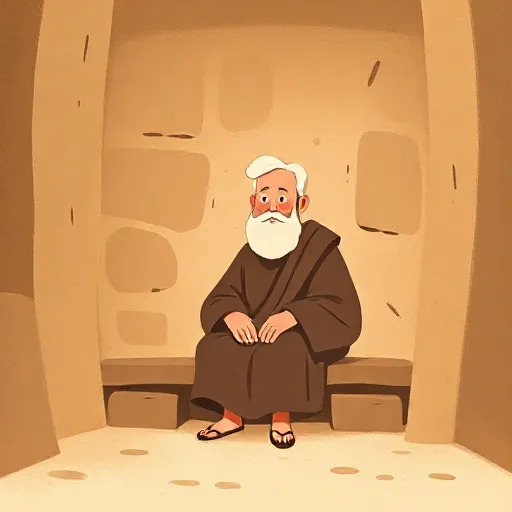
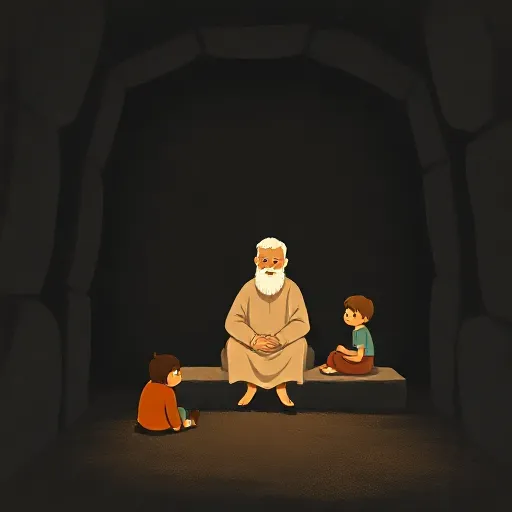
Plato (c. 428–348 BCE) answered with a bold yes — and more. In his dialogue Phaedo, set on the day Socrates dies, Plato’s characters argue that the soul is not only the source of life but is itself immortal. Most people of the time believed the soul was a fine material thing, like breath or smoke, that dissolved at death. Socrates pushes back. He asks his friends to imagine two kinds of reality: one visible, made of parts, and always falling apart (like bodies); the other invisible, without parts, and never destroyed (like numbers, justice, or the divine). The soul, he argues, is much more like the second kind. It is invisible, it naturally “rules and leads” the body, and when it turns away from the senses to study pure truths, it becomes calm and wise — as if it had come home. That makes the soul “most akin” to the eternal, intelligible world. If so, it is natural for the soul to be either indestructible or nearly so.
Plato’s final argument in the Phaedo goes further: the soul has life as part of its very essence, just as fire has heat. It cannot stop being alive any more than fire can stop being hot. So the soul is deathless — immortal.
But the Phaedo leaves a puzzle. It pictures the soul as the thinking, ruling part of a person, while the body has its own beliefs, pleasures, and fears. That splits the mind into two centres: the reasoning soul over here, and bodily desires over there. Yet when you feel torn between a craving for sweets and a quiet voice saying “don’t,” it doesn’t feel like two separate creatures fighting. It feels like you — a single you — are in conflict.
In the Republic, Plato offers a different solution. He argues that the soul itself has three parts, each with its own desires. One part is reason, which loves truth and wants to guide your life wisely. Another is spirit, which craves honor, stands up for you, and fuels anger and pride. The third is appetite, which hungers for food, drink, and other bodily pleasures. When you are thirsty but decide not to drink because the water looks dirty, reason and appetite are pulling against each other inside one soul. All your mental life — thought, emotion, desire — now belongs to the soul, not split off into the body. The soul becomes a single, many-layered self, like a chariot with three horses, each wanting to go its own way.
Aristotle’s Living Toolkit

Aristotle (384–322 BCE), Plato’s student, thought his teacher had made the soul too much like a hidden pilot. Aristotle took the ordinary Greek idea — that the soul is what makes something alive — and turned it into a careful scientific theory. In his work De Anima (On the Soul), he defines the soul as the form of a living body. By form, he doesn’t mean shape. He means the set of active abilities that make a body the kind of living thing it is.
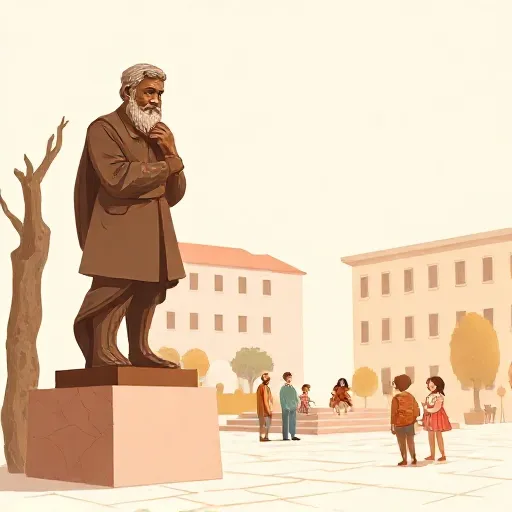
Think of a statue. Its matter is the bronze; its form is the shape of a warrior or a goddess. In a living thing, the body is the matter, and the soul is the form — the power to nourish itself, grow, perceive, move, and think. A plant’s soul is its ability to take in food and reproduce. A dog’s soul adds the abilities to sense and to move from place to place. A human soul adds the ability to reason. All these powers together are what the soul is; they are not a separate ghost that can float away. For Aristotle, when a living thing dies, its matter loses that particular set of abilities, and the soul simply ceases to be.
This means that, unlike Plato’s soul, Aristotle’s soul cannot exist without a body. Even thinking, Aristotle suspects, always involves images supplied by the senses, so it needs a working brain and sense organs. He does not promise an afterlife. Instead, he gives a unified picture: every vital function, from digesting lunch to solving a geometry problem, is something a living body does, thanks to the powers that are its soul.
Why This Ancient Puzzle Still Matters

The ancient argument didn’t stop with Aristotle. Later Greek schools, like the Stoics, narrowed the soul even further, making it the mind alone and leaving growth and digestion to other forces. That move helped pave the way for modern ideas of the mind as something purely mental, not tied to keeping your body alive.
Today, you still live with the questions the Greeks first raised. When you feel torn between what you want and what you know is right, you are replaying Plato’s dispute between appetite and reason. When you wonder whether your thoughts are just the buzzing of brain cells or a sign of something more, you are stepping into Aristotle’s workshop. And when you lie awake wondering if anything of you will survive when your body stops working, you are standing beside Achilles on the Trojan plain, risking your soul.
Think about it
- If a clever inventor built an exact robot copy of you — same appearance, same memories, same personality — would that robot have a soul? Why or why not?
- When you feel like two different desires are fighting inside you (for example, wanting to ace a test and also wanting to play video games), does that support Plato’s idea that the soul has separate parts? Or could the Stoics be right that it’s just one mind quickly changing direction?
- Aristotle thought the soul was a set of abilities like seeing, remembering, and thinking. When you fall into a deep, dreamless sleep, do you still have a soul? What about a plant that never thinks — would you say it has a soul in the same way you do?