
Can You Think About a Unicorn? The Strange World of Nonexistent Things
A Golden Mountain That Isn’t There
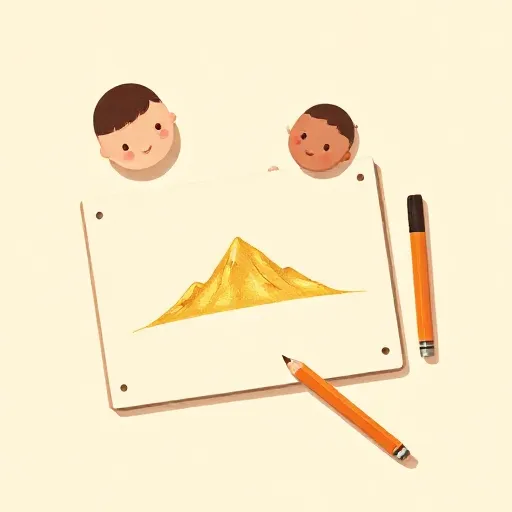
Imagine you are sitting at your desk, drawing a mountain made of solid gold. The sun glints off its peaks, and the valleys are filled with diamond trees. You can talk about this mountain all day — it’s tall, it’s shiny, it’s made of gold. But you know perfectly well that no such mountain exists anywhere on Earth. So what are you talking about?
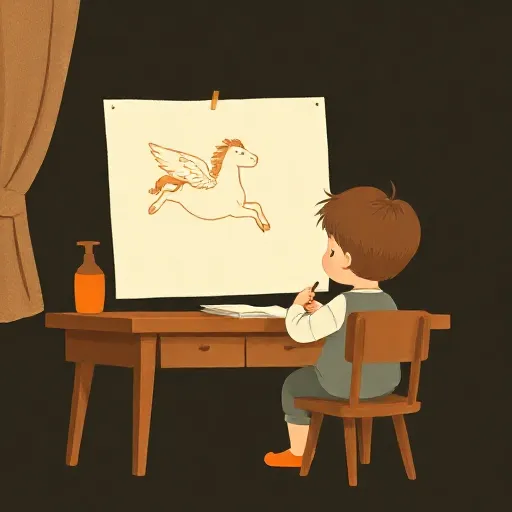
Philosophers have argued about this for centuries. The Scottish thinker David Hume (1711–1776) said that whenever you think of an object, you automatically think of it as existing. Later, Immanuel Kant (1724–1804) added that existence isn’t a “real property” you can tack onto a thing, like adding frosting to a cake. That idea got a more precise twist from Gottlob Frege (1848–1925): he held that saying “Pegasus exists” isn’t about a thing called Pegasus at all — it’s about the concept of Pegasus, claiming that something in the world matches it. According to this line of thought, talk of “nonexistent objects” seems as confused as talking about round squares. Yet the feeling that there must be something we’re talking about when we discuss unicorns, fictional detectives, and future people keeps the puzzle alive.
Why Saying “Vulcan Doesn’t Exist” Is So Tricky

To see the problem sharply, consider this sentence: “Vulcan does not exist.” In the 1800s, astronomers believed there was a planet between Mercury and the Sun, which they called Vulcan. Later they discovered it wasn’t there. Yet the sentence “Vulcan does not exist” feels true, and it feels like it’s about Vulcan. But if it’s about Vulcan, then Vulcan must be something we can refer to — and if we can refer to it, it seems to exist in some sense. You end up in a tangle: to say that Vulcan lacks existence, you seem to need it to be something first.
The philosopher Bertrand Russell (1872–1970) tried to cut this knot. He proposed that ordinary names are really hidden descriptions. “Vulcan” is just shorthand for “the planet between Mercury and the Sun.” Then “Vulcan doesn’t exist” means roughly: “There is no single thing that is a planet between Mercury and the Sun.” No mysterious nonexistent object is needed; we just deny that the description fits anything.
Russell’s trick works smoothly for many cases, but not all. Think about Sherlock Holmes: “Sherlock Holmes is more famous than any real detective.” On Russell’s picture, the name “Sherlock Holmes” disappears into a description, and that makes the sentence likely false, because there is no real detective with those qualities who is more famous than all the rest. Yet the original sentence seems plainly true. Stories about fictional characters often seem to report genuine relations between us and something that is not a flesh-and-blood person. So the puzzle refuses to stay buried.
Meinong’s Breathtaking Idea: Things That Have Being Without Existence

The most daring answer came from the Austrian philosopher Alexius Meinong (1853–1920). He was troubled by a different problem: intentionality. Every mental act — hoping, fearing, imagining — points toward something. You can’t just hope; you hope for something. But people hope for peace in the Middle East, and children fear monsters under the bed, even when there is no peace and no monster. What, then, are these thoughts about?
Meinong’s solution was startling: even thoughts that miss existing targets still have an object. That object is a nonexistent object. In his view, there are objects of every description, and some of them exist while others do not. This is the famous principle of independence: what a thing is — its “so-being” — does not depend on whether it exists. The golden mountain is genuinely golden and a mountain; it simply lacks existence. Pegasus is a winged horse; it just isn’t an existing winged horse.
With this single move, Meinong tackled several headaches at once. Negative existence sentences like “Pegasus does not exist” become straightforward: they say that an object (Pegasus) is not among the things that exist. Sentences about fiction are not forced into tricky paraphrases — “Pegasus is a flying horse” is literally true of that nonexistent horse. And intentionality is saved: every thought has an object, even if the object is nowhere to be found.
Russell’s Revenge: The Existent Golden Mountain

Meinong’s theory, however, ran straight into a wall erected by Russell. Meinong treated existence as a property that some objects have and others lack. If that is so, Russell argued, we can describe an object that has the properties of being golden, being a mountain, and being existent. Then such an object would have to exist — yet we know there is no golden mountain. The theory seems to generate a contradiction from its own rules.
Worse, consider the “round square.” Meinong’s original view says this object is round and square, therefore round and not round. It violates the law of contradiction. Meinong replied that the law of contradiction applies only to objects that exist, but many philosophers found that response unsatisfying. Further puzzles piled up. The object that is “blue and nothing else” seems to have exactly one property, yet having exactly one property is itself a property — so it ends up with two. And if an object simply stops existing, the theory seems to say that everything else about it remains the same, which clashes with how we normally think about coming into and going out of existence.
The Clever Fix: Abstract Objects and Two Kinds of “Is”

To rescue the core insight while dodging the paradoxes, later philosophers refined Meinong’s picture. One influential route divides properties into two families: nuclear and extranuclear. Nuclear properties — like being blue, being a mountain, being round — make up the nature of an object. Extranuclear properties — like existence, being fictional, or being thought about — are outside that nature. In this revised view, you can describe the golden mountain using only nuclear properties: golden, mountain. You cannot simply toss existence into the description, because existence is extranuclear. The existent golden mountain never gets formed, so the paradox is blocked.
A more radical fix is the dual copula strategy. According to this view, the word “is” has two different meanings. A thing can exemplify a property (like an apple exemplifies redness) or it can encode a property (like a character in a book encodes traits). The round square, in this theory, encodes roundness and squareness, but it does not exemplify them. That means it is not round in the ordinary sense — so it isn’t both round and not round. Fictional objects like unicorns and Sherlock Holmes are abstract objects that encode a set of properties without actually having them. They exist as abstracta, just as numbers or laws might, but they are not concrete things walking about. In this framework, the difference between a “nonexistent” object and an ordinary one isn’t just a missing property of existence; it’s a whole different kind of thing: an abstract bundle of encoded features, not a physical entity. The theory no longer needs to claim that some objects genuinely lack existence in the way Meinong originally thought.
Why It Matters for Dragons, Future Popes, and Imaginary Friends

Why should a twelve-year-old care about abstract objects and encoded properties? Because this debate shapes how you understand your own thoughts and stories. When you say “Harry Potter is a wizard,” you aren’t making a false claim about a boy who never existed; you’re describing an abstract character from a book. When you worry about future generations who don’t yet exist, the whole apparatus of nonexistent (or abstract) objects gives you a way to talk about them right now. And when you imagine a golden mountain or a flying horse, philosophy offers a story about what, exactly, your imagination is reaching toward.
Of course, the puzzles haven’t vanished entirely. If the thing you imagine is really an abstract object sitting outside space and time, does that fit how it feels to imagine a monster? If you fear the devil, are you really fearing an abstract code of properties? Many philosophers think the abstract-object solution trades one mystery for another. That’s why, even today, some thinkers prefer to say there simply are no nonexistent objects — only true sentences that don’t require any strange entities at all. Others try to keep the original Meinongian dream alive while taming its wild consequences. The discussion is wide open.
What’s certain is that the question you started with — “How can I talk about a golden mountain that isn’t there?” — leads into some of the deepest puzzles about language, thought, and reality. It has no easy answer, and that’s what makes it worth thinking about.
Think about it
- If a book never reveals a character’s middle name, can it still be true or false that the character has one? Why or why not?
- When you imagine a monster you’ve never seen before, are you creating something entirely new or just reshaping pieces of things you’ve already experienced?
- If future people don’t exist yet, do we have any responsibility to avoid harming them with the way we live today?