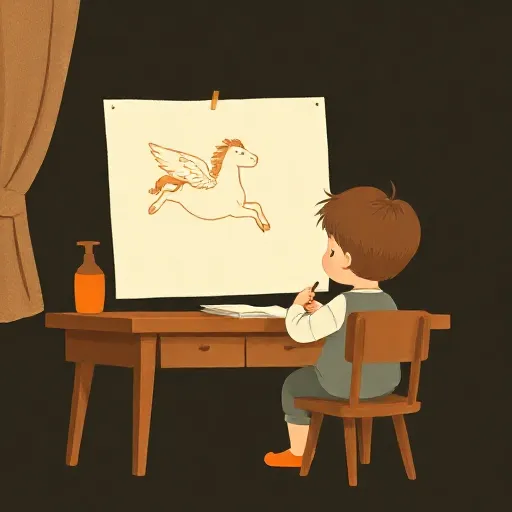

Can You Think About Something That Doesn’t Exist?
The Man Who Made Thoughts Point to Nothing

Close your eyes and picture a unicorn. Now, picture a round square — a shape that is perfectly round and perfectly square at the same time. Can you do it? If you can, what exactly are you picturing? In 1894, a young Polish philosopher named Kazimierz Twardowski (1866–1938) asked a question a lot like this. He studied with the demanding teacher Franz Brentano in Vienna, where philosophers were tangled in a puzzle: How can you judge that something doesn’t exist?
For instance, scientists once believed a mysterious substance called the aether filled all of space. Later, physicists decided the aether did not exist. But if you say “The aether does not exist,” your thought seems to be about the aether. What is that thought pointing to? If it points to nothing, how can the judgment be true? Twardowski’s answer — published in his book On the Content and Object of Presentations — was that every thought has two parts: a content inside your mind and an object it is about, even if that object doesn’t exist. This simple yet radical idea would later change logic, language, and the study of the mind.
The Arrow and the Painter

To understand Twardowski’s insight, start with an arrow. An arrow points at something. The thing it points at is the object. The arrow’s shape, its direction, the material it’s made of — that’s like the thought’s content, the part inside your mind. The act of pointing is the mental act, which Twardowski called a presentation. When you think of Salzburg as “the Roman town Juvavum” or as “Mozart’s birthplace,” you have two different presentations with two different contents, but they both point at the very same city — the same object. Twardowski called such interchangeable thoughts Wechselvorstellungen.
He also compared thinking to painting. If an artist paints a landscape, you might say “she painted a landscape.” But that phrase is tricky: a “painted landscape” could mean the real scene outside (the landscape that was painted) or the canvas hanging in a museum (the painting itself). The word “painted” works in two ways: one attributive, the other modifying. Twardowski argued that “presented object” works the same way. A “presented object” can mean the real thing you are thinking about (like a mountain) or the mental picture inside you (the content). Philosophers before him had confused the two. By separating them, Twardowski could say: the thought’s object may not exist, but the content — the mental “arrow” — does exist, right there in your mind, as long as you are thinking.
Why There Are No Empty Thoughts

Many philosophers at the time believed some presentations were objectless — that words like “nothing” or “round square” pointed to nothing at all. Twardowski disagreed. He gave several arguments that no thought is ever without an object.
First, consider how names work. A name like “Barack Obama” tells you someone is having a mental act (a presentation), it means something (the content), and it names an object. “Nothing,” Twardowski observed, is not really a name. It works more like “and” or “or” — a logical connector, not a thing you can point to. So the question “What is the object of ‘nothing’?” is a misguided question. Real names, like “round square,” do name objects. They name impossible objects, but that’s still an object — one that happens not to exist.
Second, the content of a thought exists; the object may not. When you think of a dodecahedron with thirteen sides, the mental picture in your head (the content) is real — it exists as a psychological event. But the thirteen-sided dodecahedron does not exist, because it’s geometrically impossible. Yet you’re clearly thinking about something. If the thought had no object at all, what would bear the contradictory properties like “having thirteen faces” and “being a Platonic solid”? The object does, not the content.
Third, being presented is not the same as existing. You can present a unicorn to your mind. The unicorn is presented, but that doesn’t magically make it exist. Twardowski pointed out that people sometimes discover a concept is contradictory only after thinking about it. A mathematician might consider a “highest prime number” for a long time before realizing it can’t exist. If objectless presentations were real, the moment you noticed the contradiction, the thought would suddenly have no object. But you’re still thinking about that impossible number — so the object was there all along. Thus, every presentation has an object, even if that object is a strange, impossible, or nonexistent one.
Can Truth Really Change?

Armed with his careful distinctions, Twardowski later took up a second puzzle in his new post at the University of Lvov (now Lviv in Ukraine). Many thinkers said truth was relative — that a statement like “It’s raining” could be true at one time and false at another. Twardowski argued forcefully that truth is absolute.
His strategy was simple: when people say “It’s raining” in Lvov on March 1, 1900 at noon, they don’t mean some vague rain anywhere. Their complete judgment is really something like: “On March 1, 1900, at noon Central European Time, it is raining in Lvov on the High Castle Hill and its vicinity.” That fully specified judgment does not change truth value. Tomorrow, it will still be true that on that date it rained there. The mistake, Twardowski said, is confusing sentences — which can be short and sloppy — with the judgments we actually make. Judgments are precise; sentences are just their public expression. By “eternalizing” sentences — spelling out all the hidden details — we can see that truths don’t fade or twist depending on the weather. This idea is sometimes called the omnitemporal view of truth, and it influenced later logicians like Alfred Tarski.
Why a Polish School of Logic Still Matters
Twardowski didn’t just write books. He became a legendary teacher, building what came to be known as the Lvov-Warsaw School — a movement of philosophers and logicians famous for razor-sharp thinking. His students included women like Izydora Dąmbska and Seweryna Łuszczewska-Romahnowa, who later held philosophy chairs themselves. The school’s motto could have been: never let muddy words hide sloppy ideas.
The distinction between content and object opened the door for Alexius Meinong’s wild theory of objects — a world where golden mountains and round squares have a kind of “being” even without existence — and it provoked Bertrand Russell’s famous critique. Twardowski himself later refined his view in Actions and Products (1912). There he distinguished the mental act of judging from the judgment-product, a logical object that can be studied independently of anyone’s buzzing brain. This move helped separate logic from psychology and paved the way for modern formal logic.
So when you imagine a unicorn, tell a story about a dragon, or design a character for a video game, you are doing something Twardowski thought was at the heart of being human. You can point your thoughts at things that are not here, not now, and not even possible — and that power is what makes science, storytelling, and logic possible.
Think about it
- If you imagine a creature that is half cat and half dog, does that creature exist only in your mind, or is it a real “object” for your thought? What difference would it make?
- Can you think of an object that has absolutely no properties — no color, no shape, no size? Try it. What happens to your thought?
- If every truth is absolute and never changes, does that mean we can never be wrong about what we thought was true? How could we discover a mistake?