
How Can You Imagine a Dragon That Isn’t Real?
The Chariot on the Sea: Can You Think What Isn’t There?
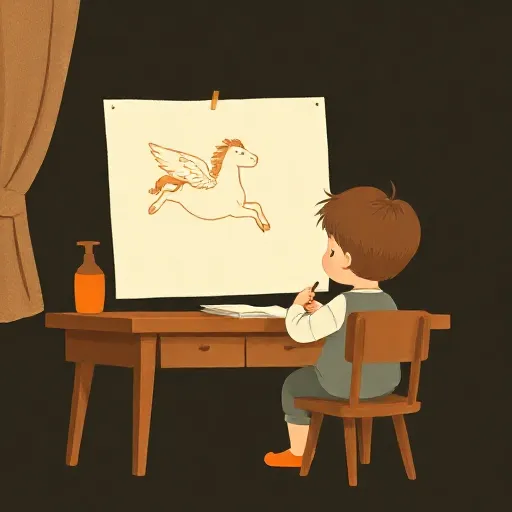
Close your eyes and imagine a bright red dragon sleeping on a pile of gold. That was easy. But here is the strange part: dragons do not exist. So how can you think about one? If your thought is about something, that something should be there to be thought about — yet it isn’t. This is the puzzle of intentionality, the word philosophers use for how our minds can be about things, even when those things are absent, made up, or simply false.
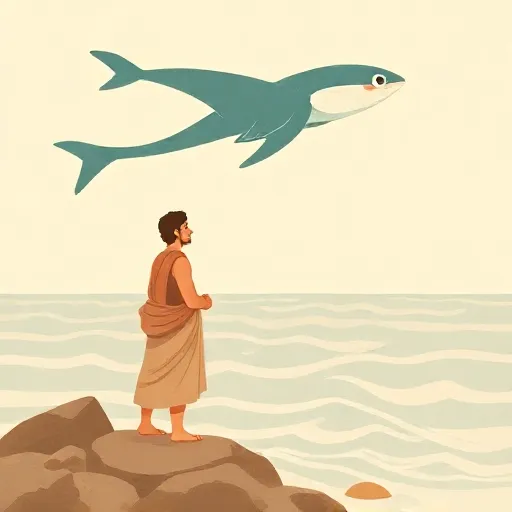
In the fifth century BCE, a Greek thinker named Gorgias (c. 483–375 BCE) made this puzzle sting. He said: picture a chariot racing across the sea. You just did. But there is no chariot on the sea. If thinking always has to point at something real, what just happened? Some people concluded you can’t really think of what isn’t there — that it must be empty noise. Gorgias turned that assumption inside out and showed that we do think about nonexistent things. The philosopher Ludwig Wittgenstein (1889–1951) later put a thumb on the same mystery: you cannot hang a man unless he is there, but you can look for him even if he is not. The mind reaches out in a way that feels almost like a connection — yet sometimes nothing is on the other end.
Parmenides’ Rule: No Thinking Without Being

Long before Gorgias, a poet‑philosopher named Parmenides (early 5th century BCE) drew a hard line. In his poem, a goddess declares that “what can be said and thought must be what is.” In plain English: you cannot think about what is not. If something is not there — if it doesn’t exist or didn’t happen — then there is nothing for your thought to grab onto. The goddess insists that trying to think about non‑being is impossible, like trying to see in total darkness.
Parmenides’ rule has a certain snap to it. Suppose every thought is a direct relation between your mind and the thing you are thinking of. A relation is like a bridge: it needs both ends to stand. If one end is missing, the bridge collapses. So if you are thinking about a hippocentaur — a half‑horse, half‑human creature — and there is no such beast, the bridge has nowhere to land. The thought would be about nothing, which sounds like no thought at all.
We can line up three simple ideas that together create a crash:
- Thought is a direct relation to the thing thought about.
- A relation cannot hold unless all the things it relates exist.
- Sometimes we do think about things that don’t exist (like dragons or a chariot on the sea).
They cannot all be true. You have to throw one out. Parmenides himself seems to have kept (1) and (2) and denied (3): he would say you never really think of a dragon; you only think you do. That price felt too high for most people. So philosophers began looking for other ways out — by either rejecting the direct‑relation picture or loosening the demand that the object be a fully existing thing.
Plato’s Big Idea: How a Sentence Can Be False

Plato (427–347 BCE) ran into the puzzle while trying to explain how we can have false beliefs. In his dialogue the Sophist, he has a visitor from Elea remind everyone of Parmenides’ warning: you cannot speak of what is not. Yet falsehood happens all the time. If you say “The sky is green,” you are not just making meaningless noise. Your sentence is about the real sky and it claims something that isn’t true.
Plato’s solution was to look at the structure of a sentence. He saw that a statement is not a single name that either hits or misses reality. Instead, it has two parts: a subject (what you are talking about) and a predicate (what you say about it). Both parts pick out something real. The subject names an existing thing; the predicate picks out a quality that really exists somewhere in the world. A false statement happens when you pair a subject with a predicate that does not belong to it — you say the sky is green, but green belongs to grass, not to the sky that day. Nothing in your statement refers to “what is not.” You have simply connected two existing things in the wrong way, like trying to fit a dog‑shaped puzzle piece into a cat‑shaped slot.
Belief works the same way, Plato thought: it is a silent sentence the soul says to itself. So even when you believe something false, your mind’s attention is on things that are — it just arranges them incorrectly. This clever move allowed Plato to explain falsehood without breaking Parmenides’ rule, and it opened the door for thinking of intentionality as something more flexible than a simple hook‑and‑eye connection.
Aristotle’s Mind Movies: Thinking Without the Thing

Aristotle (384–322 BCE) pushed further. He noticed that we can think about specific individuals who no longer exist — his example was Socrates, who had died — and about beings that never existed at all, like the hippocentaur. If thought had to reach out like a ray and touch its object, these thoughts would have nowhere to land and would be impossible. Aristotle charged that his predecessors could not explain how we think about such things.
His own answer was that the mind keeps internal models of the world. He called these models phantasmata (the singular is phantasma), a word often translated as “images” but which works more like a mental imprint. Imagine pressing a signet ring into warm wax: the wax takes on the ring’s shape, and even after you remove the ring, the seal remains. Similarly, when you see a horse, your body and soul receive its form — not the physical matter, but the shape and pattern — and that imprint stays. Later, even when no horse is in sight, you can think about horses by activating that imprint. This power he called phantasia, the capacity we use for dreaming, remembering, and imagining.
Aristotle saw that this explains how falsehood and error creep in. Your phantasmata can be combined with fresh perceptions in a mistaken way. You might match the imprint of a lion to the perception of a rock, thinking you see a lion when it is just a rock. Both the imprint and the rock exist; the mistake is the wrong pairing. That gave a working model of how the mind can be about what isn’t out there without any mysterious reaching into nothingness.
The Stoics’ Brain Tools: Sayables and Figments

The Stoics, a school founded by Zeno of Citium (334–262 BCE) and later led by Chrysippus (c. 279–206 BCE), took a bolder step. They kept the intuition that whenever you think, there is something your thinking is about — but they gave up the idea that this something must exist like a rock or a tree. The Stoics made Something the widest category of all, broader than “what exists.” Things that are merely imagined, like centaurs or giants, count as something even though they are not real. The early Stoics called such objects phantasmata, or “figments.” A figment is a mental appearance: it is not a body you can bump into, but it is still something your mind is directed at.
Chrysippus later refined this with a new idea: lekta (singular lekton), meaning “sayables.” A sayable is the content expressed by a word or sentence — the meaning you grasp, not the ink or the sound. For example, the sentence “The dog is sleeping” expresses a lekton that can be true or false. That lekton is not a physical thing; it “subsists” rather than exists, like a shadow that is there even though you cannot pick it up. This allowed the Stoics to handle false statements and thoughts about nonexistent objects without any sleight of hand. The meaning of “the centaur is wise” is a real something — an abstract content — even though no centaur stands in any field.
The Stoics also insisted that every mental state is a representation (phantasia), an impression the world makes on your soul. Representations come with built‑in content, like a rich, wordless description of how things appear. In humans, reason lets us isolate parts of that content, assent to some, reject others, and build complex thoughts. Even before reason develops, children and animals have representations with real content, which is why they can act on the world. The Stoics had given the mind a new set of tools: meanings, not just things, could be the targets of thought.
Why This Old Puzzle Still Matters Today

You probably do not spend your days worrying about centaurs. But you do daydream about a future holiday that hasn’t happened yet. You miss a friend who moved away and picture their face. You worry about a test that might be cancelled. In every case, your mind is aiming at something that isn’t there right now — and sometimes at something that was never there at all, like a villain in a story. That is intentionality in action.
The debate the ancients started is still alive. When a computer program plays chess, does it really think about its opponent, or is it just following rules? Some philosophers say the mind works a bit like the Stoics’ sayables — by shuffling internal symbols that have meaning. Others think it is more like a direct connection to the world, only far more tangled than Parmenides imagined. Whenever you wonder whether a chatbot understands you, or what happens in your brain when you imagine a new creature, you are dipping into the same stream of questions that puzzled Gorgias, Plato, and Aristotle. The problem of intentionality is not just an ancient riddle. It sits at the heart of what it means to have a mind.
Think about it
- If you can imagine a made‑up animal in perfect detail, does that mean the animal somehow “exists” inside your mind? What would that even mean?
- Could a robot ever be said to think about something that isn’t real, or is that something only living things can do?
- If false beliefs are just mismatched real pieces — like Plato’s puzzle pieces — why do they sometimes feel like they point directly to something that seems so true?