How Can You Think About Something That Doesn't Exist?
What It Means to Think About Something

Imagine you’re sitting in class, but your mind is miles away. You’re picturing a dragon from last night’s book, or hoping for snow tomorrow, or remembering your friend’s face. In each case, your thought isn’t just buzzing around inside your head — it’s about something. That reaching-out quality of mental life is what philosophers call intentionality.
The word sounds like “intention,” but it’s much broader. It comes from the Latin tendere, to stretch or aim. Franz Brentano (1838–1917), a German philosopher, argued that every single mental act works this way. When you believe, you believe that something is the case. When you hope, you hope for something. When you hate, you hate something — even if it’s a character you made up. Brentano said these mental states “contain an object intentionally within themselves.” He called this property intentional inexistence: the object you’re thinking about need not exist outside your mind like a rock or a frog. It exists in the thought as a target, an arrow’s destination.
You experience this every day. Your brain is constantly pointing. Right now you’re reading about intentionality, so your mind is aimed at this article. A moment ago it was aimed at something else. That simple fact is the starting point for a set of puzzles that have troubled philosophers from Brentano’s time until today. If your thoughts can point at things that are made up, or at things you don’t even know are the same, what exactly is happening inside you?
How Can You Think About Something That Doesn’t Exist?

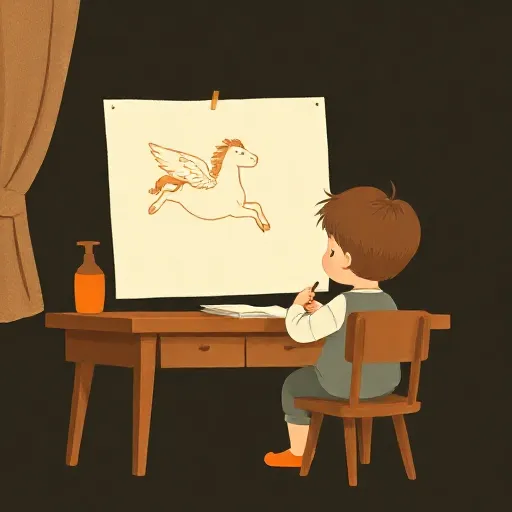
Consider the sentence “Pegasus does not exist.” If you say it and mean it, you’re having a thought that is undeniably true. Yet that thought seems to be about Pegasus. How can you truly say that something doesn’t exist if the sentence needs to point at that very something to be about it? If Pegasus doesn’t exist, what is the thought pointing at?
Brentano wrestled with this puzzle. He noted that when you correctly deny something’s existence, the existence of the object is precisely what is excluded. In other words, you can aim a thought at nothing and still get it right. But how?
A powerful answer came from Bertrand Russell (1872–1970). Russell argued that ordinary proper names like “Pegasus” aren’t really names — they’re definite descriptions hidden in a disguise. “Pegasus” is short for something like “the winged horse.” So the sentence “Pegasus does not exist” really means: there is no single thing in the world that is both a horse and winged. That claim is true, and it doesn’t need to point at any particular object. It just says a description fits nothing.
This move avoids having to say there are non-existent objects floating around. Some philosophers disagreed. Alexius Meinong, a student of Brentano’s, thought we must admit a category of objects that don’t exist but still have properties. For him, the fountain of youth is an object that instantiates both being a fountain and granting eternal life — yet lacks the property of existing. Russell found that idea messy. It seemed to fill reality with round squares and golden mountains. His description trick was designed to dissolve the puzzle without adding spooky entities to our world.
So when you think “Santa doesn’t live at the North Pole,” you’re not magically talking about a non-existent person. You’re thinking about the description “a jolly man who delivers presents on Christmas Eve” and judging that nothing satisfies it. That’s the orthodox solution, and it still shapes how many philosophers understand intentionality today.
The Evening Star and the Morning Star: One Planet, Two Thoughts

Intentionality gets even trickier when you have two different thoughts about the exact same real thing — without realizing they’re the same. The philosopher Gottlob Frege (1848–1925) invented a famous puzzle about this.
Suppose a girl named Ava sees the evening star, which ancient astronomers called Hesperus, shining in the west. She forms the belief: Hesperus is shining. The next morning she looks at the dawn sky and sees the morning star, called Phosphorus. Because nobody has told her the two names pick out the same thing — the planet Venus — she does not believe Phosphorus is shining. In her mind, the two names stand for completely different objects. So one belief is true, the other false (according to her). But both names refer to the very same planet. How can Ava rationally believe one thing and not the other if the beliefs are about the identical object?
Frege’s answer was to draw a sharp distinction. Every name, he said, has both a reference (the actual thing in the world) and a sense — the way that thing is presented to the mind. “Hesperus” and “Phosphorus” have the same reference (Venus) but different senses: one sense is something like “brightest object in the evening sky,” the other “brightest object in the morning sky.” The thoughts Ava entertains are built out of senses, not the planet itself. So she has two different thoughts with different contents, even though both trace back to the same lump of rock and gas. Her ignorance doesn’t make her irrational.
This also explains why identity statements like “Hesperus is Phosphorus” can be surprising and informative. You already knew “Hesperus is Hesperus” without any help, but discovering the two senses connect to one reference teaches you something new. Frege’s distinction has been a central tool in philosophy of mind and language ever since. It shows that the intentionality of thought depends not just on what you’re thinking of, but on how you’re thinking of it.
Why Minds Are Always Pointing at Something

So why should you care about a nineteenth-century puzzle about our minds? Because intentionality is what makes so many everyday activities possible. Every time you read a novel and care about characters who never lived, every time you plan a vacation to a place you’ve only imagined, every time you’re surprised to learn that two people you know are actually the same person, you’re using the same power that Brentano, Russell, and Frege were trying to understand.
These puzzles also reveal something big: your mind is not a camera that simply copies the world. It actively builds thoughts out of senses, descriptions, and perspectives. That’s why you can be wrong about something without your brain breaking, and why new information can genuinely change your outlook. If the planet Venus had to be “inside” your thought in some crude physical way, the Hesperus/Phosphorus mix-up would be impossible. But thoughts aren’t like that. They’re about things in a manner that remains deeply puzzling.
Today many scientists and philosophers still debate whether intentionality can be fully explained by studying the brain alone. Can you “bake a mental cake using only physical yeast and flour,” as one thinker put it? Or is the aboutness of thought something that can’t be reduced to mere physics? We don’t have a final answer. But the fact that you can think about dragons, distant planets, and what you’ll eat for breakfast tomorrow — all while sitting right where you are — is one of the most remarkable features of having a mind at all.
Think about it
- If you make up a friend who doesn’t exist, are you really thinking about something — or just shuffling descriptions in your head?
- A detective doesn’t know that Bruce Wayne and Batman are the same person. Can she rationally believe that Bruce is a careless playboy and Batman a disciplined hero? Why or why not?
- If scientists someday explain exactly how brain cells produce thoughts about things that aren’t real, would that change how you see your own imagination?