What Are Your Thoughts Pointing At? (Even When Nothing's There)
The Silent Question in a Noisy Lecture Hall

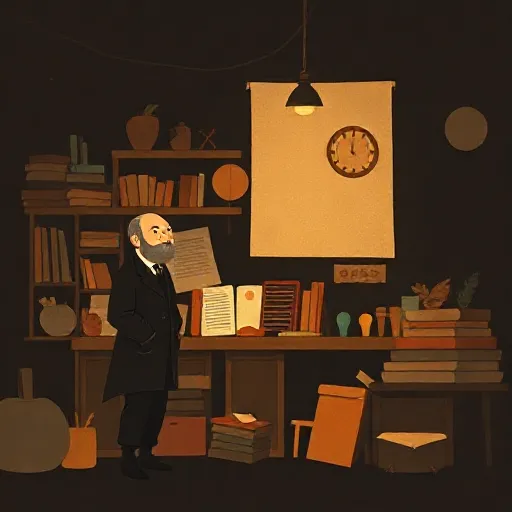
In the fall of 1874, a thin, intense man named Franz Brentano (1838–1917) began giving lectures at the University of Vienna. He had been a Catholic priest. He had argued with the Vatican, left the priesthood, and given up his salary and status. Now, standing before a classroom packed with curious students, he asked a question that seemed simple but would crack open a centuries-old puzzle.
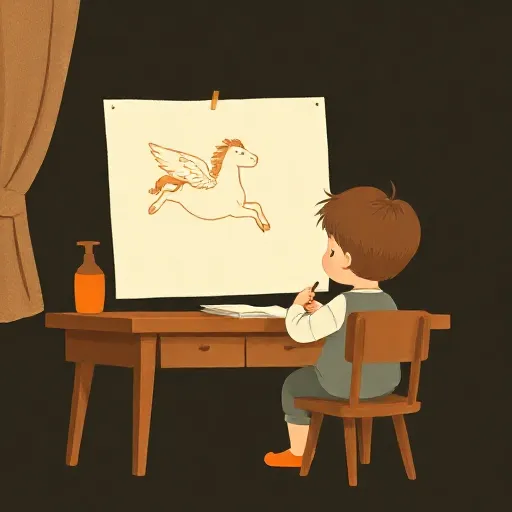
“Imagine you see a horse,” Brentano said. “Now, imagine you merely think of a horse. What is the difference?”
The room went quiet. The students could feel that a horse and a thought of a horse were obviously not the same thing. But what was the thought made of? Why did it feel as if the thought was pointing to something, even if that something was not standing in the room?
Brentano spent his whole career trying to answer that question. His ideas about what he called intentionality — the “aboutness” of the mind — would change philosophy and, more than a century later, are still at the center of arguments about what consciousness even is.
What Does It Mean to Be “About” Something?

Brentano’s big move was to define the difference between the physical world and the mental world. A rock just sits there. It isn’t about anything. But a thought is never empty. If you think, you think of something — a friend, a song, a math problem, a dragon. Even when you feel happy, you’re happy about something. Even when you’re confused, you’re confused about something.
He borrowed a dusty medieval Latin term and gave it new life: intentionality. In Brentano’s hands, it meant the built-in “directedness” of every mental act. As he put it in his 1874 book Psychology from an Empirical Standpoint, every mental phenomenon “includes something as object within itself.” When you imagine a castle, that castle is in your thought in a way that a chair is not “in” a rock.
This might sound like a small technical point. But it raises a huge problem. If the castle I imagine is inside my mental act, what is the relationship between that mental castle and a real castle? And what happens when I imagine something that has never existed — a golden mountain, or a perfectly round square? Is there some kind of “object” in my mind for that too?
The Inner Mirror: How You Know Your Own Thoughts

Brentano didn’t just ask what thoughts are about. He also asked how we know we have thoughts in the first place. When you look at a squirrel outside the window, you see the squirrel. But you also know, automatically and without effort, that you are seeing — not hearing the squirrel, not tasting it. How does that work?
Brentano’s answer was that every mental act has a secret double life. While the act is aimed at its primary object (the squirrel), it is also incidentally aimed at itself as a secondary object. He called this built-in self-awareness inner perception. It is not a separate thought that watches the first thought. It is more like the way a flame lights up both the room and its own wax. The seeing of the squirrel and the awareness that you are seeing are two sides of one single moment of consciousness.
Because of this, Brentano denied that we can ever have a truly unconscious thought. If a mental act is too faint or too brief to notice easily, it is still conscious — just at very low intensity, like a whisper you almost don’t catch. He also argued that you can’t have two fully separate thoughts at the same time. When you listen to music while tasting a strawberry and feeling the sun on your skin, all those mental threads fuse into one unified whole. You experience them as a single, flowing “now,” never as scattered pieces.
This picture of the mind — always saying something about the world, and always quietly aware of itself — was elegant. But it led straight into a trap.
The Problem of the Golden Mountain and the Round Square

If every thought is about an object, what about thoughts whose objects don’t exist? You can think of a golden mountain right now. You can form the idea “a square with exactly three sides.” Does that mean a golden mountain or a three-sided square is somewhere — maybe inside your mind?
Brentano’s early answer was uncomfortable. He seemed to suggest that the intentional object is something mental, a kind of inner stand-in for the real thing. His students quickly spotted the trouble. If the object you think of is always a mental item, then when two people think of Paris, they are not really pointing at the same city; each is pointing at a private inner copy. And when you plan to visit the real Paris, how does your private thought-object connect to the train ticket you buy?
Later in life, Brentano tried to escape the trap. He said that an intentional relation is not a normal relation at all — it is a quasi-relation. For a normal relation, both sides must exist. For “Maria is taller than Elena,” both Maria and Elena must be real people. But the mind can aim at things that do not exist without falling apart. It is a “relativliches,” a relation-like something, that works even when the target is a unicorn, the hero Hamlet, or a round square.
His most famous students — especially Alexius Meinong and Edmund Husserl — thought this was not enough. Meinong argued that even non-existent objects have a special kind of “subsistence.” A golden mountain may not exist in the real world, but it still has properties we can discuss logically. Others kept refining the idea until it became the foundation of a whole movement called phenomenology. Brentano himself was never satisfied. He kept revising his views, writing notes that were published only after his death. The puzzle remained stubbornly alive.
Why Does This Ancient Riddle Matter Today?

Brentano died in 1917, but his question — “What makes a thought about something?” — never went away. In fact, it exploded.
For much of the twentieth century, psychologists tried to ignore the inner life of the mind. They studied behavior, not introspection. But by the 1980s, philosophers and brain scientists had run head-on into Brentano’s riddle again. They wanted to explain what it means to be conscious. They split into two camps.
One camp — the higher-order theory crowd — says that a thought becomes conscious only when you have a second, separate thought about it. A mind-state feels like something only if there is a kind of internal scanner watching it.
But the other camp — following Brentano’s own hint — argues that consciousness is a self-representational business. A mental state doesn’t need a second state to make it conscious; it already and silently represents itself, just as Brentano’s inner perception was folded into every act. These are called one-level or same-order theories, and many thinkers today call themselves “neo-Brentanians” because they build directly on his old idea of the secondary object.
Why should you care? Because you live inside this puzzle every day. Right now, reading these words, you are aware of the screen, and aware of reading, and also — if you pause — aware that you are aware. That tiny move, noticing your own noticing, is the very thing Brentano spent his life studying. What does it mean that you can catch your mind in the act of thinking? Does it prove you have a soul? Is it just a clever trick of brain cells? Or is it a clue that your thoughts are never empty arrows — always pointing, even when they aim at nothing at all?
The argument is far from over. Brentano’s simple, silent question in that 1874 lecture hall is still echoing.
Think about it
- If you think of a friend who lives on another continent, where is your thought right now — inside your head, or out in the world with them?
- Try for ten seconds to have a thought that is not about anything at all. What happens? Does the attempt show that every thought has to be about something, or did you find a loophole?
- Brain-imaging machines are getting better at reading what you’re thinking about from the pattern of electricity inside your skull. If a machine can “decode” your thought of a golden mountain, does that mean the golden mountain is just a physical event in your brain? Or is something else going on?