The Bishop Who Said Space Is Just ‘Here’ and ‘There’
When Bad Money Drives Out Good
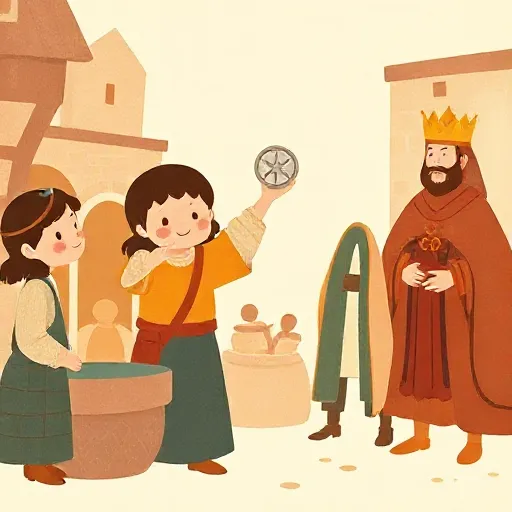
In the 1360s, King Charles V of France faced a puzzle. His royal mints kept producing coins with less and less silver. The king hoped this would stretch his treasury farther. But something odd happened: the older, purer coins vanished from people’s pockets. Only the flimsy new ones stayed in use.
The king’s top advisor was Nicole Oresme (1320–1382), a bishop with a razor-sharp mind. He had been a brilliant student at the University of Paris and even headed the College of Navarre before serving the royal court. Oresme gave the king a hard truth. He argued that coinage belongs to the whole community, not to any ruler. When a king debases the currency—mixing in cheap metal so coins are worth less—people hoard the good money. They spend only the bad. In time, the economy stumbles.
Today we call this Gresham’s Law, though Oresme and the astronomer Copernicus both spotted it earlier. But Oresme’s thinking went far beyond money. This bishop never simply accepted what everyone believed. He questioned everything—even the very nature of space and time.
Space Is Not a Giant Jar

Aristotle (384–322 BCE), the ancient Greek philosopher, taught that place is the innermost surface surrounding a thing. A fish’s place is the water touching its scales. The Earth’s place is the inside surface of the sphere of the moon.
Oresme disagreed sharply. He said the real place of a body is the physical place—the space it fills. Move a cup of water from one table to another: the water’s place is the volume of water itself, not the cup’s inside surface. For Oresme, space is not a substance like wood or air. It’s not even an accident like redness or heat. He insisted that space cannot be named by a noun, only by adverbs like “here” and “there.” Space has a very thin kind of existence—much less real than any ordinary thing.
But Oresme went further. He imagined what lies beyond the outermost sphere of the stars. Aristotle had claimed there is absolutely nothing—no space, no void. Oresme argued, by a clever train of reasoning, that outside the cosmos there must be an infinite empty space. He called it “the immensity outside the Heavens.” Even more startling, he identified this infinite void with God himself. For Oresme, the endless “there” is not a separate thing but God’s own presence. Later, Isaac Newton (1643–1727) would treat absolute space as almost a divine substance, but Oresme kept space flimsy: a divine “where” without any thingness. Next time you point up at the night sky and ask “what’s beyond?” know that a medieval bishop already imagined an infinite, God-filled nothing.
Time Without Tick-Tocks
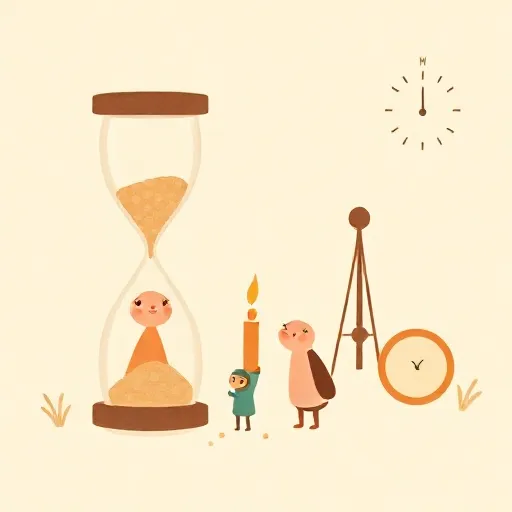
Aristotle tied time to motion. Time, he said, is the measure of motion with respect to before and after. No motion, no time. Oresme found that unsatisfying. He defined time as successive duration—the lasting of things as they exist.
Imagine the entire universe freezes: every atom halts, all clocks stop, the planets pause. For Aristotle, time would vanish. For Oresme, time would still roll on. The world would simply endure, moment after moment, even in total stillness. He called this uninterrupted existence duratio successiva. And just as he linked infinite space to God, he identified eternity—duration all at once, without any sequence—with God. So God is not just in time; God is eternity itself.
This was a huge departure from the standard medieval view. Only a handful of thinkers before him had dared to separate time from motion. Oresme’s concept nudges closer to how modern physics sometimes treats time as something independent of the things that happen in it. Yet he still kept time’s reality lighter than physical substances—another instance of his habit of kicking away solid-looking ideas to see what really stands.
Adding Up Endlessness
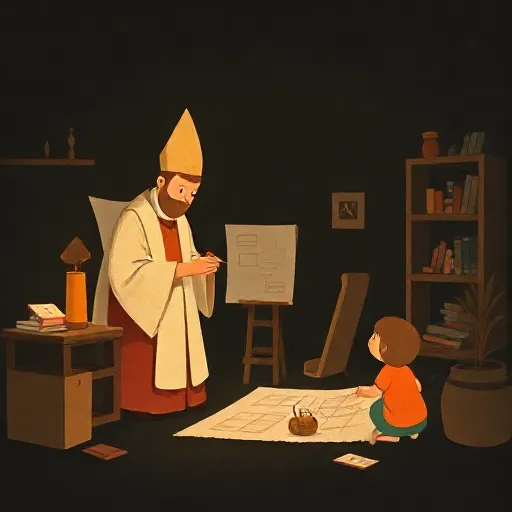
Oresme loved mathematics. He may have been the first to use something like coordinate graphs, calling the horizontal baseline longitudo and the vertical height latitudo. He drew shapes to show how speed changes over time. A right triangle represented uniform acceleration: the base was time, and the sloping line grew as speed increased.
Using these figures, Oresme gave the first clear proof of the Merton theorem, discovered at Oxford in the 1330s. The theorem says: if a body accelerates uniformly from zero, the distance traveled in a given time is exactly the same as if it moved at a constant speed equal to its speed at the middle instant. Oresme showed this by noting the area under the triangle’s slope matches a rectangle whose height is the speed exactly halfway. His trick later helped René Descartes (1596–1650) invent analytic geometry.
But his real magic was with infinite series. Can you add up an infinite number of shrinking things and get a finite answer? Oresme showed you can. He found a rule for series like 1 + 1/3 + 1/9 + 1/27 + … forever. He noticed that the ratio between successive terms is always the same. By a simple trick, he proved the total sum is m/(m−1) times the first term. For that series, the sum is 1 × 3/(3−1) = 3/2, or 1½. So infinite bits add up to a tidy number.
He then tackled the harmonic series: 1 + 1/2 + 1/3 + 1/4 + … . Everyone before him thought it would add up to some limit. Oresme saw it doesn’t. He grouped the terms: the next two terms (1/3+1/4) are each at least 1/4, so their sum exceeds 1/2. The next four terms (1/5 through 1/8) are each at least 1/8, so their sum also exceeds 1/2. This grouping goes on forever, piling up more than half-sized chunks infinitely. The harmonic series diverges—it grows without bound.
When it came to actual infinities, Oresme got even bolder. He paired odd numbers with all natural numbers: 1 with 1, 3 with 2, 5 with 3, 7 with 4, and so on. He saw that this one-to-one correspondence shows that the odd numbers are not fewer than all the numbers. Yet he refused to say they are equal in the usual sense. Instead he concluded that actual infinites are incomparable—words like “bigger” or “smaller” simply don’t apply. It was a stunningly careful move, centuries before Georg Cantor would rigorously explore similar ideas.
The Stars Are Not in Charge

In the 1300s, many people believed the planets and stars decided your future. Kings relied on astrologers. Oresme thought this was dangerous nonsense. He attacked astrology with both religion and math.
In his work on ratios, he took a hint from Thomas Bradwardine (c. 1290–1349) and examined how forces, resistances, and speeds relate. Using Bradwardine’s exponential formula, Oresme showed that the ratios of celestial motions are probably incommensurable—they don’t form neat fractions. If the periods of planets never repeat exactly, no conjunction or opposition will ever happen the same way twice. That makes precise predictions impossible. Oresme concluded that astrology was refuted.
He also wrote against magic and marvels, explaining weird events by natural causes. And he even imagined possibilities that would have made Aristotle gasp: in his book Le livre du ciel et du monde, Oresme argued that no experiment could prove the Earth stands still. A daily rotation of the Earth is perfectly possible. He also reasoned that a plurality of worlds could exist. Yet in the end, Oresme remained cautious—he kept the old belief in a stationary Earth and a single cosmos. Still, he opened doors that later scientists would walk through.
In optics, Oresme said that starlight bends in a gentle curve through the atmosphere, not in a sharp kink as earlier thinkers had claimed. He described this as a series of tiny refractions along a curved path, more than 300 years before Robert Hooke and Isaac Newton refined the idea.
Why a Questioning Bishop Still Matters
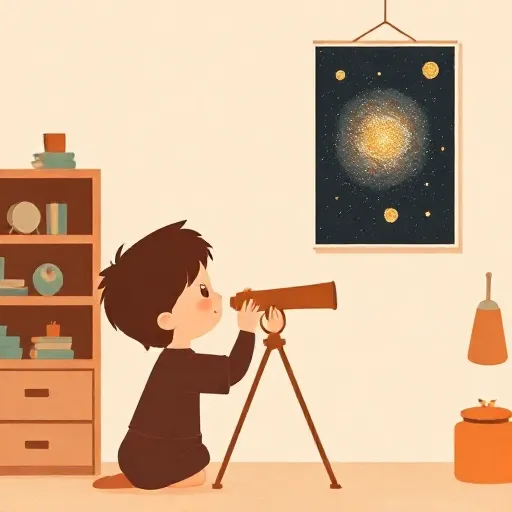
Oresme never became famous like Copernicus or Galileo. He didn’t start a scientific revolution by himself. But his habit of prodding at Aristotle’s ideas, his willingness to treat space as a thin “where,” time as enduring existence, and infinity as something manageable, all nudged European thought forward. His graphical representations of motion fed into later kinematics. His mathematical arguments about infinite series and the incomparability of infinites planted seeds that sprouted much later. And his down‑to‑earth warning about debased coinage remains a classic insight in economics.
Now, when you stare at a screen that uses coordinates, or puzzle over whether the universe is infinite, you’re walking in the footsteps of a bishop who drew triangles to capture speed and imagined an endless void beyond the stars. Oresme shows us that questioning old authorities—even if you end up partly agreeing with them—can reveal new truths. So next time someone tells you something is “just obvious,” you might ask: what if it’s only half of the story?
Think about it
- If space isn’t a substance but just a way of saying where, can you still travel through it? How would you explain moving to someone who says “here” and “there” don’t exist independently?
- Oresme proved the harmonic series never ends, yet some infinite series do have a finite sum. Does that mean some infinities are “smaller” than others in a sneaky way? How would you decide?
- Oresme showed that the Earth’s rotation is possible but still believed it didn’t move. Is it ever okay to keep believing something even if you can’t prove it’s true? What about in your own life?