Is Space Something Out There, or Just in Your Head?
The Room That Has No Edges

Close your eyes and picture an empty room. Take away the chairs, the posters, the carpet. Now take away the floor, the ceiling, the walls themselves. What’s left? You are suspended in pure nothingness. That “nothingness” — the openness that lets things be located somewhere — is what philosophers call space. But what is space, really? Does it exist out there in the world, like a giant invisible container? Or is it just a useful idea that our minds create, like a mental map that helps us keep track of where our lunch is?
These questions have fascinated thinkers for centuries. In the 1600s and 1700s, two of the sharpest minds in Europe — Isaac Newton and Gottfried Wilhelm Leibniz — fought over them in letters and books. Then a German philosopher named Immanuel Kant came along and claimed both giants were wrong. He argued that space isn’t a thing at all, but a built‑in lens your mind uses to see the world. His answer still makes us wonder: is the space you move through every day something you discover, or something you bring with you?
Newton’s Giant Container vs. Leibniz’s Cosmic Web
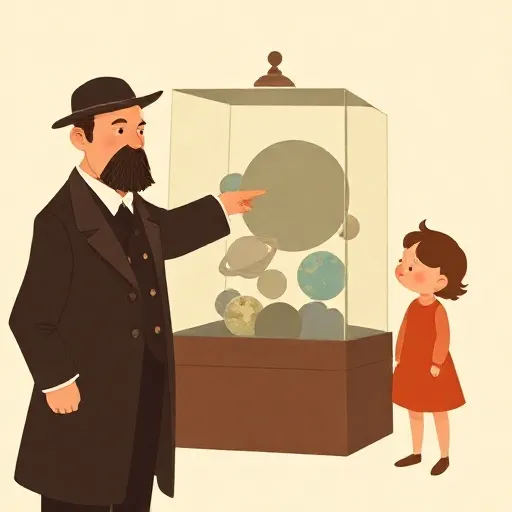
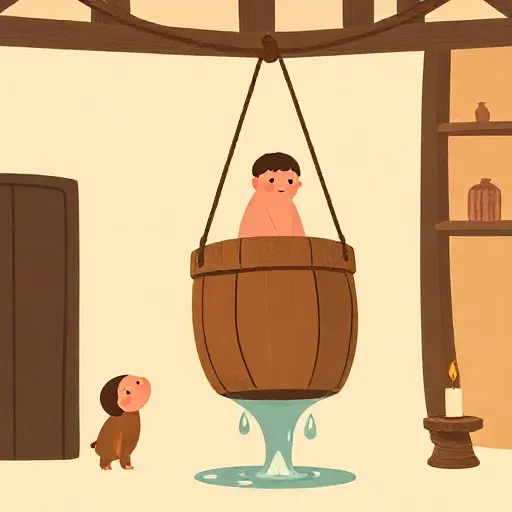
Isaac Newton (1643–1727) thought of space as a real, physical thing — a huge invisible expanse that stretches out forever, regardless of whether any objects are in it. Even if you could magically remove every planet, star, and speck of dust, Newton believed the empty absolute space would still be there. It is smooth, unchanging, and motionless, like an infinite glass box. This view had a philosophical payoff: it let Newton say that some motions are truly real, not just apparent. A spinning bucket of water, for example, would still bulge at the center even if it were the only object in the universe — because it’s moving relative to absolute space itself.
Gottfried Wilhelm Leibniz (1646–1716) thought that was absurd. If space truly existed on its own, he asked, why would God put the universe here rather than a few feet to the left? All places in empty absolute space are identical, so there would be no reason to choose one over another. This went against a rule Leibniz thought was basic: the Principle of Sufficient Reason — the idea that there must be a reason why things are one way and not another. Leibniz concluded that space is not a thing at all, but simply the order of relations among objects. To create a universe full of matter just is to create space; talk of space before objects makes no more sense than talk of a family tree without any people.
So two great thinkers gave opposing answers. Newton: space is a giant container, a real substance-like thing. Leibniz: space is a web of relationships, nothing more. Yet both agreed on one deep assumption: space, whatever it is, exists outside of us — in the world.
Kant was about to flip that.
Kant’s Third Way: Space Is a Form of Your Mind

Immanuel Kant (1724–1804) read the Newton–Leibniz debate carefully and decided something crucial was missing. Both sides treated space as something “out there” — a property of the world, independent of the human mind. Kant called this shared mistake transcendental realism. He thought it led to hopeless puzzles. If space is a real thing like a substance, it’s invisible, untouchable, and has no causal power — a ghost you can never detect. If it’s just a relational order that depends on objects, how do we explain the fact that we can easily imagine space completely empty of objects?
Kant proposed a radical surgery: move space from the world into the mind. Space, he claimed, is not a feature of things in themselves; it is the form of outer intuition. That mouthful means it’s a basic framework your own mind uses to organize everything you sense “out there.” Whenever you see a tree, hear a bird, or feel the ground under your feet, your mind automatically locates those experiences in a spatial grid — left, right, near, far, above, below. That grid isn’t discovered through the senses; it’s what makes sensing an outside world possible in the first place.
This was Kant’s transcendental idealism — a middle path between Newton’s container and Leibniz’s relational web. Rather than ask whether space is a substance or a relation, Kant asked: what must my mind be like for me to experience anything outside myself at all? His answer: my mind must come pre‑equipped with a built‑in sense of space.
To make this vivid, imagine a character in a video game. The game world has a spatial layout — rooms, distances, directions. But that space doesn’t exist in the computer’s hardware as a thing-in-itself; it’s a way the game’s engine organizes data and presents it to you. Kant thought your mind works somewhat like that engine — you don’t perceive data and then add space to it; space is the very organizing structure that lets perception happen.
Four Arguments That Space Is in Your Head
Kant didn’t just claim this; he offered a battery of arguments. In his book Critique of Pure Reason, a section called the “Metaphysical Exposition of Space” lays out four reasons our idea of space cannot be something we pick up from experience or build out of concepts. Let’s walk through them.
First argument: space isn’t learned from the senses. Suppose you see a cup on a table. You perceive the cup as outside you and next to the table, not just as a blob of color. Kant insisted that to represent something as outside you, you must already have a representation of space. A baby doesn’t first see colored patches and then later figure out they’re in different places. The very notion of “different places” relies on a prior grasp of space. So you can’t get your idea of space from outer experience — outer experience already requires it.
Second argument: space is necessary; you can’t think it away. Close your eyes and try to imagine the absence of all space. You can’t. You can easily picture a region of space with nothing in it — the blackness between stars — but you can’t picture no space at all. Kant took this to mean that the representation of space is not something your mind constructs from simpler pieces; it’s a necessary background that underlies all outer perception.
Third argument: space is a single whole, not a collection of parts. When you talk about “spaces” — the space under your bed, the space between two buildings — you’re really talking about limited regions inside one all‑embracing space. You can’t first have the idea of a small place and then glue many places together to get the idea of space; you only get the idea of a place by marking a boundary within space. Kant contrasted this with the way we think about kinds of things. The concept
Fourth argument: space is infinite, and concepts can’t hold infinities from the bottom up. If the idea of space were a concept, we’d have to pack an infinite number of sub‑concepts (all possible places) inside it. Kant thought our finite minds can’t grasp concepts with infinite internal parts. Yet we clearly represent space as containing infinitely many places, all existing at once. So the representation cannot be conceptual; it must be an a priori intuition — a non‑empirical, immediate grasp of something boundless.
Together, these arguments nudge us toward a stunning conclusion: you don’t learn space by bumping into things; you bring the very framework of “out there” with you from the start. For Kant, space is the mind’s silent contribution to every waking moment.
Why This Still Matters: The World Through Your Own Lenses

Today, physicists talk about space very differently — they speak of curved spacetime, expanding universes, and quantum foam. Those theories go far beyond anything Kant could have imagined. But the puzzle Kant raised hasn’t gone away. Whenever you wonder if the world you see matches what’s really there, you’re stepping into his shadow.
Think about the glasses you can never take off. If you were born wearing permanent, invisible spectacles that turned every object into a version with a blue tint, you would never notice the tint — you’d just think the world is blue. Kant argued that space is like those spectacles. We never catch a glimpse of “unspecial” reality because we can’t step outside our own minds to compare. Yet we feel, moment to moment, as if space is simply there — a stage waiting for objects to fill it.
This doesn’t mean the cup on your desk is a hallucination. It means that the spatial way in which you experience that cup — its “to‑the‑left‑ness,” its “just‑beyond‑reach” quality — is a gift your mind gives the world. Other creatures with different kinds of minds might organize experience without anything like our three‑dimensional space. And mathemathical descriptions of space (like the geometry of a donut‑shaped universe) might capture truths our intuitions can’t picture.
By asking whether space is out there or in your head, Kant opened a door we still walk through. Every time you look at a star‑filled sky or the narrow gap between two parked cars, you’re using a tool that your own mind provides — a tool that feels so natural you almost never notice it. And that’s the mark of a truly deep philosophical idea.
Think about it
- If a person who was born blind suddenly gained sight, do you think they would immediately understand spatial distances and directions, or would they have to learn to see space the way we do? Why?
- A video game generates a virtual space that exists only while the game is running. In what ways could real space be like that mental space — and in what ways could it be completely different?
- If space is something your mind adds to experience, could an intelligent alien with a different kind of mind have a completely different experience of “outside” — for example, feeling things as musical notes instead of as locations in 3D?