
Why Is There Anything at All, and Not Just Nothing?
What if everything vanished?

You are sitting in your room. You look around and then close your eyes. Imagine your bed. Now imagine it isn’t there. The window, gone. The walls, the floor, the air, your own body—all gone. What is left? Could there be a world with absolutely no concrete entities at all?
By concrete entities, philosophers mean things that take up space or time: a grain of sand, a camel, a star. The question is not about numbers or sets, which don’t cause anything and have no location. The real puzzle is why there are any concrete things, rather than emptiness.
The philosopher Thomas Baldwin (born 1947) sharpened this puzzle with a thought experiment. Imagine a universe with only finitely many objects. Now mentally subtract them one at a time: a hundred, then ninety-nine, then ninety-eight… eventually three, two, one. And then—poof!—the last object disappears. You have arrived at an empty world. Baldwin argued that if we can imagine this step-by-step subtraction without hitting a logical impossible barrier, then an empty world is genuinely possible. And if it is possible, why isn’t it actual? That’s the question that shakes you awake: why is there something rather than nothing?
An infinite lottery for existence
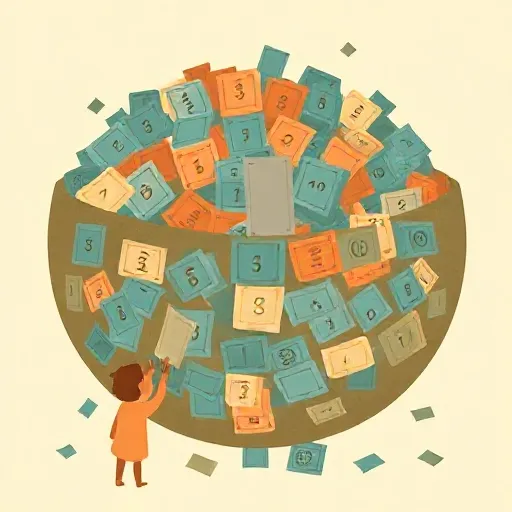
One bold reply comes from philosopher Peter van Inwagen (born 1942). He asks you to think of all the ways a world could be—the different possible worlds. Among them, only one is totally empty. All the others contain at least one concrete object. If we treat each possible world like a lottery ticket, then the chance of randomly picking the empty world is effectively zero. In an infinite lottery, the probability of a populated world is 1. So we shouldn’t be surprised that something exists; it was overwhelmingly likely.
This is a kind of statistical explanation, like explaining why the oxygen in your room hasn’t all squeezed into a corner—most arrangements simply spread it evenly. But does it really answer the question? Van Inwagen’s argument depends on there being exactly one empty world. What if empty worlds can differ? If an empty world can have different laws of nature, there might be infinitely many empty worlds, each with its own gravitational constant or set of rules. Then the lottery would contain just as many “nothing” tickets as “something” tickets, and the probability wouldn’t favor either. The debate remains open.
The trap of explaining everything

If you try to explain why there is something, you quickly face a dilemma. To explain your own existence you might point to your parents; they came from your grandparents; and so on, back to the beginning. But what explains the whole chain? If you say “God made it,” you are assuming that God already exists. If you say “a quantum fluctuation produced particles,” you are assuming that quantum fields exist. Any explanation seems to start by taking some being for granted.
The philosopher William Rowe (1931–2015) turned this into a stark logical problem. Everything in the world is contingent—it exists but could have not existed. Now take all the contingent truths together. Can that total collection be explained? If you point to another contingent truth, you are merely pointing to part of the very collection you want to explain; that would be circular. If you point to a necessary truth (something that must exist, like a mathematical fact), that necessary truth can only guarantee other necessary truths—it cannot force contingent things to pop into existence. So Rowe concluded that the question “Why are there any contingent beings?” might be impossible to answer.
Some philosophers, like Gottfried Leibniz (1646–1716), believed that God, a necessary being, freely chose to create the world because something is better than nothing. But that still leaves us asking why God exists rather than nothing. The trap tightens.
The question that is really a feeling

Maybe the question was never a puzzle to solve. The philosopher Ludwig Wittgenstein (1889–1951) suggested that the real content of “Why is there something rather than nothing?” is not a demand for an explanation but an expression of awe. In his early work he wrote, “It is not how things are in the world that is mystical, but that it exists.” You don’t need a new fact; you need a shift in how you see. The question is more like a poem than a scientific query.
Wittgenstein’s contemporary, the psychologist and philosopher William James (1842–1910), offered a simple recipe for that feeling: shut yourself in a dark closet and think about your own existence. The sheer oddness that anything should be—and that you should be—can wash over you. From this perspective, the question isn’t nonsense and isn’t an unsolved riddle; it’s a signature human experience of wonder in the face of contingency.
Wittgenstein believed that when we try to turn that feeling into a factual question, we get lost. The deepest things cannot be put into words. So the question remains precious precisely because it tugs at the limits of language.
Why it still matters

The question hasn’t gone away. Modern cosmology describes how the universe expanded from an incredibly hot, dense state—the Big Bang. But why was there a Big Bang at all? Why are there any laws of nature rather than nothing? The physicist Lawrence Krauss has argued that quantum field theory shows how particles can emerge from “nothing.” But philosophers like David Albert reply that the quantum vacuum is not nothing—it’s a particular arrangement of fields, a concrete entity in its own right. The old philosophical puzzle refuses to evaporate.
“Why is there something rather than nothing?” stays alive because it touches something deep in us. It reminds you that even the most ordinary facts—that you are reading this, that there is a screen, that there is a world—could easily have not been. That sense of radical luck or mystery doesn’t depend on religion, on science, or on finding a final answer. It’s at the core of what philosophy is: learning to wonder at things that seem too basic to question.
Think about it
- If you could erase every object from the world, would an empty space still exist? Why or why not?
- Suppose a computer simulation created a world out of nothing—would that count as a real explanation, or just push the question back to who made the computer?
- Is it possible to feel that the world is a miracle without believing in God? How would you describe that feeling?