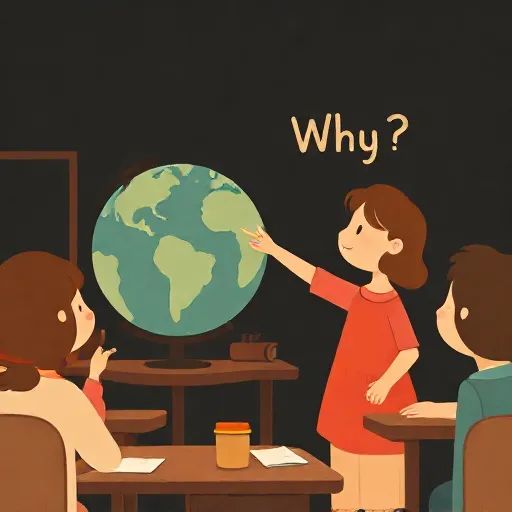

Why Is There Something Rather Than Nothing?
The Biggest Question: Why Is There Anything?

You are lying on the grass, looking at the stars. The sky is huge. You’re small. And a thought pops into your head: Why is there anything at all? Not why this planet or that star—but why there is a universe, instead of nothing. It’s one of the oldest, deepest puzzles humans have ever faced.
Philosophers call the attempt to answer this question the cosmological argument. The word “cosmos” means universe, and the argument tries to show that the universe itself needs a special kind of cause—one that is not part of the universe, a necessary being that many call God. This isn’t a single tidy proof. Over 2,500 years, thinkers have built several versions, each with its own twist. Some start with the simple fact that things change. Others begin with the idea that the universe had a beginning. All of them try to grab hold of that one big “why.”
The argument didn’t appear out of nowhere. An ancient Greek, Aristotle (384–322 BCE), first sketched the idea that every motion traces back to an unmoved first mover. Later, thinkers in the Islamic world, like Ibn Sina (c. 980–1037) and al-Ghazali (1058–1111), developed powerful new versions. Their work traveled into medieval Christian philosophy through Thomas Aquinas (1225–1274) and later into modern debates led by Samuel Clarke (1675–1729) and Gottfried Wilhelm Leibniz (1646–1716). Even today, the argument sparks fierce, careful discussion. So let’s start where the argument always starts: with the things right in front of us.
The Chain of Whys: From This Cup to a Necessary Being

Pick up a cup. It exists, but you can easily imagine it not existing. A few moments ago, someone could have knocked it off the table. In a hundred years, it will be dust. Philosophers say this cup is contingent. A contingent thing is something that exists, but could have not existed—it depends on other things to bring it into being and keep it here.
Now look around. Your body, your house, the trees, the planet—all of them are contingent. Even the atoms that make up everything are contingent: they could have been arranged differently or not at all. The cosmological argument asks a simple but powerful question: why do these contingent things exist rather than nothing?
The classic answer, given by Aquinas and many after him, goes like this. A contingent being needs a cause or an explanation outside itself. You can’t explain your own existence without mentioning your parents, and they need their parents, and so on. But could this chain of contingent things go back forever? Suppose every being in the chain is contingent. Then the whole chain, the entire collection, is also contingent. If you could remove every link, there would be nothing. So something must exist that is not contingent, something that does not depend on anything else for its existence. That something is a necessary being. A necessary being is one that, if it exists, cannot not exist—it has to exist, in all possible situations. And that necessary being, the argument concludes, is what explains why any contingent things are here at all.
Leibniz pressed this idea further with his Principle of Sufficient Reason: every fact or event must have a full explanation for why it is so and not otherwise. If the universe is contingent, its full explanation cannot be found within itself. You have to step outside the series of contingent things, to a necessary being that contains its own reason for existing. For Leibniz, that necessary being is God.
A Universe That Began to Exist: The Kalām Argument

There’s a second, very different path through the cosmological argument. While Aquinas cared about a sustaining cause—something that keeps the universe in existence right now—a tradition from Islamic philosophy focuses on a beginning. This version is called the kalām cosmological argument, after the Arabic word for “speech” or “discourse,” referring to the reasoned theology of Muslim thinkers like al-Ghazali.
Al-Ghazali argued this way: Everything that begins to exist must have a cause. The universe began to exist. Therefore, the universe must have a cause outside itself. Simple as that sounds, every premise has been fought over for centuries.
In recent decades, the philosopher William Lane Craig has revived this argument and added a scientific spin. He points to modern cosmology’s Big Bang theory, which says the universe expanded from an incredibly hot, dense state about 13.8 billion years ago. If you rewind the cosmic movie, you reach a moment where matter, energy, space, and time themselves come into being. There’s no prior time, no prior space. The universe, Craig says, literally began.
Now, Craig also uses a mathematical argument against an infinite past. He claims an actual infinite—a collection with a definite, unlimited number of members—cannot exist in the real world. Think of a library with an actually infinite number of books. If you remove every other book, you still have an infinite number. That’s fine as a mathematical idea, but if you tried to build such a library, weird contradictions would pile up. Since a universe with no beginning would mean an actually infinite number of past events, Craig concludes the universe must be finite in age. And if it’s finite, it began to exist, and if it began to exist, something outside space and time caused it—something personal, like a mind choosing to create.
Objections: Do We Really Need an Explanation?
Not everyone loves the cosmological argument. Some of the sharpest criticisms came from David Hume (1711–1776) and Immanuel Kant (1724–1804). Hume questioned whether the idea of “cause” even applies to the universe as a whole. We learn about causes by seeing one thing follow another—fire heats water, one billiard ball moves another. But we’ve never seen a universe being caused. Maybe the universe just exists, with no further explanation needed. The twentieth-century philosopher Bertrand Russell put it bluntly: “The universe is just there, and that’s all.”
Another objection targets the move from “each part has a cause” to “the whole has a cause.” If every brick in a wall is small, the wall isn’t necessarily small. Likewise, even if every thing inside the universe is contingent, it doesn’t automatically follow that the universe itself is contingent. That’s the fallacy of composition—assuming a whole has the same property as its parts.
Then there’s the idea of a necessary being itself. Kant argued that the cosmological argument secretly leans on another proof, the ontological argument, which tries to define God into existence. The cosmological argument, he said, ends up needing the idea of a “most real being” whose very nature guarantees it exists. But if we can’t prove that such a being is even possible, the argument hits a wall.
Modern physics has also entered the fray. Quantum mechanics seems to show that, on the tiniest scale, events happen without deterministic causes. Particles pop into and out of existence uncaused. If that’s true, maybe the whole universe could emerge from a quantum “nothing”—though physicists debate whether that quantum vacuum really counts as nothing. And some cosmologists propose models where the universe cycles endlessly, or where time behaves so strangely at the beginning that “before the Big Bang” is meaningless. If the universe never truly began as an event, then the kalām argument’s second premise crumbles.
Why This Fight Still Matters (and Why You’re in It)

So after all this, where are we? The debate is alive and kicking. Some philosophers, like Alvin Plantinga, think no version of the cosmological argument is a knockout proof. Others, like Richard Swinburne, say the argument gives us a good reason—though not a certainty—to think a necessary being exists, making the universe more likely than not. Still others, like Graham Oppy, argue that a naturalistic worldview (the universe as a brute fact) is simpler than adding a supernatural being.
Notice what’s happening here: the same question you asked under the stars is the one that keeps professional philosophers writing thick books. Why is there something rather than nothing? It’s not a question you can dodge. Even saying “the universe has no explanation” is a kind of answer, a claim about how reality works. And the fact that we can even ask this question, that our minds reach for a reason behind everything, says something about us.
You don’t need to pick a side today. But the next time you see a falling leaf, or a baby’s hand, or a mountain range, you might feel the tug of the question. Some things seem so obviously temporary and dependent—you can’t help looking for what, if anything, is not. That search, that wonder, is exactly where philosophy begins.
Think about it
- If the universe had no cause and just “was there,” would that feel more satisfying than saying a necessary being had no cause? Why or why not?
- When you ask “why” about small things—like why your pencil fell—you expect an answer. Does the same rule work when you ask “why” about everything combined? What might be different?
- Can you imagine something that exists and yet could never go out of existence, no matter what? What would that thing be like?